



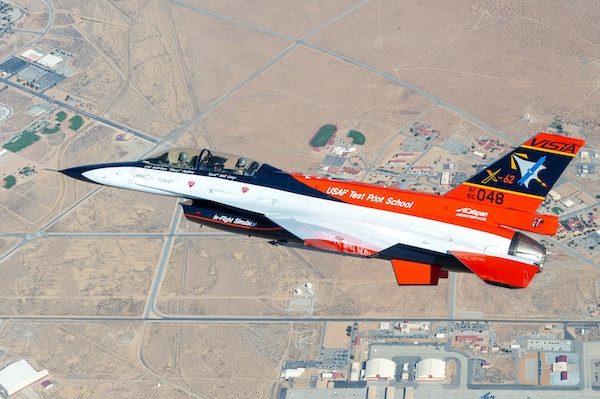
The Lockheed Martin VISTA X-62A was flown by an artificial intelligence agent for more than 17 hours recently, representing the first time AI engaged on a tactical aircraft. VISTA, short for Variable In-flight Simulation Test Aircraft, is changing the face of air power at the U.S. Air Force Test Pilot School at Edwards Air Force Base in California. VISTA is a one-of-a-kind training airplane developed by Lockheed Martin Skunk Works® in collaboration with Calspan Corporation for the USAF TPS. Built on open systems architecture, VISTA is fitted with software that allows it to mimic the performance characteristics of other aircraft.
Dr. M. Christopher Cotting, U.S. Air Force Test Pilot School director of research, commented: "VISTA will allow us to parallelize the development and test of cutting-edge artificial intelligence techniques with new uncrewed vehicle designs. This approach, combined with focused testing on new vehicle systems as they are produced, will rapidly mature autonomy for uncrewed platforms and allow us to deliver tactically relevant capability to our warfighter."
The 17-plus hour flight by an AI agent took place as part of a series of tests in December. VISTA is a modified F-16D Block 30 Peace Marble Il aircraft upgraded with Block 40 avionics. Previously designated NF-16D, in June 2021 VISTA was recognized by the U.S. Air Force and deemed a national asset with a formal redesignation to VISTA X-62A. This new mission system capability with VSS, MFA and SACS emphasize advancing autonomous aircraft algorithm development and integration. At the heart of SACS system is the Skunk Works Enterprise-wide Open Systems Architecture (E-OSA) which powers the Enterprise Mission Computer version 2 (EMC2) or "Einstein Box."
Additional SACS components include integration of advanced sensors, a Multi-Level Security solution, and a set of Getac tablet displays in both cockpits. These components enhance VISTA's capabilities while maintaining its rapid-prototyping advantage, specifically allowing for quick software changes to increase the frequency of flight test flights and accelerating the pace of AI and autonomy development to meet urgent national security needs.
For decades, Lockheed Martin has been applying and deploying trusted AI technologies to help its customers maximize performance, safety, and situational awareness across all domains. Lockheed Martin's implementations keep people in control while enabling them to be safer, more effective and better able to focus on higher-level tasks by empowering them to make more-informed decisions quickly.
VISTA will continue to serve an integral role in the rapid development of AI and autonomy capabilities for U.S. Air Force. It is currently undergoing a series of routine inspections. Flights will resume at Edwards Air Force Base throughout 2023.
Dutch flag carrier KLM, part of the Air France-KLM Group, has welcomed its first Airbus A350-900, marking a significant step in the airline’s long-haul fleet modernization strategy. The arrival...
In a landmark step towards next-generation regional aircraft manufacturing, Jungheinrich has delivered an advanced automated logistics centre to Deutsche Aircraft at Leipzig/Halle Airport. Supporting...
Emirates has officially inaugurated services to Helsinki, marking a significant milestone in connectivity between Finland and the United Arab Emirates. The new daily route is the only year-r...
For the fourth consecutive year, Corsair is reaffirming its commitment to the fight against breast cancer by partnering with the association "Les Hôtesses de l’Air cont...

