



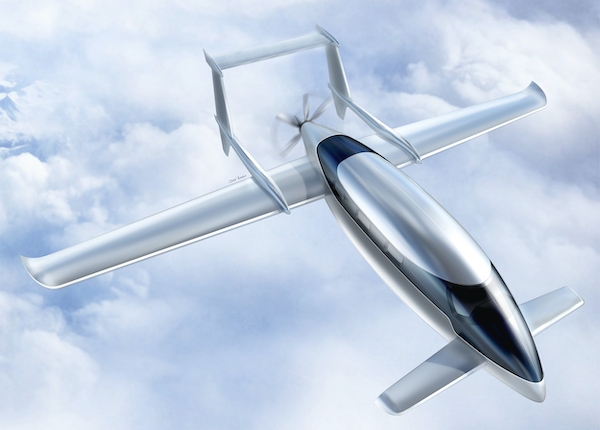
VoltAero design of Cassio electric-hybrid aircraft family has been recognized with the 2023 Janus Label of Excellence from the prestigious l’Institut Français du Design (French Institute of Design). In awarding this Label of Excellence, the Institut Français du Design highlighted VoltAero’ airframe configuration that is based on a sleek, aerodynamically-optimized fuselage, a forward fixed canard, and an aft-set wing with twin booms that support a high-set horizontal tail. By integrating VoltAero’ patented electric-hybrid propulsion system into this purpose-designed airframe, the Cassio aircraft family will deliver an order of magnitude higher performance as compared to the current competition and provide significantly lower operational costs.
In selecting Cassio for its 2023 Janus Label of Excellence, the Institut Français du Design also recognized the work of Dassault Systèmes’ DESIGNStudio in visualizing VoltAero’s concept through immersive virtual modeling – underscoring the aircraft’s eco-responsible ambition, along with its modular, comfortable and ergonomic use.
Jean Botti, VoltAero’s CEO and Chief Technology Officer, commented: “The Janus Label of Excellence has become a benchmark for designs that represent sustainability through creativity. Cassio’s selection reflects our goal to develop a truly unique general aviation family of aircraft with electric-hybrid propulsion as the future for safe, quiet, efficient and eco-friendly flight.”
Cassio will be produced as a highly capable and reliable product line for regional commercial operators, air taxi/charter companies, private owners, as well as in utility-category service for cargo, postal delivery and medical evacuation (Medevac) applications.First production aircraft version will be the Cassio 330, with a four/five-seat interior configuration and operating on a combined electric-hybrid propulsion power of 330 kilowatts. It is to be followed by the six-seat Cassio 480 with a combined electric-hybrid propulsion power of 480 kilowatts, and the Cassio 600 – sized at a 10/12-seat capacity with electric-hybrid propulsion power of 600 kilowatts.
Cassio aircraft will utilize an electric motor in the aft fuselage-mounted hybrid propulsion unit for all-electric power during taxi, takeoff, primary flight (if the distance traveled is less than 150 km.), and landing. The hybrid feature – with an internal combustion engine – comes into play as a range extender, recharging the batteries while in flight. Additionally, this hybrid element serves as a backup in the event of a problem with the electric propulsion, ensuring true fail-safe functionality.
The U.S. Federal Aviation Administration has certified the Boeing 737-10, the newest and largest member of the 737 MAX family, paving the way for Boeing [NYSE: BA] to begin customer deliveri...
Air Baltic Corporation AS , Latvia’s national airline and the leading carrier in the Baltic States, announced that airBaltic and its subsidiaries participating in the voluntary Ch...
Bombardier marked the 40th anniversary of its industry-leading Smart Services cost-per-flight-hour programs, which today support more than 1,500 enrolled aircraft and account for over 11 mil...
Archer Aviation has unveiled plans to develop three air taxi networks across Austin, Dallas-Fort Worth and Houston, aiming to improve connectivity between major airports, business centers and key regi...

