



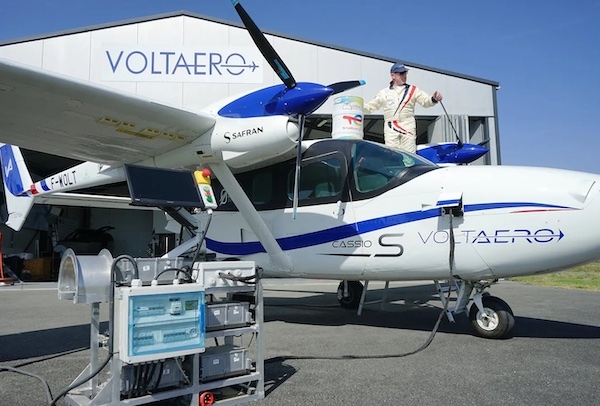
VoltAero has flown the proprietary electric-hybrid powertrain for its Cassio family of aircraft with 100% sustainable fuel provided by TotalEnergies. Conducted from VoltAero development facility at Royan, France, the flight used the hybrid powertrain’s electric mode and its internal combustion engine – which was fueled by TotalEnergies Excellium Racing 100, made from bioethanol produced from waste that originates in French vineyards. This demo flight was performed with VoltAero Cassio S testbed airplane, operated by the company. The goal is to validate its electric-hybrid powertrain and the application of sustainable fuels, thereby de-risking airworthiness certification for upcoming production versions of the Cassio aircraft family.
Jean Botti, VoltAero’s CEO and Chief Technology Officer, commented: “Based on initial results, we calculated a truly impressive CO2 reduction of approximately 80 percent while operating the Cassio powertrain in its electric-hybrid mode and with the internal combustion engine fueled by TotalEnergies’ Excellium Racing 100. It underscores the opportunity for production Cassio aircraft to represent a major step closer to aviation’s decarbonization goals by replacing standard Avgas 100 high-octane fuel for aviation piston engines.”
Joël Navaron, the President of TotalEnergies Aviation, said: “This demonstration flight is part of our commitment to support players in the aviation sector for their decarbonization objectives. More broadly, it demonstrates our desire to continue our research and development efforts to offer an alternative to aviation gasoline containing lead, thereby meeting the challenges of general aviation’s decarbonization. We already have initiated several actions – such as the installation of several electric charging stations for general aviation aircraft, and the launch of a pilot program aimed at offering SP98-type fuel for compatible aircraft.”
Botti added that VoltAero is proud to have been associated with TotalEnergies in this achievement, which marks an advancement toward the future use of biofuel in general aviation – and which complements the ongoing introduction of sustainable aviation fuel.Excellium Racing 100 fuel has been used since 2022 in certain automobile competitions, including the famous 24 Hours of Le Mans endurance sports car race. It is made from winemaking waste, and allows a reduction in CO2 emissions of at least 65% over its entire life cycle when compared with the fossil fuel equivalent.
VoltAero Cassio family will be a highly capable and reliable aircraft product line for regional commercial operators, air taxi/charter companies, private owners, as well as in utility-category service for cargo, postal delivery and Medevac applications. By integrating VoltAero patented electric-hybrid propulsion system into the purpose-designed airframe, Cassio will deliver an order of magnitude higher performance as compared to the current competition, and provide significantly lower operational costs.
First VoltAero production aircraft will be Cassio 330, with a four/five-seat interior configuration and operating on a combined electric-hybrid propulsion power of 330 kilowatts. It is to be followed by the six-seat Cassio 480 with a combined electric-hybrid propulsion power of 480 kilowatts, and the Cassio 600 – sized at a 10/12-seat capacity with electric-hybrid propulsion power of 600 kilowatts.
* Excellium Racing 100 is certified as a 100% sustainable product according to the mass balance system applied by a voluntary certification organization approved by the European Union.

Asco, a subsidiary of Montana Aerospace AG, achieves significant technological milestone in the development of a hybrid multi-material Rear Secondary Structure for Airbus. Montana Aerospace,...
Few infrastructure projects have the potential to reshape an island's future quite like the ongoing transformation of Nevis Airport. To gain deeper insight into this ambitious development and the...
Private jet catering requires an understanding of the journey as much as the passengers' preferences. SkyDine Jet Catering explores how flight duration, departure schedules, airport location, and...
Bombardier marked the 40th anniversary of its industry-leading Smart Services cost-per-flight-hour programs, which today support more than 1,500 enrolled aircraft and account for over 11 mil...

