



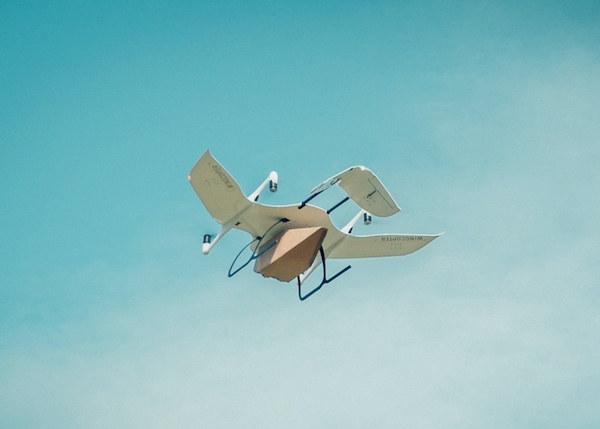
26 kilometers (16 miles) between Greifswald and Wolgast – that is the distance over which Wingcopter drones recently transported blood samples in the Northeast German federal state of Mecklenburg-West Pomerania. The flights were carried out by Greifswald University Medical Center in cooperation with DRF Luftrettung and Wingcopter as part of the MV|LIFE|DRONE Challenge project of the hospital's Department of Anesthesiology. The project is funded by the German Federal Ministry of Health and the Ministry of Energy, Infrastructure and Digitalization of Mecklenburg-West Pomerania and intends to improve structures of regional emergency care by integrating Unmanned Aircraft Systems (UAS) into the rescue chain and emergency medical transports.
The flights beyond the pilots’ visual line of sight (BVLOS) carried a pneumatic tube including 250 grams of blood samples. The Wingcopter completed the 26-kilometer route in an average of 18 minutes, nearly twice as fast as ground-based transport. The use of Wingcopter drones could thus significantly speed up emergency medical care in rural areas and help save lives. In the event of a blood transfusion being necessary at short notice, for example, blood samples from Wolgast District Hospital must be transported to Greifswald University Hospital for analysis in order to determine the appropriate donor blood.
Ansgar Kadura, co-founder and CSO of Wingcopter, comments: "With this project, we have demonstrated that we can also improve medical care and quality of life in rural areas in Germany. With our new unmanned aerial vehicle, the Wingcopter 198, this can be carried out even more efficiently in the future. We look forward to continued collaboration with the project team at the Department of Anesthesiology as part of the MV|LIFE|DRONE Challenge and beyond."
The goal of Greifswald University Medical Center is to establish permanent flight connections between the medical center in Greifswald and hospitals in the surrounding area as soon as possible. Drones are also to be used to support first responders on site, for example by quickly transporting medications, transfusions, or emergency medical equipment such as defibrillators to the scene of an accident.
"We are continuing to work towards the goal of shortening long distances in the region for the benefit of our population. Key to this is the integration of new technologies into existing rescue and care systems as part of comprehensive care concepts," emphasizes Dr. Mina Baumgarten, project manager of the MV|LIFE|DRONE-Challenge project, adding: "The next step on the way to realizing this must be to transfer tests into longer-term use under real-world circumstances; the conditions in the region are ideal for this.”
Rising production rates and the launch of new aircraft programs are driving increased demand for manufacturing capacity across the aerospace industry. To support this growth, FACC plans to i...
British Airways has unveiled the next phase of its Heathrow lounge transformation programme, marking the beginning of a significant investment aimed at modernising every lounge across the airport in t...
TRU Simulation + Training Inc. will showcase its Veris Virtual Reality Flight Training Device (FTD) for the Cessna Skyhawk at NBAA-BACE 2026, marking the simulator's first appearance at the indust...
Dutch flag carrier KLM, part of the Air France-KLM Group, has welcomed its first Airbus A350-900, marking a significant step in the airline’s long-haul fleet modernization strategy. The arrival...

