



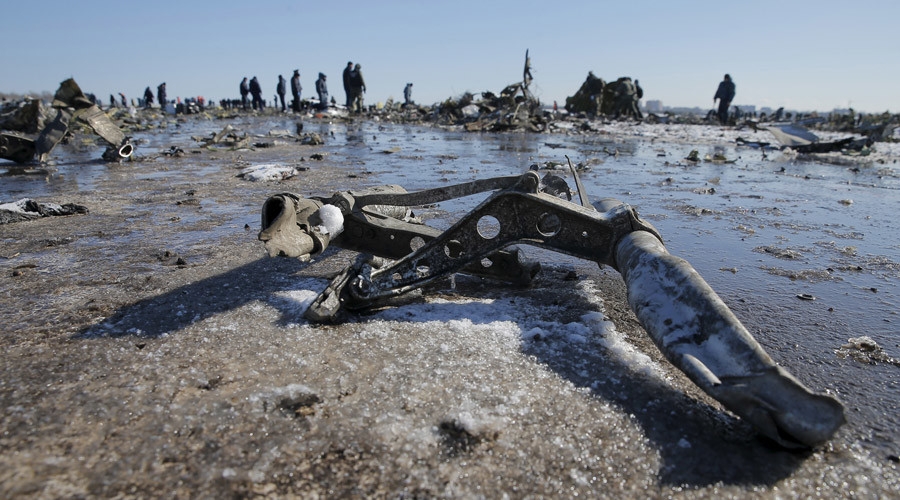
All ground and on-board navigation, landing and communications systems functioned as normal on the Flydubai passenger jet, which crashed in Rostov-on-Don this March, the Russian aviation watchdog said.
"At the time of the accident, the ILS, outer and inner markers, the lighting system and PAPI lights were operative and operated as per design. The aircraft flight recorders did not record any evidence of improper operations of navigation and landing aids," the Interstate Aviation Committee (IAC) said in an interim report issued on Wednesday.
"According to preliminary information, all aids subject to certification were holding valid operational certificates and were fit for operation in terms of assigned life and service time," the document added.
On March 19, a Flydubai Boeing 737-800 plane hit the ground while attempting to land at the Rostov-on-Don airport in southern Russia in bad weather conditions and poor visibility.
There were 55 passengers and a seven-member international crew, headed by a Cypriot captain, onboard. Nobody on board survived the crash.
In its interim report, IAC confirmed that the accident occurred as result of a nosedive caused by the commands of the pilots.
“At a height of 900 m there was a simultaneous control column nose down input and stabilizer nose down deflection from -2.5 deg (6.5 units) to +2.5 deg (1.5 units), as a result the aircraft, having climbed to about 1000 m, turned into descent with negative vertical acceleration of -1g,” the paper said.
“The following crew recovery actions did not allow it to avoid an impact with the ground,” it added.
However, the watchdog didn’t specify the motives behind the actions of the Flydubai pilots.
The report said that the investigators plan to examine the psycho-emotional and physiological condition of the crew in connection with their working schedule and rest time.
IAC stressed that their current paper “is preliminary and can be subject to clarification and amendment based on the pertinent examinations” ahead of the final report.
Shortly after the crash, pilots from Flydubai and another UAE airline, Emirates, contacted RT revealing mass overwork issues at the companies.
They said that they had to perform flights despite being exhausted, while complaints of fatigue were ignored or even met with threats by the management.
Viasat has significantly expanded the capacity of its JetXP in-flight connectivity service across the United States, delivering up to five times more bandwidth for business aviation customers equipped...
Samson Sky has enlisted renowned Italian automotive designer Luigi Memola to develop the interior design of its Switchblade Flying Car, bringing world-class automotive styling expertise to the roadabl...
The U.S. Federal Aviation Administration has certified the Boeing 737-10, the newest and largest member of the 737 MAX family, paving the way for Boeing [NYSE: BA] to begin customer deliveri...
Few infrastructure projects have the potential to reshape an island's future quite like the ongoing transformation of Nevis Airport. To gain deeper insight into this ambitious development and the...

