



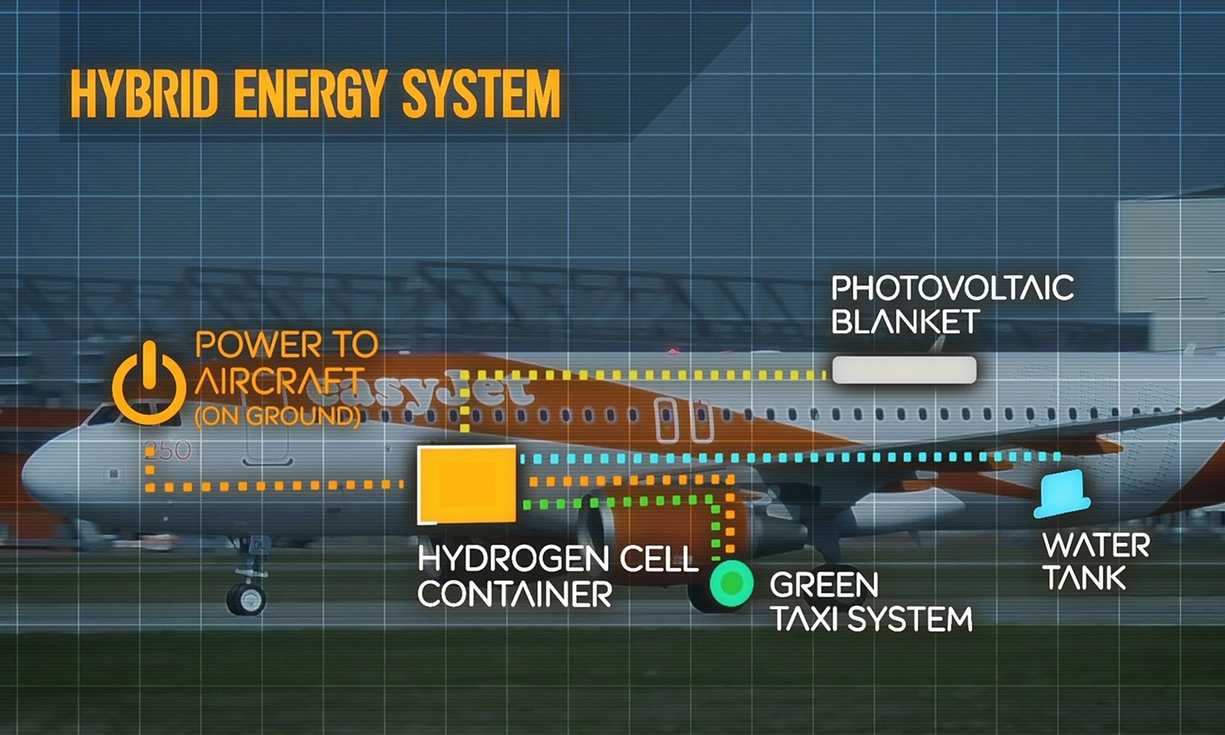
EasyJet has unveiled plans to use hydrogen fuel cells on its aircraft to save up to 50,000 tonnes of fuel a year and cut its carbon emissions.
The airline hopes to trial technology later this year that would allow planes to taxi to and from the runway using zero-emissions fuel.
Around 4% of easyJet’s total fuel consumption is used in taxiing, or an average of 20 minutes a flight.
While aviation’s progress in developing sustainable alternatives to jet fuel has been minimal, the industry is hoping to reduce its carbon footprint with more efficient aircraft, improved air traffic control and initiatives such as easyJet’s at airports.
EasyJet’s “hybrid plane” would use a hydrogen fuel cell stowed in the aircraft’s hold, which would capture energy generated by brakes on landing and could charge the system’s lightweight batteries on the ground – a similar system to one developed in Formula 1 cars.
Instead of relying on tug vehicles to manoeuvre planes in and out of airport stands, the aircraft would use electric motors in their main wheels when taxiing, which easyJet said should also improve operations and punctuality.
EasyJet has targeted a 7% cut in its CO2 emissions (currently 81 grams a passenger kilometre) by 2020, and claims its relatively young fleet and full planes already mean its passengers have a significantly lower carbon footprint than traditional, full-service airlines.
The airline’s head of engineering, Ian Davies, said: “We are continuing to apply the use of new digital and engineering technologies across the airline. The hybrid plane concept we are announcing today is both a vision of the future and a challenge to our partners and suppliers to continue to push the boundaries towards reducing our carbon emissions.”
The design came from a competition run with Cranfield University to come up with ideas for aircraft of the future, although easyJet has pledged to trial the cell this year.
In a 2008 test conducted by Boeing, a light plane flew a short distance using hydrogen fuel cells.
The Tennessee Valley Authority is demonstrating the real-world value of the Tecnam P2012 Special Mission Platform (SMP), which has become a vital tool for monitoring and maintaining its...
Samson Sky has enlisted renowned Italian automotive designer Luigi Memola to develop the interior design of its Switchblade Flying Car, bringing world-class automotive styling expertise to the roadabl...
Aviation Capital Group, the Newport Beach, California-based global aircraft asset manager, has signed a firm order for 75 additional Airbus A320neo Family aircraft, bringing its cumulative orders for...
Bristow Group Inc., in partnership with Electra, Avinor and the Norwegian Civil Aviation Authority (CAA Norway), will undertake a series of demonstration flights across five locations in Norway using...

