



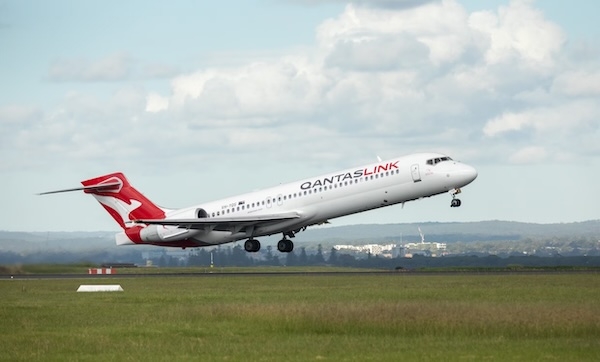
26th October marks the end of an era for the Qantas Group with the last remaining QantasLink Boeing 717 jet taking passengers to Australian skies for the final time. The final flight (QF1511) landed in Canberra at approximately 18:00 this evening, operated by a crew with a long and proud history operating this aircraft and more than 100 years combined experience flying the 717 in Australia. The flights were flown on ‘Great Otway National Park’ (registration VH-YQS) between Sydney, Launceston and Canberra. After completing more than 15,000 flights, over 17,000 flight hours and safely carrying more than one million customers for QantasLink over almost 11 years, Great Otway National Park will spend the next few weeks on the ground in Canberra ahead of its retirement in November.
The 717s have flown for QantasLink and Jetstar for more than 20 years.
QantasLink is one of the last three commercial airlines in the world to operate the Boeing 717 aircraft, which were popular for their ability to deliver on high-frequency short to medium routes and serve smaller ports, while carrying around 100 passengers, tapping into a gap in the market for this size aircraft. Following more than two decades of service in the Qantas Group, connecting Australian capital cities and regional hubs and supporting the resource sector in the West, the fleet of 20 QantasLink 717 aircraft are being replaced by 29 new fuel-efficient Airbus A220s, as part of the Qantas Group’s fleet renewal program, which will reshape its domestic and regional network over the next decade and beyond.
With four A220s currently flying for QantasLink, the next A220 to arrive the ‘Tasmanian Devil’ and is scheduled to enter into service by the end of the year.
QantasLink Chief Executive Officer Rachel Yangoyan said the airline was proud to celebrate and recognise the 717’s history and contribution to aviation in Australia: “Today marks a significant moment in Australian aviation with the 717’s iconic T-shaped tail taking passengers to Australian skies for the last time. The 717 aircraft have a long history in Qantas and Jetstar’s fleet. From being the aircraft that launched Jetstar’s first ever flights in 2004 to serving major cities, regional towns and the mining sector in the West as part of QantasLink for more than 20 years, we know our people and customers have loved flying on the 717. As we farewell the Boeing 717 in Australia and the end of an era, we are excited about the future of QantasLink jet flying onboard the A220 aircraft. We’re already getting great feedback from customers and our crew about their experience onboard the A220 aircraft. With almost double the range, lower emissions per seat and a more comfortable inflight experience, the A220s will allow us to deliver the next generation of flying for our customers and our people."
History of the 717 Fleet
Looking to the future with the A220
The next generation A220 will deliver an improved onboard experience with a number of key features including:
From Learjets and Challengers to turboprops such as the Pilatus PC-12, different aircraft bring different capabilities to a medical flight. Sebastian Demiet, COO of MTI 24/7, explains why aircraft sel...
EBAA France, the representative body for France’s business aviation ecosystem, brings together aircraft operators, airport activities, aircraft manufacturing, maintenance, and training providers...
Information Design One AG, the Frankfurt-based aviation technology company behind the aFuel platform, has achieved a major operational milestone. During the first half of 2026, aFuel processed 50...
Marking a significant industry milestone, Garmin has delivered its 1,000th G1000 integrated flight deck retrofit for a King Air aircraft. The program has helped redefine cockpit modernizatio...

