15 years ago, two Japan Airlines jetliners narrowly avoided a mid-air collision near Yaizu, Shizuoka, Japan.

Japan Airlines Flight 907, a Boeing 747-446D (JA8904) was en-route from Haneda International Airport to Naha International Airport with 411 passengers & 16 crew members on board.

Japan Airlines Flight 958, a McDonnell-Douglas DC-10-40 (JA8546) was en-route from Gimhae International Airport to Narita International Airport with 237 passengers & 13 crew members on board.
The mid-air incident occurred as flight attendants began to serve drinks onboard flight 907 (B747). The TCAS (Traffic Collision Avoidance System) sounded 20 minutes after its departure as the jet climbed towards 39,000ft.
Flight 958 (DC10) cruised at 37,000ft. The pilots of both planes had received instructions from their TCAS, but flight 907 received conflicting instructions from the flight controller at the Tokyo Area Control Center.
Flight 907 (B747) followed an order to descend issued by the flight controller while flight 958 (DC10) descended as instructed by the TCAS, meaning that both planes remained on a collision course.
The trainee for the aerospace sector handled ten other flights at the time of the near miss. Hachitani intended to tell Flight 958 (DC10) to descend. Instead, he told Flight 907 (B747) to descend. When the trainee noticed that Flight 958 (DC10) cruised at level altitude instead of descending, the trainee asked Flight 958 (DC10) to turn right; the message did not get through to the JAL 958 pilot. The trainee's supervisor ordered 'JAL 957" to climb, intending to tell JAL 907 to climb. There was no "JAL 957" in the sky.

The aircraft avoided a collision by using evasive maneuvers once they were in visual proximity, and passed in within about 135 meters of each other. An unidentified passenger told NHK "I have never seen a plane fly so close. I thought we were going to crash."

Seven passengers and two crew members of the B747 sustained serious injuries. 81 passengers and 10 crew members reported minor injuries. Some unbelted passengers, flight attendants, and drink carts hit the ceiling, dislodging some ceiling titles. The maneuver threw one boy across four rows of seats. Most injuries to occupants consisted of bruising. The maneuvers broke the leg of a 54-year-old woman. A drink cart spilled, scalding some passengers. No passengers & crew on board the DC-10 sustained injuries.
The incident was attributed to errors made by the air traffic controller trainee and trainee supervisor. The incident caused Japanese authorities to call upon the International Civil Aviation Organization (ICAO) to take measures to prevent similar incidents from occurring. Had the collision occurred given the 677 people on board both aircraft combined, this could have potentially been the deadliest aviation accident disaster in the world, surpassing the Tenerife Airport Disaster, which killed 583 people.
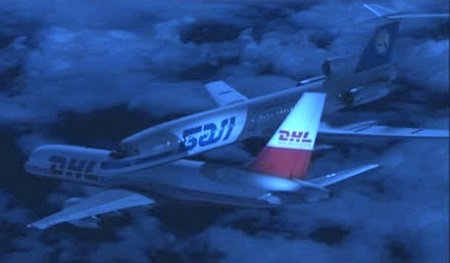
Almost 17 months after the Japan Airlines mid-air incident. On 1 July 2002, Bashkirian Airlines Flight 2937 & DHL Flight 611 collided over Überlingen, Germany killing all 71 people on board both aircraft.
The accident was caused by similar circumstances one of the aircraft had received conflicting orders from the TCAS and ATC. The ICAO did not take action until after the crash over Germany in 2002. Four near misses in Europe occurred before the German disaster because one set of pilots obeyed the air traffic controllers while the other obeyed TCAS. The ICAO decided to fulfill Japan's request 18 months after the Japan Airlines incident.
Dassault will introduce the fourth-generation EASy IV flight deck on newly built Falcon 2000LXS aircraft, while also making the upgrade available as a retrofit across the entire Falcon 2000 EASy fleet...
Cirrus Aircraft is celebrating the 10th anniversary of its Collier Trophy-winning Vision Jet at NBAA-BACE 2026, marking a decade of innovation that has continuously advanced the world&r...
Textron Aviation has marked a key milestone in the development of the Cessna Citation CJ4 Gen3 with the rollout of the program’s first production aircraft. The achievement brings the next-g...
Samson Sky has enlisted renowned Italian automotive designer Luigi Memola to develop the interior design of its Switchblade Flying Car, bringing world-class automotive styling expertise to the roadabl...