



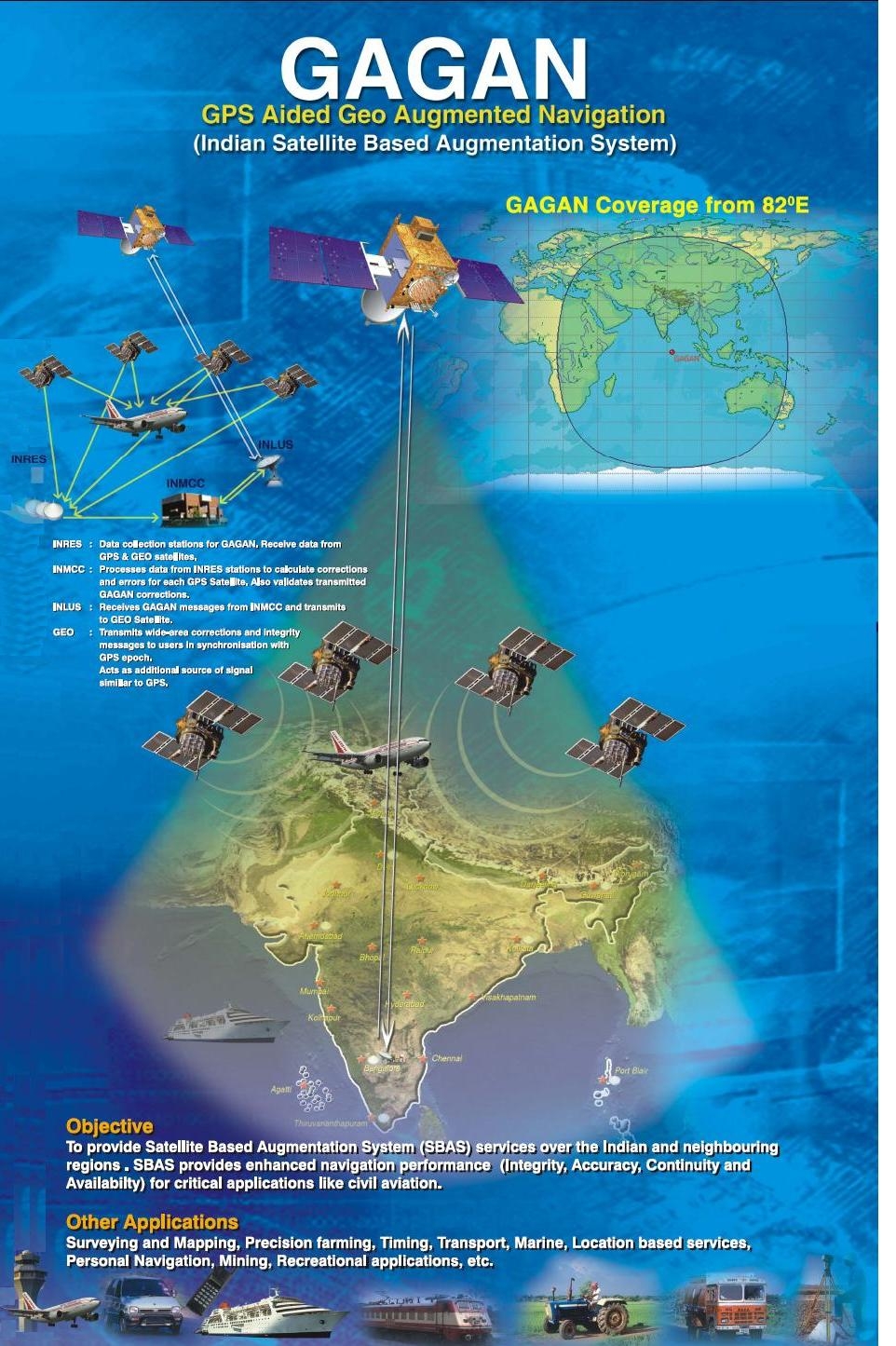
The Airports Authority of India (AAI) is looking at an incentive-based scheme to attract commercial airlines and general aviation companies to adopt India’s “GPS Aided GEO Augmented Navigation” (Gagan)–which is equivalent to Europe’s EGNOS and the U.S. WAAS system, but for the Indian subcontinent. As such, Gagan will be the first satellite-based augmentation system (SBAS) in the world certified for approach with vertical guidance in the equatorial ionospheric region.
The AAI has also proposed that, in support of Gagan, focused technology parks are to be set up in Delhi and Bangalore, “similar to those in China for training and infrastructural resources, including manufacturing of receivers, a data center and incubating facilities,” said S.V. Satish, former general manager ATM-Gagan. Satish was recently appointed executive director of safety at AAI.
To gain the maximum benefit from en route and guided approaches to landing, operators will need to equip all aircraft with global navigation satellite system (GNSS) avionics. “The success of a program lies in the utility and will depend on the users taking [part in] the program,” said R.K. Srivastava, chairman of AAI.
The AAI board recently gave approval in principal to provide financial incentives to regional airlines. They will be funded by earmarking 5 percent of India’s Route Navigation Facility Charges. The incentive will be restricted to upgrades for aircraft equipped with retrofits or forward-fits, and airlines that have entered into an agreement withAAI for aircraft equipage.
While AAI is in discussions with airlines to implement the proposal, there has been resistance, with some Indian domestic carriers citing the high cost of associated equipment and the time needed for retrofits, training and certification. “We are trying to make the time change requirement by 2019,” said Satish.
India’s Director General Civil Aviation (DGCA), M. Sathiyavathy, confirmed last year that discussions were in the early stages: “I only hope our scheduled [airlines] and general aviation start using Gagan at an early date.” Airlines are looking for a dual-frequency multi-constellation “that will take us up to 2020,” Satish explained. This would mean the receiver market would grow, making the equipment more cost-effective.
Perhaps taking this cue, the general aviation industry has shown interest in adopting Gagan. “The enormous costs of instrument landing systems and technical feasibility of installation in terrain-challenged airports is a major concern for AAI,” said Srivastava. “Gagan procedures can be designed for any flight operation into any airport, assisting aircraft without a ground-based terminal navigation system [but maintaining the] accuracy of terminal guidance.”
Companies such as Reliance and Jindal are looking at producing Gagan receivers, with an eye to the time when procedures will have been tested and ground validation completed, said Satish. A meeting of the GA industry is scheduled in Mumbai at the end of February to encourage operators to equip their aircraft with Gagan receivers. “Companies like Reliance and Jindal that own airports and aircraft will get the best benefit of the system,” Satish said.
India has attempted to promote Gagan in neighboring countries where uplink stations will have to be installed. Satish confesses aggressive marketing is not the AAI’s forte and admits it may have to look at outsourcing this important role. Meanwhile AAI is in talks with the power sector and Geological Survey of India to adopt Gagan for their use.
AAI has indicated that India would like to start a program called HUGI (Helicopters Use Gagan in India), making instrument approaches to heliports possible. However, government-owned Pawan Hans has yet to respond to the proposal.
The challenge of Gagan, as with any SBAS, is the need to keep upgrading it to avoid obsolescence. One of the world’s four satellite-based augmentation systems, Gagan is a joint project of AAI, the Indian Space Research Organization (ISRO) and Raytheon.
Its advanced air navigation technology provides coverage for the entire Indian Flight Information Region via broadcast signals from two Indian-built satellites (GSAT 8 and GSAT 10). Citing advantages such as simplified approach procedures and reduced separation standards possible with SBAS navigation technology, Raytheon’s country director and senior executive for India, Nik Khanna, told AIN, “It improves the fuel efficiency of airlines operating throughout India.”
Bombardier marked the 40th anniversary of its industry-leading Smart Services cost-per-flight-hour programs, which today support more than 1,500 enrolled aircraft and account for over 11 mil...
BPE Air, the aviation company founded and wholly owned by entrepreneur Aldrew Crowe, reported approximately US$90 million in revenue in 2025, marking a major milestone in the growth of its integrated...
Few infrastructure projects have the potential to reshape an island's future quite like the ongoing transformation of Nevis Airport. To gain deeper insight into this ambitious development and the...
The U.S. Federal Aviation Administration has certified the Boeing 737-10, the newest and largest member of the 737 MAX family, paving the way for Boeing [NYSE: BA] to begin customer deliveri...

