



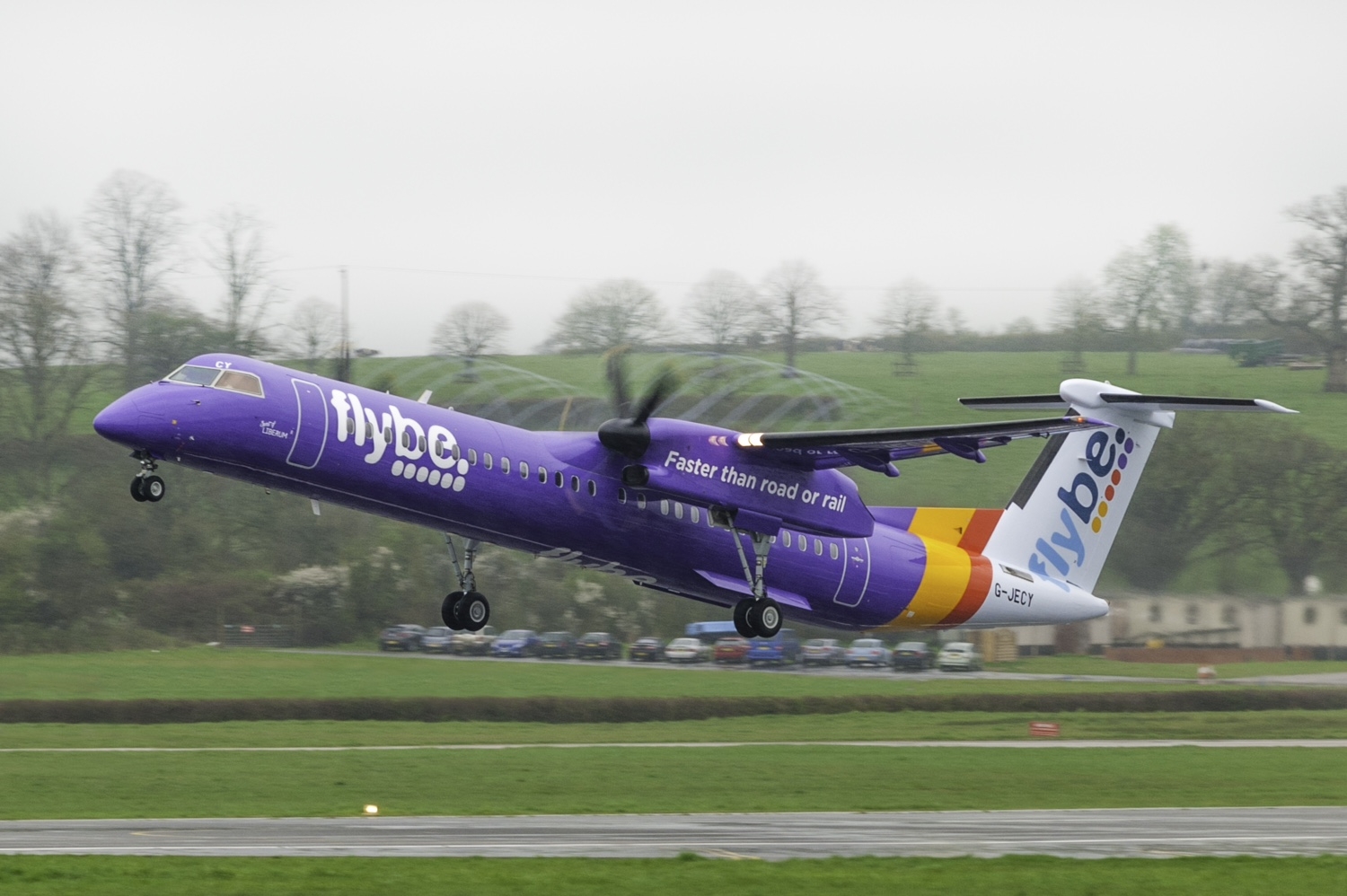

wo years into a three-year restructuring plan, British regional airline Flybe says it is on track to return to profitability. The rescue program has seen the carrier get out of its $1.4 billion order for Embraer E175 twinjets and abandon its Flybe Finland joint venture to focus on services out of the UK using its fleet of 48 BombardierQ400 twin turboprops.
“This business was in mortal danger in 2013. We have knocked all the legacy issues on the head bar one,” FlybeCEO Saad Hammad told AIN in an interview at the company’s Exeter Airport headquarters in southern England.
Hammad initiated cost-cutting measures when he joined the company August 2013 from low-cost carrier Easyjet. Over the past 12 months these have reduced expenses by £74 million ($116 million), with the loss of more than 1,000 jobs (leaving a workforce of some 2,000 people) as 6 of its 13 bases were closed. Flybe has still to resolve the future of seven surplus E195 aircraft that it has on lease.
During the first quarter of the current 2015/16 financial year, Flybe grew seat capacity by 12 percent to 2.8 million seats, passenger headcount by 10.5 percent to 2.1 million, and passenger revenue by 11.6 percent to £147.7 million (£232 million). “We are driving unit revenue growth through significantly improved load factors,” said Hammad. “Last year, we delivered a record-high load factor, at 75.2 percent, 570 basis points above the prior year. Growth in unit revenue was 3.2 percent. We drove that by investing in yields and by improving our commercial execution.”
Last year, Flybe did a neat swap with U.S. carrier Republic Airlines. “The 20 [88-seat] E175s went to Republic and in return we got 24 Q400s,” Hammad explained. “Now we are at 48 [78-seat] Q400s, with the three from Republic delivered, 11 E175s, and we managed to [exit] seven of the E195s. We have to find homes for the last seven [118-seat] E195s. That's the one issue we have fully to resolve. We are looking all over the world. It's a lovely airplane but it is just too big for our needs.”
Unfair Competition
Another item on the agenda is fighting what Flybe calls unfair competition with competitors due to the mandatory compensation required under European Union regulation EU261 for flights over three hours late due to factors within the operator’s control. “We compete against ferry, train and coach [bus],’ said Hammad. “They do not have such onerous requirements on them. It is not a level playing field with other modes of transport; we are talking to the British government.”
Now, Hammad has set his sights on the wider regional European market. “We can get you there point-to-point within the UK and nearby Europe, but we also connect to four of the biggest international long-haul hubs in Europe, namely Manchester, Paris, Dublin and Amsterdam,” he said. “If Flybe didn't exist, you'd have to invent it.”
The Tennessee Valley Authority is demonstrating the real-world value of the Tecnam P2012 Special Mission Platform (SMP), which has become a vital tool for monitoring and maintaining its...
Turkish Airlines has taken another major step in its fleet expansion strategy with the signing of a Memorandum of Understanding with CFM International for more than 300 LEAP-1B engines and a long-term...
Viasat has significantly expanded the capacity of its JetXP in-flight connectivity service across the United States, delivering up to five times more bandwidth for business aviation customers equipped...
Qantas Freight and Australia Post have entered the next chapter of their long-standing partnership with the arrival of the first of three additional Airbus A321 Passenger-to-Freighter (A321P2F) aircra...
