



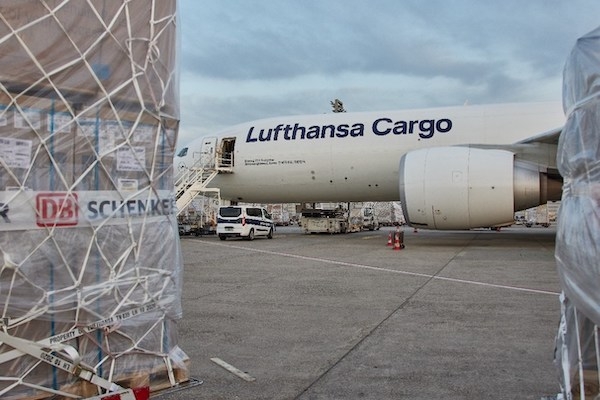
Air freight can now be transported with zero carbon dioxide tailpipe emissions: DB Schenker and Lufthansa Cargo launched the first regular carbon neutral cargo flight connection in history. With the arrival of a Boeing 777F at 02:00 am local time today, the companies finished the first leg of their first weekly flight between Frankfurt am Main and Shanghai Pudong, where the fuel requirements are covered entirely by Sustainable Aviation Fuel (SAF).This will save around 174 metric tons of conventional kerosene each week.
Jochen Thewes, CEO of DB Schenker: "As of now, carbon neutral supply chains are also feasible with air freight. Our weekly flights between Frankfurt and Shanghai are the kick-off of a new era. We are proud to have already convinced so many customers of this future-orientated product. Next, business and politics have to take charge to create more capacity for regenerative fuels and clean aviation."
Dorothea von Boxberg, CEO of Lufthansa Cargo: "With the world's first sustainable cargo flight with DB Schenker at the end of 2020, we demonstrated that flying without fossil emissions is already possible. Today, we jointly launched the world's first regular sustainable cargo flight connection. This paves the way for many more connections of this kind. We are counting on the determination of our industry and the dedication of consumers to get this off the ground together."
Sustainable Aviation Fuel is produced mainly from biomass waste, such as used vegetable and cooking oils. Thus, when burned in the engine, the same amount of carbon dioxide is released which was previously removed from the atmosphere during the original growth of the plants.
In addition, greenhouse gases produced during the manufacture and transport of the fuel are fully offset by sustainable compensation projects. This ensures that flights are completely greenhouse gas neutral.
The weekly volume of SAF procured by DB Schenker and Lufthansa Cargo corresponds to 174 metric tons of kerosene, which is about the amount needed for the connection to Shanghai and back. However, for technical and legal reasons, it is currently not possible to fuel an aircraft with SAF only. Therefore, the SAF is blended with conventional kerosene via the airport's refuelling system and consumed proportionally by all subsequently refuelled aircraft.
In total, greenhouse gas neutrality of 20,250 metric tons will be ensured during Lufthansa Cargo's summer flight schedule. Of this, around 16,200 metric tons will be avoided from direct combustion in the engine. The participating customers, including Mercedes-Benz, ZF and Merck, can credit their reduced carbon footprint on a pro rata basis.
Currently, SAF is about three times more expensive than fossil kerosene and the quantity available on the market is limited. With the launch of the sustainable freight flight connection, DB Schenker and Lufthansa Cargo are reiterating their call to other companies in the logistics industry as well as politicians to jointly expand production and infrastructure for Sustainable Aviation Fuel and thus drive forward decarbonization in logistics.
Gulfstream Aerospace has enhanced the capabilities of its Customer Support Performance Analytics program, further strengthening its ability to transform aircraft data into actionable insight...
In business aviation, exceptional service is defined by attention to detail, and few amenities reflect that more clearly than premium catering. At the intersection of hospitality and private aviation,...
Turkish Airlines has taken another major step in its fleet expansion strategy with the signing of a Memorandum of Understanding with CFM International for more than 300 LEAP-1B engines and a long-term...
Gogo has unveiled its long-term vision for the Galileo connectivity platform at NBAA-BACE 2026, outlining a roadmap designed to enhance and protect customer investments well into the mid-2030s and bey...

