

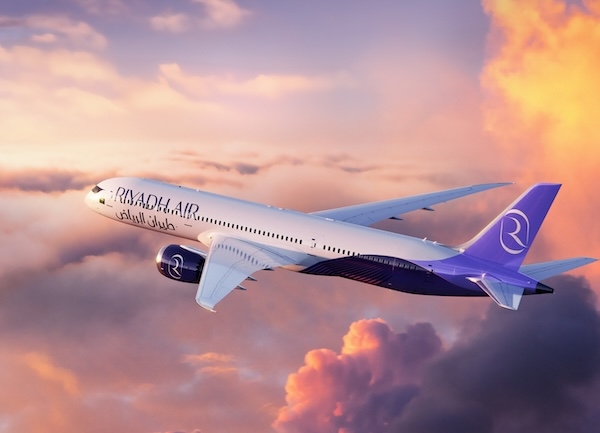
IBM and Riyadh Air announced a major milestone in their collaboration, unveiling Riyadh Air as the world's first AI-native airline. Designed from the ground up without legacy patch work, these AI-driven operations provide the foundation to transform guest and employee experiences and set a new benchmark for innovation in the aviation industry. With initial flights underway and its first commercial service expected in early 2026, the three‑year collaboration between Riyadh Air and IBM has reached a pivotal moment.
Riyadh Air is leveraging IBM Consulting's deep industry and technical expertise, broad partner ecosystem, and IBM watsonx Orchestrate to operate as an AI-native enterprise from day one. IBM Consulting served as the orchestrator behind this ambitious AI vision, bringing together 59 workstreams and more than 60 partners, including Adobe, Apple, FLYR, and Microsoft. Using IBM Consulting Advantage, its AI-powered delivery platform designed to accelerate value creation, IBM consultants were able to help provide seamless execution of the airline's end-to-end technology strategy.
Adam Boukadida, Chief Financial Officer, Riyadh Air commented: "We had a clear choice--be the last airline built on legacy technology or the first built on the platforms that will define the next decade of aviation. With IBM, we've stripped out fifty years of legacy in a single stroke. Riyadh Air isn't just built for today; it's built for the future and creating a pathway for many airlines to follow in the years to come."
Mohamad Ali, Senior Vice President, IBM Consulting stated: "By embedding AI into the very foundation of its operations, Riyadh Air is setting a new blueprint for what it means to build a modern, adaptive enterprise from the ground up. As a company born in the AI era, Riyadh Air is redefining what's possible in aviation and it's been a privilege for IBM to help make that vision a reality."
Bringing together employee and guest experiences
Riyadh Air is reimagining how employees work and engage with travelers in the AI era. By infusing generative AI and agentic AI capabilities into workflows, the airline is creating a synchronized environment where people and technology deliver effortless travel.
Operational efficiency as the engine for innovation
Built for efficiency from the start, Riyadh Air isn't constrained by legacy systems or incremental productivity gains. Beginning with a completely blank digital slate, the airline is using AI to create new revenue opportunities and reinvest in innovation across its operations.
IBM Consulting implemented an enterprise performance management suite to bring together financial, operational and commercial data across the organization, automating planning, budgeting, forecasting and analysis to deliver real time insights and support data driven decision making. By building this integrated foundation, Riyadh Air is enhancing its efficiency, optimizing route profitability and strengthening overall business performance.
Together, IBM and Riyadh Air have built an AI‑native enterprise with the digital strategy, architecture and operating models needed for the airline to achieve its ambition of transforming aviation and expanding the Kingdom of Saudi Arabia's connectivity to more than 100 destinations, serving millions of travelers by 2030.
Velocity Maintenance Solutions, an FAA-certified provider of maintenance, repair and overhaul services, has announced a significant expansion of its facilities at Wilmington Airport (ILG) in Delaware,...
TARMAC Aerosave has set a new industry benchmark by becoming the first company in the world to secure Aircraft Fleet Recycling Association (AFRA) accreditation across all three scopes of aircraft disa...
Cirrus Aircraft is celebrating the 10th anniversary of its Collier Trophy-winning Vision Jet at NBAA-BACE 2026, marking a decade of innovation that has continuously advanced the world&r...
Gogo has unveiled its long-term vision for the Galileo connectivity platform at NBAA-BACE 2026, outlining a roadmap designed to enhance and protect customer investments well into the mid-2030s and bey...