



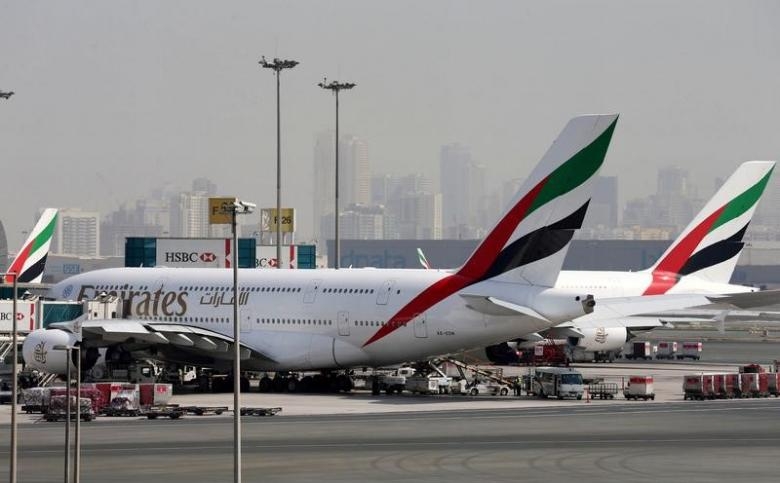
The profitability of airlines based in the United Arab Emirates, the Middle East's main aviation hub, is likely to fall this year amid limited growth in demand, the head of IATA said on Tuesday.
The UAE is home to Emirates [EMIRA.UL], which flies more passengers long haul than any other airline, as well as rapidly expanding Etihad Airways and low cost carriers flydubai and Air Arabia.
"The UAE carriers will have a year that is probably below 2016," Alexandre de Juniac, director general and chief executive of the International Air Transport Association (IATA), told reporters in Abu Dhabi. Low-cost carriers that offer long-haul services, as seen in Europe, could also soon start to take hold in the region, he said.
IATA said in December that Middle East airlines are likely to see profits fall to $300 million in 2017 from $900 million last year in part due to high capacity and limited demand growth, but did not give specifics on UAE carriers at that time.
Half-year profit fell 75 percent at Emirates and the airline's President Tim Clark said last week that while yield declines had halted it was still a tough year.
Air Arabia and flydubai reported lower full-year profit for 2016, while Etihad has not yet reported its results but has said it is reviewing its business.
Airlines in the Gulf benefited for years from high oil prices that spurred government spending and regional growth. But demand has softened and travel budgets have tightened after more than two years of depressed oil prices, exposure to weaker markets and currency fluctuations.
Emirates and Etihad are both reviewing their workforces, while Emirates has agreed with Airbus to delay the delivery of 12 A380 jets over the next two years.
Both airlines have hundreds of aircraft on order from Airbus and Boeing and neither has signaled further delays to deliveries.
De Juniac told Reuters that airlines across the world need to "manage their assets cleverly."
"There is a lot of capacity so it explains why the yield is declining and many companies are suffering," he said, but added that he "would not advise" airlines on how to define their capacity.
The growth of low-cost airlines that fly long haul, like Norwegian Air Shuttle, is expected to continue to pressure established trans-Atlantic carriers as these newcomers expand using longer-range single-aisle aircraft to fly between smaller, cheaper local airports.
Growth of low-cost, long haul is "starting to accelerate" in Europe and Asia and is likely to eventually develop in other markets such as the Middle East, de Juniac said.
A Discover Airlines Airbus A330 has become the first Airbus aircraft worldwide to enter regular commercial service after undergoing a full-scale AeroSHARK retrofit, marking a signi...
Daher Aircraft will present its TBM and Kodiak aircraft families at next week’s NBAA Business Aviation Convention & Exhibition (NBAA-BACE), showcasing how their combination of performance, e...
Embraer has delivered the first E175 fitted with next-generation RECARO passenger seats to American Airlines, marking another step in the ongoing modernization of one of the world's most successfu...
Piaggio Aerospace will return to NBAA-BACE this October, bringing its flagship P.180 Avanti EVO to one of the most important gatherings of the global business aviation community while also highlightin...

