



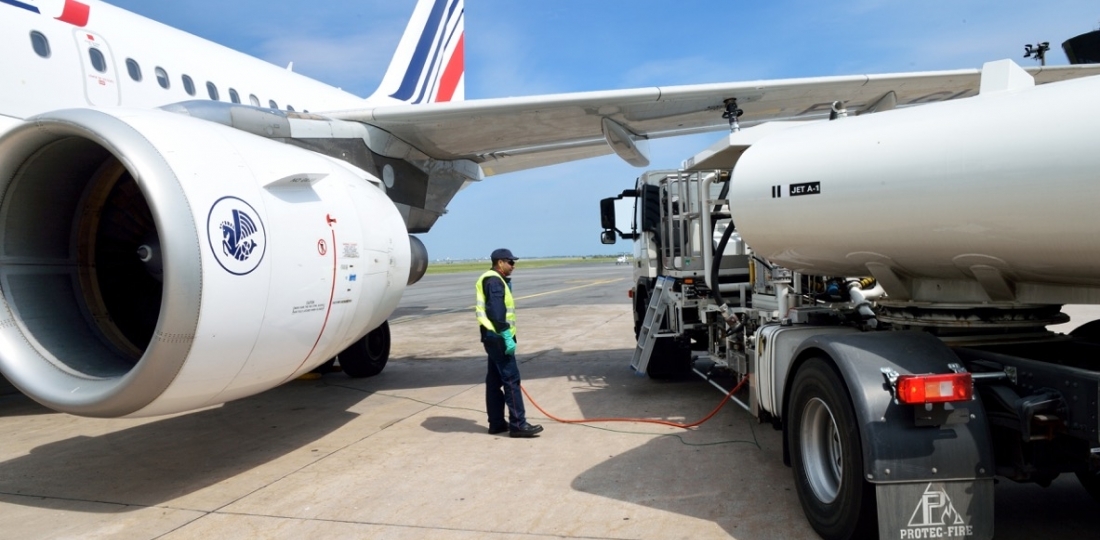
Biofuels for aviation continue to face multiple challenges, the most daunting of which centers on ways to make production economical, according to a recent report jointly released by the French Académie des Technologies and Académie de l'Air et de l'Espace. The experts admit the environmental benefit, although proven in principle, is difficult to quantify. They consider hydrotreated esters and fatty acids (HEFA) made from vegetable oil the only option immediately available.
A biofuel intrinsically costs more to make than a fossil fuel, due to the expense associated with renewal costs, or the growth of the plant. Consequently, a biofuel for aviation costs more than its road transportation counterpart, the report notes. Technical requirements, such as the need to eliminate oxygen, are more stringent. Biojet fuel costs at least 30 percent more to produce than conventional fuel, French energy research center IFP-ENestimates, and the final price will total at least twice that of conventional kerosene.
Recurring cost presents only one problem. Should biofuels cover all of air transport’s needs, the investment in production facilities would require hundreds of billion dollars, the report continues. More realistically, biofuels would cover just a few percent of midterm needs. The European Union, for instance, has set a goal of 3.5 percent of the total aviation fuel consumption on the continent in 2020, or two million metric tons. The experts called the goal unachievable.
The main point behind the use of biofuels centers on a desire to cut greenhouse gas (GHG) emissions. Measuring precisely how much gets cut, however, has proved difficult. “It is a bit early to evaluate the gain from field to wing,” said Bruno Jarry, one of the authors and a specialist in biotechnology. Depending on the path,GHG emission savings fall in the 60- to 90-percent range, according to IFP-EN expert Alain Quignard.
The HEFA path resides in the 60-percent class but authorities in the field consider it “mature, industrially proven…and having a strong synergy with developing vegetable oil resources.” Therefore, said the report, current research appears unlikely to develop another path until 2020. The biomass-to-liquid path uses the Fischer-Tropsch process, historically well known in aviation, but suffers from the need to organize the collection of its raw material—essentially waste from forestry activities. It nevertheless retains a strong potential for high-volume production and GHG reduction.
Cirrus Aircraft is celebrating the 10th anniversary of its Collier Trophy-winning Vision Jet at NBAA-BACE 2026, marking a decade of innovation that has continuously advanced the world&r...
In business aviation, exceptional service is defined by attention to detail, and few amenities reflect that more clearly than premium catering. At the intersection of hospitality and private aviation,...
Piaggio Aerospace will return to NBAA-BACE this October, bringing its flagship P.180 Avanti EVO to one of the most important gatherings of the global business aviation community while also highlightin...
Aviation Capital Group, the Newport Beach, California-based global aircraft asset manager, has signed a firm order for 75 additional Airbus A320neo Family aircraft, bringing its cumulative orders for...

