



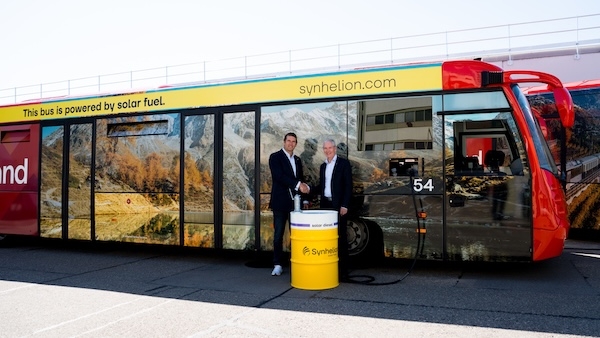
Synhelion and Zurich Airport have reached another milestone on the road to more sustainable transportation solutions: for the first time, a passenger bus at Zurich Airport has been fueled with solar diesel from Synhelion’s DAWN plant. The fuel is fully compatible with existing engines and infrastructure. Synhelion has thus proven that the technology is ready for deployment and the next phase of scaling.
Just in time for the start of the fall vacation – one of the busiest travel periods at Zurich Airport – the passenger bus powered by solar diesel will be operating in regular service. The bus was fueled with a 190-liter barrel of a solar diesel blend, which is sufficient for around twelve days of operation. This application of solar fuel marks another step toward defossilizing the transportation sector and demonstrates that Synhelion’s technology works under real-world conditions. Its compatibility with existing engines makes solar fuel an immediately deployable solution for more sustainable mobility.
Philipp Furler, Co-CEO and Co-Founder of Synhelion commented: “The successful operation of a passenger bus with solar diesel shows that our technology is easy to implement seamlessly. We are proud to have Zurich Airport Ltd. as a long-term partner and customer by our side. Collaborations like this give us momentum for the next steps in scaling up.”
Emanuel Fleuti, Vice President Sustainability at Zurich Airport Ltd., added, “We are delighted to be the first airport in the world to operate a passenger bus powered by solar diesel. Even though it’s just one bus today, this step clearly demonstrates the potential of this technology. In the long term, synthetic diesel will enable us to operate even those vehicles that cannot be electrified in a CO2-neutral manner. Together with Synhelion, we are doing truly pioneering work here for a sustainable future.”

The renewable synthetic fuel comes from Synhelion’s industrial demonstration plant, DAWN, in Jülich, Germany. There, Synhelion uses solar heat to convert biogas, CO2, and water into syngas through a thermochemical process – the basis for the production of renewable liquid fuels. This syngas is then refined into renewable kerosene, diesel, and gasoline. Unlike fossil fuels, Synhelion’s solar fuels are nearly CO2-neutral: when burned, they release only as much CO2 as was used in their production. This makes them an immediately usable solution to defossilize transportation – without the need for modifications to existing engines or fuel infrastructure.
Zurich Airport recognized the potential of solar fuels early on and has been supporting Synhelion in scaling its technology since 2020. In addition to decarbonizing buildings and infrastructure, the airport’s net-zero strategy for 2040 focuses primarily on electrifying its vehicle fleet. However, certain special-purpose vehicles, such as those used in winter operations, cannot be electrified due to insufficient battery performance. Synhelion’s solar fuel is to be utilized for these special vehicles. With the successful first use of solar fuel in a passenger bus, Synhelion and Zurich Airport are jointly proving that using solar fuel is not only possible but also straightforward and scalable.
Velocity Maintenance Solutions, an FAA-certified provider of maintenance, repair and overhaul services, has announced a significant expansion of its facilities at Wilmington Airport (ILG) in Delaware,...
Viasat has significantly expanded the capacity of its JetXP in-flight connectivity service across the United States, delivering up to five times more bandwidth for business aviation customers equipped...
Samson Sky has enlisted renowned Italian automotive designer Luigi Memola to develop the interior design of its Switchblade Flying Car, bringing world-class automotive styling expertise to the roadabl...
Gogo has unveiled its long-term vision for the Galileo connectivity platform at NBAA-BACE 2026, outlining a roadmap designed to enhance and protect customer investments well into the mid-2030s and bey...

