



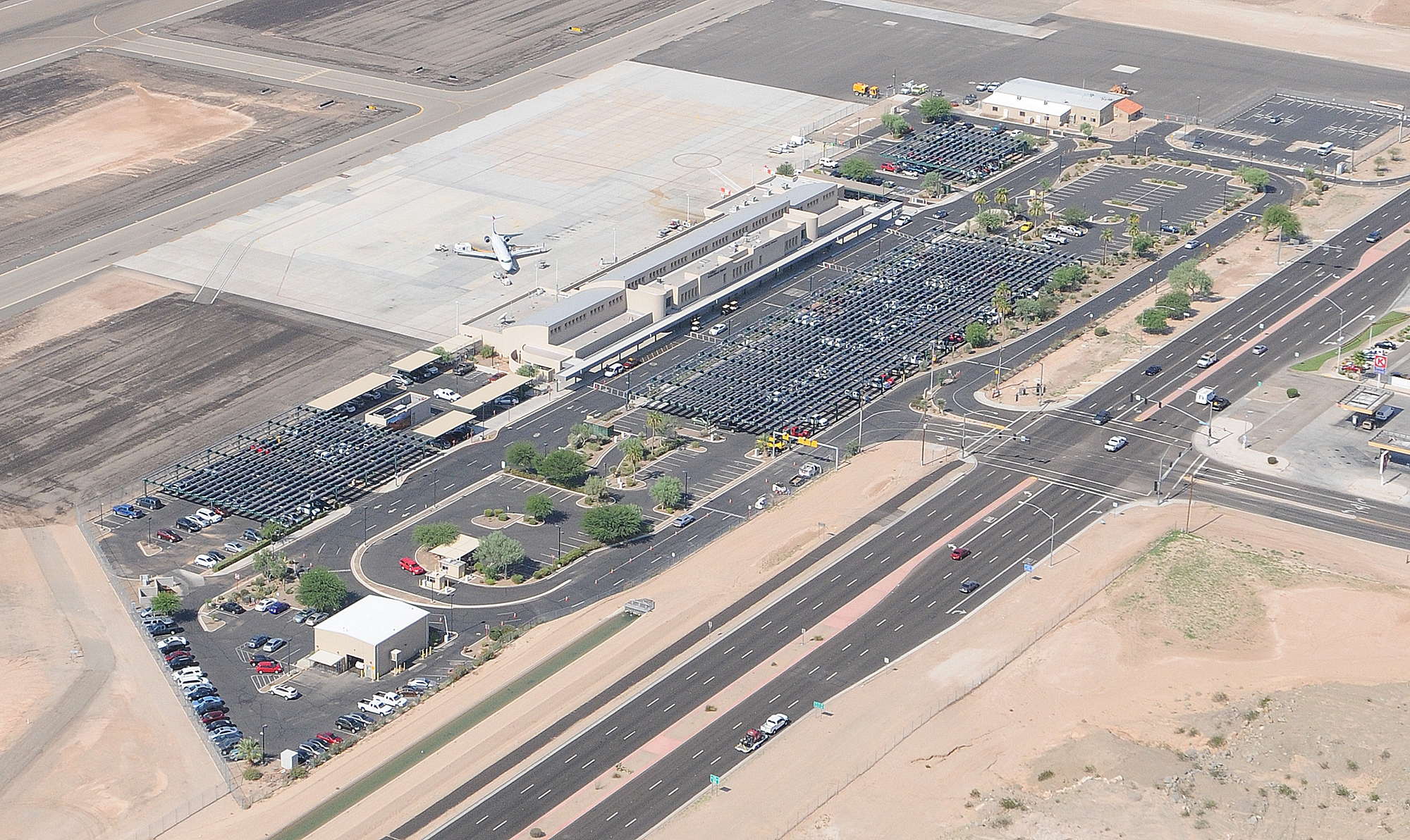
Yuma’s rich aviation history began when aviation pioneer Robert Fowler landed in Yuma on Oct. 25, 1911, near South 4th Avenue in pursuit of a $50,000 prize to be the first aviator to fly across the U.S. from coast to coast in 30 days or less. Four days after he landed in Yuma, Fowler made aviation history by being the first person to fly west to east across the U.S.
Robert Fowler’s historical landing sparked the Yuma community’s interest in aviation, and in 1925 the Yuma Chamber of Commerce went to work to secure land from the federal government for an airport in Yuma. President Calvin Coolidge signed the Yuma Aviation Bill on Feb. 27, 1928. The land was officially designated as an active airport and named Fly Field after Col. Ben Franklin Fly.
Almost immediately, the Chamber’s aviation committee started lining up activities for the airport. Yuma was selected to be a night stop for three transcontinental air races from New York to Los Angeles, and an international air race from Mexico to Los Angeles. In 1929, Yuma was the second stop for the Women’s Transcontinental Air Race. Amelia Earhart hit a dozer at the end of the runway when she went to take off and had to repair her Vega airplane with a new propeller.
Fly Field experienced a downturn during the depression; but in the late 1930s it became clear that the United States War Department needed facilities to train combat pilots and crews. In 1939, the Yuma County Board of Supervisors recommended Fly Field as a base for the Army Air Corps, thus the beginning of Yuma’s rich history in military aviation.
Mr. E.N. Sturdivant of Somerton had been a flight instructor for the Army for nearly three years, and on Aug. 18, 1945, announced to the Yuma Daily Sun that he would open and manage a new airport east of Somerton. Mr. Sturdivant became an aircraft dealer for Piper and Fairfield aircraft, and became a flight instructor, opening Sturdy’s Flying School. He earned a contract from the Veteran’s Administration for flight training, where hundreds of veterans earned their pilot’s license.
In 1946, a number of airports began flight training schools to take advantage of training pilots under the GI Bill in Yuma. Marsh Aviation built an airport east of the railroad tracks near downtown Yuma, and Larry Spain and Archie Mellon started crop-dusting services at the Yuma Air Park located south of 4th Avenue. Larry Spain eventually made his way to the Yuma County Airport where he opened Bet-Ko Air and began to offer a variety of aviation services.
With Yuma’s faltering economy in 1949, the Yuma County Chamber of Commerce decided something needed to be done to attract attention to the region and improve the situation. Volunteers responded with sheer determination and pure tenacity in one of the greatest and most successful promotions ever conducted in Arizona – the infamous Endurance Flight.
Local pilots Bob Woodhouse and Woody Jongeward volunteered to fly a 1948 Aeronca Sedan, named the City of Yuma, with the intent to break the record of 1,008 continuous hours in the air, in turn highlighting the region’s weather as being very conducive to flying. Their mission was to encourage the military back to Yuma. They flew from Aug. 24 to Oct. 10, managing to break the record and surpass it by 116 hours, thus setting the new record of 1,124 hours.
This event, which involved over 600 volunteers, not only succeeded in setting a new record but also received publicity all over the world. A book entitled “The Longest Flight, Yuma’s Quest for the Future,” written by Shirley Woodhouse Murdock, Bob Woodhouse’s daughter, and co-authored by James A. Gillaspie, documents this great adventure.
On Jan. 1, 1954, the United States Air Force Air Defense Command decided that they should have their own rocket-firing interceptor training base, and reactivated Yuma County Airport which became the home of the 4750th Training Wing (Air Defense). The first squadron arrived at Yuma on Feb. 1, 1954 for the two week Rocketry Proficiency Program which included ‘live-fire’ exercises over the Williams SFB and Luke AFB gunnery ranges. A total of 18 squadrons rotated through the Yuma program by the end of the year.
In August 1954, the airfield was named Yuma Air Base, but was renamed Vincent Air Force Base in 1956 for Brigadier General Clinton D. “Casey” Vincent, a pioneer of bombing techniques. On January 1, 1959, the Army Air Force signed Fly Field to the Navy, and nine days later, Col. L.K. Davis became the first commanding officer of the newly designated Marine Corps Auxiliary Air Station. On July 20, 1962, the designation was changed to Marine Corps Air Station.
Aviation Capital Group, the Newport Beach, California-based global aircraft asset manager, has signed a firm order for 75 additional Airbus A320neo Family aircraft, bringing its cumulative orders for...
Bombardier marked the 40th anniversary of its industry-leading Smart Services cost-per-flight-hour programs, which today support more than 1,500 enrolled aircraft and account for over 11 mil...
Bristow Group Inc., in partnership with Electra, Avinor and the Norwegian Civil Aviation Authority (CAA Norway), will undertake a series of demonstration flights across five locations in Norway using...
Turkish Airlines has taken another major step in its fleet expansion strategy with the signing of a Memorandum of Understanding with CFM International for more than 300 LEAP-1B engines and a long-term...

