



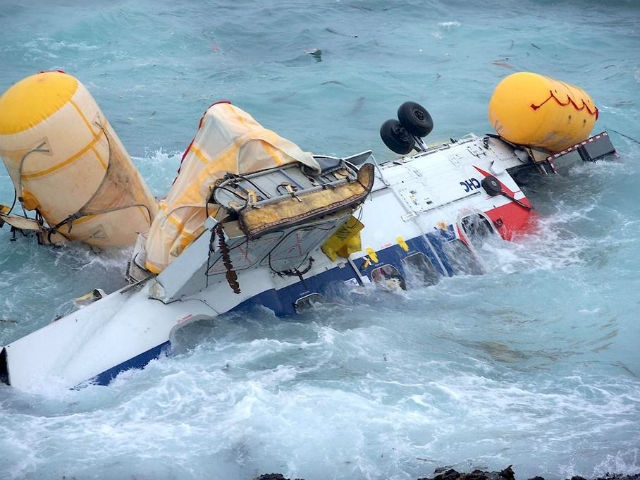
UK safety investigators have called for a raft of new Europe-wide regulations to be introduced covering the operation of offshore transportation helicopters in the wake of a fatal accident off the north coast of Scotland.
The recommendations are contained in the UK Air Accidents Investigation Branch’s final report into the 23 August 2013 crash of a CHC Scotia-operated Airbus Helicopters AS332 L2 (G-WNSB) which came down on approach to Sumburgh airport, Shetland. Four of the 16 passengers on board died in the incident after the helicopter hit the sea and then inverted.
Investigators determined the accident was caused by a failure by the pilot in command to monitor the Super Puma’s airspeed as it performed a non-precision instrument approach to Sumburgh in “marginal” weather conditions.
Meteorological data for Sumburgh at the time indicated broken cloud at 300ft, with 2,800m visibility.
The approach was performed with the helicopter's four-axis autopilot controlling only three axes.The pilot retained authority over the helicopter’s airspeed through inputs with the collective lever.
The airspeed was allowed to decay to less than 35kt (68km/h) at 230ft before any corrective action was taken, says the AAIB, by which time the helicopter was descending at 1,000ft/min – rising to 1,800ft/min while at 100ft – and in an unrecoverable state.
“The helicopter’s flight instruments were not monitored effectively during the latter stages of the non-precision instrument approach. This allowed the helicopter to enter a critically low energy state, from which recovery was not possible,” it says.
It suggests the AS332 had entered “vortex ring state” where the helicopter descends through its own downwash, causing the rotor blades to stall unpredictably.
This cut the available lift by about 30-45% in the final 8s before impact, according to calculations from manufacturer Airbus Helicopters.
The AAIB found CHC’s standard operating procedure for non-precision instrument approaches “were not clearly defined” and the flightcrew “had not developed a shared, unambiguous understanding of how the approach was to be flown,” it says.
It is now calling for European Aviation Safety Agency action on a number of issues, including the mandatory installation of a helicopter terrain awareness warning system on all transport rotorcraft of 3,175kg maximum take-off weight and above, or those with capacity for nine passengers and upwards. This would apply to all helicopters made before 31 December 2018.
The AAIB also calls for all transport helicopters equipped with cockpit voice and flight data recorders to be fitted with cockpit and cabin image recorders.
The body also recommends EASA’s certification specifications for rotorcraft in the small and large categories – CS-27 and CS-29, respectively – “require the installation of systems for the automatic arming and activation of flotation equipment”. Side floats also need to be added, it says.
Both changes should “be applied retrospectively to helicopters currently used in offshore operations”.
The AAIB also calls for modifications to the way flightcrew are trained, recommending a requirement is introduced for instrument-rated pilots to “receive initial and recurrent training in instrument scan techniques” specific to the type of aircraft operated.
EASA must review the training around scan techniques, it says, particularly related to glass cockpit displays “with a view to addressing shortcomings identified” in current levels of instruction.
Greater oversight by the UK Civil Aviation Authority of offshore operators’ standard operating procedures and their compliance with them is also required, it says.
Airbus 2026 Cargo Global Market Forecast, unveiled at the Cargo Facts Symposium, predicts that the global fleet of dedicated freighter aircraft will expand by 46%, rising from 2,360 aircraft in 2026 t...
A Discover Airlines Airbus A330 has become the first Airbus aircraft worldwide to enter regular commercial service after undergoing a full-scale AeroSHARK retrofit, marking a signi...
In business aviation, exceptional service is defined by attention to detail, and few amenities reflect that more clearly than premium catering. At the intersection of hospitality and private aviation,...
Few infrastructure projects have the potential to reshape an island's future quite like the ongoing transformation of Nevis Airport. To gain deeper insight into this ambitious development and the...

