



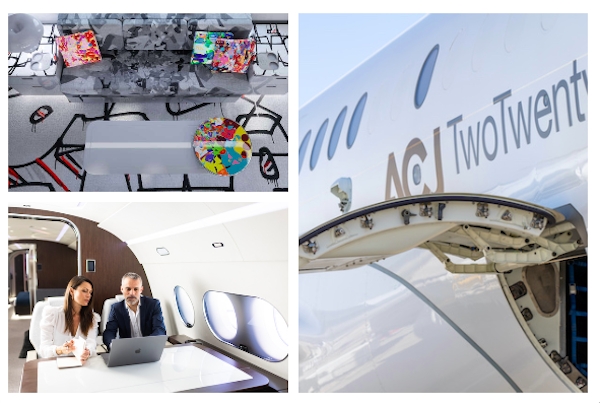
If we talk about senior executives from large U.S. businesses whose companies own or lease business jets, what are key reasons for a company to upgrade its current business aircraft? According to a new survey commissioned by Airbus Corporate Jets, answers are quite evident - greater fuel efficiency, better onboard technology and lower operational costs. Analysis of industry reveals the average age of business aircraft in the U.S. is 18.5 years. In 11 states, the average age is 20 years or more. Newer aircraft would offer better fuel efficiency, advanced technology and lower operational costs.
Sean McGeough, VP Commercial ACJ for North America commented: “Our analysis shows that a significant number of business aircraft in the U.S. are older, and many of their owners will be looking to replace them with newer, more efficient models. The level of innovation and development in the larger business aircraft segment has been staggering, and this bodes well for this market.”
In another survey3 of U.S.-based business aviation financiers and brokers, 85% said they expect to see purchases of large, heavy business jets increase over the next five years. Nearly all of those interviewed (99%) said that demand for large and midsize jets is increasing at a faster rate than other categories due to their range and capacity. They also said manufacturers are driving interest in these categories with the introduction of new models, further improving the sector’s appeal.
ACJ analysis shows that there are around 1,021 business aircraft for sale in the U.S., and 96 of these are large, long-range jets. ACJ offers a range of large business aircraft. The recently launched ACJ TwoTwenty is carving out a whole new market segment – ‘The Xtra Large Bizjet.’ The ACJ TwoTwenty offers twice the cabin real estate compared to similarly priced ULR business jets with market-leading fuel efficiency and unrivaled reliability. It occupies the same parking footprint as competitive ULR jets and can take off from the same airports, but the ACJ TwoTwenty operating costs are one-third less.
With a range of up to 5,650 nm (more than 12 flight hours), the ACJ TwoTwenty can meet the requirements of 99.9% of all U.S. departures,4 connecting city pairs including Los Angeles to London, Miami to Buenos Aires, and New York to Istanbul. As with all ACJ aircraft, the ACJ TwoTwenty is capable of flying with up to a 50% blend of kerosene and sustainable aviation fuel (SAF) while keeping to the technical specifications of Jet A. All Airbus commercial aircraft and helicopters will be capable of operating with 100% SAF by 2030. This capability will play an important role in the sector’s decarbonization journey. Over 200 Airbus corporate jets are in service worldwide, flying on every continent.


AMAC Aerospace Group continues to experience strong business momentum, marked by new certifications, contract wins and rising demand across its maintenance, completion and aircraft modification activi...
In business aviation, exceptional service is defined by attention to detail, and few amenities reflect that more clearly than premium catering. At the intersection of hospitality and private aviation,...
A Discover Airlines Airbus A330 has become the first Airbus aircraft worldwide to enter regular commercial service after undergoing a full-scale AeroSHARK retrofit, marking a signi...
Daher Aircraft announced the delivery of a Kodiak 900 to Swiss owners Roland and Claudia Primus, who plan to use the aircraft for adventure flying to remote and short-runway destinations. Their travel...

