



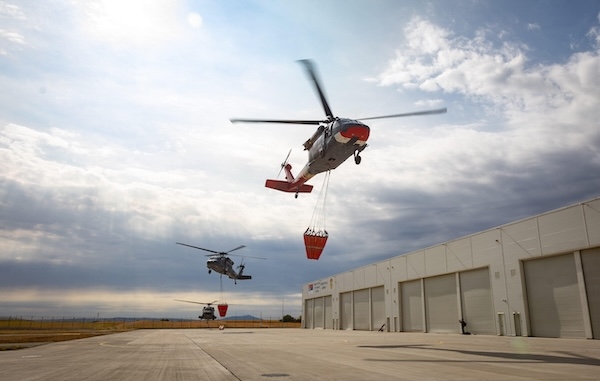
UH-60 Black Hawk helicopters operated by Helicopter Alliance played a vital role in combating wildfires across Central and Southern Europe during the aerial firefighting season that has now concluded. Operating under framework agreements with the Fire Rescue Service of the Czech Republic and the Fire and Rescue Corps of the Slovak Republic, the company provided aerial firefighting support from June through September. In addition to domestic missions in the Czech Republic and Slovakia, the helicopters were deployed internationally through the European Union’s rescEU programme, supporting wildfire response efforts in France and Serbia.
Throughout the season, Helicopter Alliance’s Black Hawk fleet carried out 1,993 water drops, delivering nearly six million litres of water to wildfire areas and demonstrating the aircraft’s effectiveness in protecting communities and critical infrastructure.
Among the most notable operations were two separate deployments to France, which underscored both the severity of the wildfire situation and the strategic value of rescEU resources. In a rare occurrence, France requested assistance from Helicopter Alliance’s Black Hawk helicopters twice within a matter of weeks through the Czech Republic’s rescEU capacity. The requests came as the country faced an extraordinary combination of prolonged drought, extreme heat and widespread wildfires. According to Météo-France, 2026 recorded the largest area affected by wildfires since records began, placing unprecedented pressure on national firefighting resources and prompting international support.
Two Missions to France, 670 Water Drops
France was the destination of Helicopter Alliance’s most demanding international deployments of the 2026 firefighting season. The first mission began on 10 July, when a UH-60 Black Hawk helicopter departed the Czech Republic for France, followed by a second aircraft two days later. Operating initially from the town of Die in the Drôme region, the crews were tasked with supporting firefighting efforts across some of the country’s most challenging wildfire zones.
The helicopters first responded to fires near Valence and in the mountainous Diois area, where steep slopes, rocky terrain and limited accessibility complicated ground operations. In many locations, fire crews were unable to reach the affected areas quickly, making aerial support a critical element of the response.
As wildfire activity expanded, the two Black Hawks were redeployed to the Pyrenees, where they continued working alongside French emergency services. Operating as a coordinated team, the helicopters delivered repeated high-volume water drops, helping to contain and suppress fires in difficult-to-access terrain. Over the course of the French deployments, Helicopter Alliance crews carried out 670 water drops, providing essential aerial firefighting support during one of the country’s most severe wildfire seasons on record.
Helicopter Alliance CEO Aleš Kvídera commented: “This year’s season was the most demanding we have experienced so far. Behind those nearly two thousand drops were crews flying in difficult conditions, in the mountains and in strong winds, often for several consecutive days, as well as technicians preparing the aircraft so they could take off again the following day. I am proud of the whole team. They demonstrated that the Black Hawk is an exceptionally reliable aircraft for aerial firefighting and that we can deploy it quickly wherever it is needed. We also greatly value the professional cooperation with firefighters in the Czech Republic, Slovakia and on international missions."
Second French Ddployment and major mission to Serbia
Just days after the conclusion of the first French deployment, Helicopter Alliance was called upon once again. On 24 July, a UH-60 Black Hawk was redeployed from the Czech Republic to support wildfire suppression efforts in France, highlighting the severity of the situation and the continued demand for aerial firefighting resources.
The helicopter was assigned to the Gironde department, where a major wildfire near the village of Saumos was rapidly advancing towards Le Porge and the Lège-Cap-Ferret peninsula. The blaze affected a vast area, forcing the evacuation of residents and holidaymakers and becoming one of France’s most significant wildfire events in recent decades. During the operation, the Black Hawk played a crucial role in protecting populated areas and supporting ground crews working to contain the fire.
Following the stabilisation of the situation in Gironde, the Czech module was redeployed on 28 July to the Var department in southeastern France. Operating from Le Luc-Le Cannet Air Base, the aircraft joined another Helicopter Alliance UH-60 Black Hawk that had been deployed from Slovakia. Flight crews faced particularly challenging conditions, including extreme temperatures, shifting winds and the rapid emergence of new fire outbreaks across the region. On 1 August alone, the Czech-operated helicopter completed 49 water drops. The mission concluded on 4 August after nine days of operations, during which the aircraft carried out a total of 263 water drops.
Combined, the two French deployments saw Helicopter Alliance helicopters operating within the Czech rescEU modules perform 670 water drops. The repeated mobilisation of Czech aerial firefighting assets to assist the same country within a matter of weeks was exceptional, reflecting both the intensity of the wildfire season and the operational flexibility required to reposition aircraft rapidly between France’s most affected regions.
International cooperation in Serbia
Another significant international deployment followed in August, when Serbia requested assistance to combat large wildfires in the Deliblatska Peščara protected area of Vojvodina. On 22 August, two Czech rescEU modules equipped with UH-60 Black Hawk helicopters departed for the mission, joining an extensive multinational firefighting effort.
Operations were conducted under particularly demanding conditions, with high temperatures, prolonged dry weather, strong winds and difficult sandy terrain complicating access for ground crews. The deployment brought together three Helicopter Alliance Black Hawks operating from the Czech Republic and Slovakia, alongside a fourth aircraft provided by Romania.
The joint operation enabled substantial aerial firefighting capacity to be concentrated over a single, extensive fire area, demonstrating the effectiveness of international cooperation and the Black Hawk’s ability to operate as part of a coordinated, multi-helicopter firefighting force. The mission further reinforced the aircraft’s growing role as a key aerial asset within Europe’s collective wildfire response framework.
Intensive operations in Czechia and Slovakia
The substantial international deployments did not reduce Helicopter Alliance’s readiness to respond to fires in Czechia and Slovakia. This was clearly demonstrated on 4 August, when one of the Czech Black Hawks was returning from the second deployment in France together with the Slovak aircraft, while another Helicopter Alliance Black Hawk remained ready to respond in Czechia. At that time, aerial resources were being deployed, among other operations, to a major forest fire near Křečovice in the Benešov district and a fire at the SONO landfill in Čížkovice in the Litoměřice district.
In Slovakia, a UH-60 Black Hawk belonging to Helicopter Alliance was also repeatedly called out by Slovak firefighters during August to fight major fires in difficult-to-access terrain. It first assisted at a fire in the Súľov Rocks before moving directly to the High Tatras, where it operated near Popradské pleso lake. During this operation alone, it carried out more than 21 water drops. Further deployments followed in the Záhorie District and near Trstín in the Trnava district, where a fire affected approximately 130 hectares of forest and grassland. The helicopter collected water from the Buková reservoir and delivered it directly to the fire site.
Nearly 2,000 water drops and 489 flight hours
The overall figures best illustrate the scale of this year’s season. From June to September, helicopters operated by Helicopter Alliance carried out a total of 1,993 water drops and logged 489 hours of aerial firefighting. In doing so, they delivered nearly six million litres of water to fire sites. To put that into perspective, this is equivalent to approximately 1,500 standard firefighting tanker trucks, each with a tank capacity of 4,000 litres.
Helicopter Alliance – the 2026 firefighting season in numbers:
- 1,993 water drops,
- nearly 6 million litres of water delivered to fire sites,
- 489 flight hours during aerial firefighting,
- operations in the Czech Republic, Slovakia, France and Serbia,
- 670 water drops during two missions by Czech modules in France.


A Discover Airlines Airbus A330 has become the first Airbus aircraft worldwide to enter regular commercial service after undergoing a full-scale AeroSHARK retrofit, marking a signi...
Daher Aircraft announced the delivery of a Kodiak 900 to Swiss owners Roland and Claudia Primus, who plan to use the aircraft for adventure flying to remote and short-runway destinations. Their travel...
AMAC Aerospace Group continues to experience strong business momentum, marked by new certifications, contract wins and rising demand across its maintenance, completion and aircraft modification activi...
Private jet catering requires an understanding of the journey as much as the passengers' preferences. SkyDine Jet Catering explores how flight duration, departure schedules, airport location, and...

