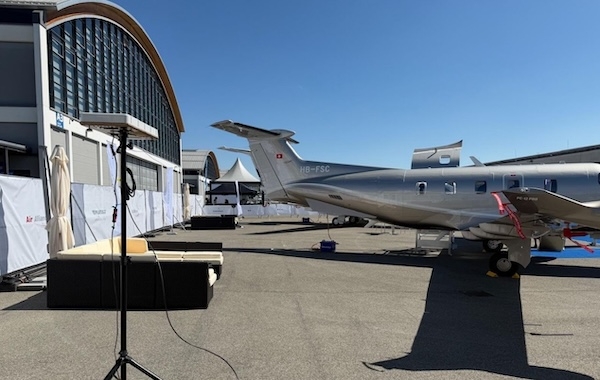
The debut of Gogo team at AERO Friedrichshafen was the perfect moment not only to share news regarding growing Gogo Galileo portfolio, but also just discuss with the team their first impressions of the show and get fresh feedback from customers during the event. Main point highlighted at AERO 2026 is that now Gogo now brings high-speed, reliable and low-latency inflight connectivity to a broader range of aircraft – including light jets and turboprops,that previously had limited or no viable high performance connectivity options.Gogo is also reinforcing its commitment to cybersecurity and customer privacy at a time when regulatory requirements are evolving including in Europe which is seeing a major shift. Victor Andrès and Laura Guillaume, both Business Development Manager Europe welcomed me at the static display. I am pleased to share the essential of our discussion:
T.O.: Impressions of AERO 2026, positive, neutral and what to improve?
V.A. & L.G.: This was Gogo’s third year attending AERO Friedrichshafen, and its first year exhibiting, a decision made based on the airshow’s increasing popularity amongst the business aviation community. We really liked it. It’s a show at which we find people are more relaxed and at which we can have longer meetings with clients and potential clients. Although traditionally a general aviation show, the business aviation portion has grown enough that a high percentage of our customers and potential customers are here, so it’s a great opportunity for an in-person touchpoint.
At any show, there are things to improve, and we think that if the organizers listen, this will happen. We were in the DOME, which we had great and constant foot traffic, but was too hot. We also recognize there will be things to iron out in future years if the business aviation portion of the show grows, such as taxis and hotels, but already the show organizers came to us to inform us that they were going to help with hotel bookings next year, which is a good sign.
T.O.: Did you achieve goals you had for the event?
V.A. & L.G.: We did achieve our goals. Gogo has been coming to AERO Friedrichshafen for the past three years because it’s a great place with a relaxed atmosphere to meet our clients and potential clients in person. We don’t really expect to meet new potential clients here – we already know our potential clients in Europe. However, that opportunity to see each other in person and have time to talk is important for us.
In addition, we demonstrated the speed and performance of the Gogo Galileo system with the HDX antenna this year on the static, and that was a great way to show potential customers its high speed, low latency performance – able to achieve 60 Mbps. This is big news in business aviation connectivity because the Gogo Galileo can be installed on all airframes, from light aircraft, such as the Pilatus PC-12 and 24, Cessna Citations and Embraer Phenom 300s, to executive airliners. The light airframes didn’t have high speed connectivity solutions before and were stuck with speeds of 200 Kbps – just enough to send a text or email or two. Now a group of 10 can stream, hold online meetings, game, write emails – do everything they do on the ground but in the air.
T.O.: What would you say as 3 main points of potential customer’s feedback?

T.O.: How would you describe connectivity trends changing within the industry?
V.A. & L.G.: First, the trend to get high speed connectivity on increasingly smaller airframes, as users for business aviation need high performance, reliable connectivity whether on the ground or in the air. Second, as customers increasingly prioritize connectivity on business jets, the ability to create redundancy with our multi-orbit solutions is interesting to them. Gogo is actually the only connectivity provider that offers solutions for a variety of orbits: we have the Gogo Galileo that uses low earth orbit (LEO) satellites, the Plane Simple antennas that use geostationary earth orbit (GEO) satellites, and in the U.S., we have an air-to-ground (ATG) network. Each orbit has its strengths and weaknesses and using them together on an aircraft ensure consistent, reliable coverage no matter where the aircraft flies in the world. Third, the ability to push software updates remotely, like you do on your computer or iPhone, makes the system what Gogo calls “future-proof”. It means that the systems are almost maintenance free.
T.O.: How do you help clients who wants to improve connectivity without having a precise idea of how and what?
V.A. & L.G.: At Gogo, we have several solutions, as described above. Our goal is to make our customers happy and satisfied with our solutions. We therefore sit down with them and ask them what their mission profile is. From there, we help them select which Gogo system would best suit their needs.
Archived
5 months ago

A new travel industry coalition is urging EU policymakers to adopt a balanced and proportionate approach to biometric travel, ensuring passengers can benefit from secure and seamless journeys while ma...
Rising production rates and the launch of new aircraft programs are driving increased demand for manufacturing capacity across the aerospace industry. To support this growth, FACC plans to i...
British Airways has unveiled the next phase of its Heathrow lounge transformation programme, marking the beginning of a significant investment aimed at modernising every lounge across the airport in t...
Tecnam introduces the P2008JC NG to the United States market, bringing flight schools a certified, next-generation training aircraft designed to dramatically reduce operating costs while maximizing fl...