



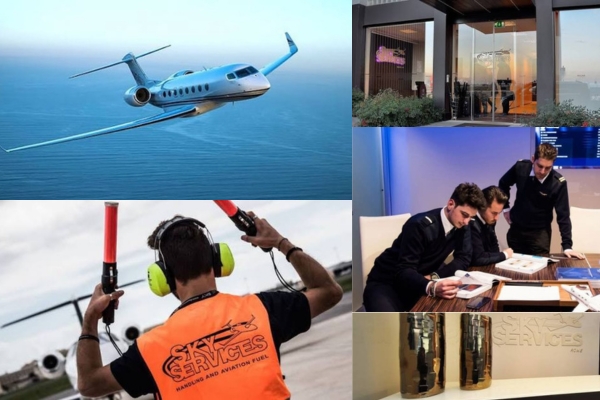
Italy is often associated with luxury, fashion, the art of living, and, of course, all services related to the business aviation industry. I had the opportunity to discover more and discuss with the Italian market leader, SKY Services Group. Important points to remember- over 20 years of experience, full range of luxury services. Whati s important, the company is privately-owned. For clients and partners it means that decisions withing the company can be taken quickly, adapting to market conditions if needed. I am pleased to share with you this detailed profile of the company—it is truly fascinating and highly informative.
T.O: The company has four business units within the group: FBO, chartering & management, MRO, and a flight school. Can you tell us if each division is growing at the same pace, or if there are some “standout performers” ?
S.G. : Today, SKY Group is a fully integrated general and business aviation operator, built around four core business units—FBO, Charter & Aircraft Management, MRO, and Flight Academy—supported by a range of high value-added services including Ground Support & Flight Permits, Aviation Fuel Services, Sky Cuisine, CAMO, Aerospace Research & Development, and Aviation Consultancy. Rather than operating as separate divisions, these businesses form a fully integrated aviation ecosystem.
Our FBO division remains the historical cornerstone of the Group. It was through this business that SKY entered the Italian market following the liberalisation of airport handling services in 1999. Today, it continues to experience steady growth, driven by the increasing demand for premium ground handling services and the continued expansion of the business aviation sector. At the same time, we are strengthening our international presence by developing strategic partnerships and progressively expanding our operational network beyond Italy.
Our Charter & Aircraft Management division is also experiencing significant growth, fuelled by increasing demand for tailor-made aircraft management and charter solutions. Meanwhile, our MRO business, although established more recently, represents one of the Group’s most promising growth areas. By integrating maintenance, Continuing Airworthiness Management (CAMO), and operational support, we are able to provide customers with a comprehensive solution covering the entire lifecycle of their aircraft.
The Flight Academy probably represents the business unit with the greatest long-term growth potential. The worldwide shortage of qualified aviation professionals has transformed training into a strategic industry. For this reason, SKY is developing one of Southern Italy’s largest aerospace training centres at Capua Airport, a project also supported by the Campania Regional Government. Our objective is to establish a centre of excellence dedicated not only to training professional pilots, but also aircraft maintenance engineers, aviation specialists, and highly qualified professionals for the entire aviation and aerospace sectors.
Another key differentiating factor is our growing commitment to Aerospace Research & Development, which has become an increasingly important pillar of our strategy. Over the years, SKY has successfully delivered numerous research and innovation projects in collaboration with prestigious partners such as the Italian National Research Council (CNR), Thales Alenia Space, the Italian National Institute for Astrophysics (INAF), as well as several leading Italian and international universities. These partnerships enable us to transfer cutting-edge technologies and scientific expertise into operational applications, contributing to innovation across both the aviation and space industries.
All of this is supported by one of the most comprehensive EASA certification platforms in the industry, including AOC, SPO, ATO, CAMO and Part-145 approvals, allowing us to seamlessly integrate operational services, maintenance, training and research within a single industrial group.
Our strategy is not focused on prioritising one business unit over another. Instead, we aim to develop each area in a balanced manner, leveraging the synergies between training, airport services, aircraft management, maintenance, research and technological innovation. This integrated approach represents SKY’s greatest competitive advantage and enables us to position ourselves as a trusted aviation partner not only throughout Italy, but increasingly across international markets.
T.O. :.Among the 10 FBOs in Italy, are there significant differences in activity or passenger demographics? What are the trends for 2025 and this year?
S.G.: Each of our FBOs has its own distinctive characteristics, closely linked to its geographical location and the type of clientele it serves. Our facilities at Milan Linate and Rome Ciampino are the Group’s primary business aviation hubs, serving a large number of corporate executives, entrepreneurs, multinational companies, government operators and institutional flights. Other locations, such as Naples Capodichino, experience a strong seasonal demand driven by leisure traffic to destinations such as Capri, the Amalfi Coast and Southern Italy, while airports such as Venice and Rome benefit from a balanced mix of corporate and high-end leisure traffic.
As a result, our customer profile varies considerably, ranging from corporate executives and business leaders to government officials, Heads of State, members of Royal Families, VIPs and international travellers who expect the highest standards of service quality.
In this environment, SKY Services has established itself as one of Italy’s leading business aviation operators and is widely recognised for its ability to manage highly sensitive and complex missions. Over the years we have successfully supported numerous high-profile governmental and institutional operations, including flights involving several Royal Families, requiring exceptional standards of security, confidentiality, operational coordination and close cooperation with civil, military and diplomatic authorities. This level of expertise has become one of the defining characteristics of our Group.
From a market perspective, 2025 confirmed the strong growth trend observed in recent years, while 2026 is delivering further expansion. Business aviation continues to benefit from increasing demand for flexibility, time efficiency, privacy and highly personalised services. At the same time, we are witnessing growing demand for value-added services such as dedicated customer assistance, concierge services, premium catering, integrated aircraft management and worldwide operational support, reflecting the industry’s continuous evolution towards ever higher standards of excellence.

T.O.:.Speaking of your chartering and management business, could you share with us the current trends in charter flights and aircraft selection? Have you noticed any changes in customer behavior? Perhaps a preference for sleeker, more sustainable aircraft?
S.G.: The Charter & Aircraft Management market continues to experience strong and sustained growth, driven by clients who increasingly view business aviation not simply as a luxury, but as a strategic tool for improving efficiency, productivity and connectivity. Today’s customers are looking above all for flexibility, rapid decision-making, complete confidentiality and a fully bespoke travel experience. Last-minute bookings have become increasingly common, requiring operators capable of responding immediately while flawlessly coordinating even the most complex missions, including multi-leg international itineraries and time-critical operations.
At the same time, we are seeing growing interest in the latest generation of aircraft, offering greater fuel efficiency, longer range, enhanced cabin comfort and more advanced onboard technology. Sustainability is becoming an increasingly important consideration, particularly among corporate clients, although it remains part of a broader evaluation that also includes operational reliability, safety, aircraft availability, performance and the overall quality of the travel experience. In today’s market, however, the true added value is no longer represented solely by the aircraft itself, but by the operator’s ability to manage the entire mission from start to finish.
This is precisely where SKY Services differentiates itself. We provide our customers with a fully integrated organisation capable of combining charter services, aircraft management, FBO operations, ground handling, maintenance, CAMO, fuel supply, catering, flight permits and worldwide operational support under a single point of contact. This genuine end-to-end service model, delivered with consistently high standards of quality, safety and operational reliability, has become one of the key reasons why customers choose SKY.
Beyond operational excellence, we also believe that the future of business aviation lies in combining innovation with sustainability. As an integrated aviation group, we continuously invest in modern technologies, digitalisation and process optimisation to improve efficiency while reducing environmental impact. Our long-term vision is to support customers with increasingly advanced, sustainable and customised mobility solutions without compromising the premium service standards that define the business aviation experience.

T.O. :Your’s new maintenance activity is CAMO Part 145 certified. Tell us why you took the decision to invest in this activity ? 4 stations across Italy, how the activity is splitted between them ? Where do you have more jets and where more propellers?
S.G.: Our investment in CAMO and Part-145 maintenance capabilities represents the natural evolution of SKY’s business model and long-term industrial strategy. Our objective was not simply to add another service, but to complete an integrated aviation platform capable of supporting an aircraft throughout its entire lifecycle—from pilot and technician training to operational management, continuing airworthiness, maintenance and premium FBO services.
Today, our CAMO and Part-145 approvals enable us to support not only our own managed fleet, but also third-party operators, providing the highest standards of safety, reliability and regulatory compliance in accordance with EASA requirements. This development is closely linked to the significant investments SKY is making in aviation education and professional development. At Capua Airport, we are creating one of Italy’s most ambitious aerospace training centres, a strategic project also supported by the Campania Regional Government. Our vision extends well beyond pilot training: we are building a centre of excellence that will educate aircraft maintenance engineers, CAMO specialists, ground handling personnel, aviation managers and executives, creating highly qualified professionals for the entire aviation and aerospace industry.
For us, maintenance is therefore much more than a business activity—it is an essential component of our strategy for developing skills and expertise. We firmly believe that service quality ultimately depends on the quality of the people behind it. That is why we are investing in an ecosystem where education, operational experience and maintenance activities are fully integrated.
This strategy is further strengthened by our expanding Aerospace Research & Development activities, which have become one of the Group’s key strategic pillars. In recent years, SKY has successfully carried out numerous innovation projects in collaboration with prestigious organisations including the Italian National Research Council (CNR), Thales Alenia Space, the Italian National Institute for Astrophysics (INAF), as well as several leading Italian and international universities. These collaborations enable us to transfer technological innovation directly into training programmes, maintenance processes and operational activities, creating a powerful synergy between research, industry and professional development.
Our maintenance operations are currently distributed across several strategic locations throughout Italy, allowing us to respond efficiently to the different needs of our customers. Maintenance for business jets is primarily concentrated at airports with a strong executive aviation presence, while turboprop activities are mainly carried out at locations serving regional operators and general aviation. This distributed model allows us to remain close to our customers, minimise aircraft downtime and deliver fast, efficient and highly specialised technical support nationwide.
Looking ahead, we do not see maintenance, training and research as separate businesses, but as three complementary components of a single industrial vision. It is precisely this integration of operational expertise, technical excellence, innovation and education that distinguishes SKY today and positions us among Italy’s most comprehensive and forward-looking aviation and aerospace groups.
T.O. :Let’s talk about your flight academy – soon first Alsim ALX FNTP II in Milan Bresso. Can you share how many pilots are ex cadets of you ? How many are now doing the internship in business aviation companies ? To put it simply—what path do you suggest for turning the dream of becoming a pilot into reality?
S.G.: The ALSIM ALX FNPT II simulator, which has been operating for several years at our Milan Bresso facility, is currently being relocated to Capua Airport, where it will become one of the key assets of the new SKY Aerospace Training & Research Hub.This represents far more than the transfer of a simulator. It is part of a long-term strategic investment, also supported by the Campania Regional Government, aimed at creating one of Italy’s most advanced centres for aviation and aerospace education, research and innovation.
Our vision extends well beyond the traditional concept of a flight school. We are building a 360-degree training ecosystem designed to meet the evolving needs of the aviation industry. While pilot training remains a fundamental pillar of our activity, the Academy will also train aircraft maintenance engineers, CAMO specialists, ground handling personnel, FBO professionals, dispatchers, aviation managers and future industry executives. Our ambition is to develop the next generation of professionals who will shape the future of aviation and aerospace.
What makes this model particularly distinctive is the close integration between education and real operational experience. Students are immersed in an active aviation environment where they can interact daily with aircraft management, executive handling, maintenance, CAMO, charter operations and FBO activities carried out by SKY throughout Italy. This enables them to acquire practical knowledge and operational awareness that are rarely available within traditional flight training organisations.
Equally important is the strong connection between education and innovation. Through our Aerospace Research & Development programmes—developed together with organisations such as the Italian National Research Council (CNR), Thales Alenia Space, the Italian National Institute for Astrophysics (INAF) and several leading Italian and international universities—our students will study in an environment where technological innovation is part of everyday activity rather than simply an academic subject.
Over the years, many of our former cadets have successfully joined major airlines, business aviation operators and other organisations across the aviation industry. Others have secured valuable professional opportunities through internships and partnerships developed by SKY with national and international aviation companies. For us, this is the most meaningful measure of success: our mission is not simply to issue licences, but to guide our students towards long-term professional careers.
To anyone dreaming of becoming a pilot, our advice is to choose a training organisation that offers much more than flight instruction. Look for an academy that provides exposure to real operations, advanced technology, experienced instructors and strong industry connections. Today’s aviation sector demands technical excellence, operational discipline, international awareness and increasingly multidisciplinary skills.
At SKY, our ambition is not only to train professional pilots, but to educate the future leaders of the aviation and aerospace industries. Through the integration of training, operational services, maintenance, research and technological innovation, we are creating a unique educational model designed to prepare professionals for the challenges of tomorrow’s aviation ecosystem.


LATAM Airlines Brazil and Embraer have marked a major milestone with the commencement of deliveries of the carrier’s first-ever E195-E2. Scheduled to enter commercial service in the coming days,...
Falcon Executive Aviation, a member of Alex Group Investment, has been awarded General Civil Aviation Authority (GCAA) certification for commercial helicopter operations at its state-of-the-art Dubai...
Etihad Airways has signed an interline agreement with Nigerian airline Ibom Air, enabling travellers to connect seamlessly beyond Lagos and Accra to five destinations across Nigeria on a single t...
Dutch flag carrier KLM, part of the Air France-KLM Group, has welcomed its first Airbus A350-900, marking a significant step in the airline’s long-haul fleet modernization strategy. The arrival...

