



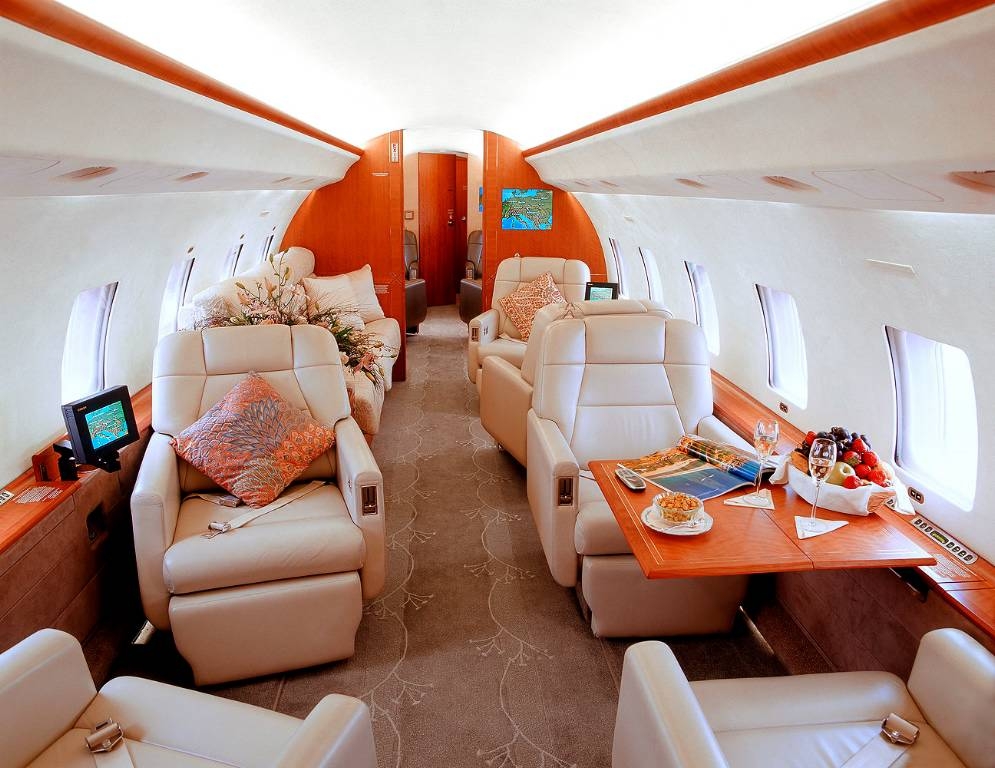

Why would a company buy a multimillion-dollar airplane? To get more than that in results. The question is "how?" According to one study, the use of business aircraft can increase the time available to business travelers by at least 40 percent. That doesn't sound like much until you realise that 40 percent can:
-- Add two weeks to your company's business calendar.
-- Add another mover and shaker to your top marketing and management team.
-- Take your wasted hours, week in and week out, and make them some of your best.
Is that worth the investment in an ultra long-range corporate aircraft valued at almost $40 million? For the world's largest and fastest growing companies, yes.
For the Middle East region the report makes a compelling study of the reasons, both financial and professional which are positively impacted upon by the purchase of a company aircraft.
Many executives who routinely use such business aircraft say they cannot justify them financially because of their "cost." Of course they can't. But cost is not the main issue. It is strategic results that count the most.
Progressive companies have addressed these challenges by going to more remote markets. Fortune 500 companies frequently compete for production and distribution dominance in various regions of the world. Each of them recognises that the long-term impact of today's strategic struggle will pay off in tomorrow's profits.
Not long ago the chairman of a multi-billion dollar company was asked why he invested his company' s capital in long-range business aircraft when the airlines are obviously cheaper. He responded by describing a recent situation.
His company's corporate jet carried the senior marketing team to South America to probe potential new markets. Preliminary meetings with one organisation went extremely well.
So well, in fact, the on-site marketing executives arranged to fly the representatives from the group back with them on the company jet for a tour of their US facilities and a meeting with the chairman.. The outcome was a five-year exclusive agreement worth hundreds of millions of dollars in annual revenues.
The deal took less than five weeks, start to finish. It pre-empted competitors from access to this new and lucrative market. As the chairman put it, "if that airplane doesn' t fly again for the rest of the year, it has more than paid for itself."
Two key points are underscored by this example:
The economics of ultra long-range business aircraft use have much more to do with leveraged results than reducing travel costs. These results are usually measured in new or preserved revenues and profits.
A business aircraft makes it easier to put the right people face to face. A business jet can be the difference between being there or not. With senior people doing business together the deal is more apt to get done and be of a higher dollar value.
The use of business aircraft as a marketing and management tool is a well-proven tactic.
Many executives declare emphatically that, when they use business aircraft, they take trips they would otherwise delay or avoid. Those delayed and avoided trips fall right off the bottom-line.
If you ask a senior executive how much spare time he or she has you may be surprised by the intensity of their response. These key people live under huge amounts of pressure in their efforts to meet the needs of their organisation, shareholders, customers, industry, community, family, and themselves. They know there just aren't enough hours in a week and they don't like it.
When top executives are asked about their biggest "time" frustrations, airline travel is often a leading complaint. Many of them have calendars that are managed to the nearest fifteen minutes. For the harried business traveller the airlines are a black hole for time:
Airline flights rarely match the needs of the traveller you adapt your schedule to meet theirs.
The airlines' hub-and-spoke system requires that travellers often endure connecting flights, with the resulting lost time and increased risk of missed or cancelled flights.
Airline travel is stressful -- the fight for carry-on baggage space; tight and uncomfortable seating arrangements; no privacy in which to conduct business en route; delays and cancellations that include little information flow and even fewer options.
Many senior executives travel at least once each week. If their trip has only two legs, he or she will travel about 100 legs per year. A business jet requires at least one hour less per leg than do the airlines. This includes parking, baggage check-in, security checks, boarding processes, departure delays, en route time, arrival delays, baggage claim, and ground transportation. One hundred hours lost in bite-sized chunks still adds up to more than two and one-half weeks of lost productivity for the people most influential in a company' s business.
Surveys indicate en route productive time is at least 40 percent greater when travelers are on business aircraft. They can work and meet during the trip at their own convenience rather than submitting to the disruptions of the commercial airlines' routines for departure, meal service, and prolonged pre-landing preparations.
Privacy and a discrete working atmosphere are equally important as well. Business aircraft passengers are free to discuss openly the matters at hand. By contrast, airline travel, even in first class, is a public environment that requires discretion. Private discussions on the airlines are easily overheard.

Textron Aviation has marked a key milestone in the development of the Cessna Citation CJ4 Gen3 with the rollout of the program’s first production aircraft. The achievement brings the next-g...
Piaggio Aerospace will return to NBAA-BACE this October, bringing its flagship P.180 Avanti EVO to one of the most important gatherings of the global business aviation community while also highlightin...
Archer Aviation all-electric Midnight air taxi successfully completed several days of piloted flights across the San Francisco Bay Area as part of the company’s “No Roads” flight tou...
Gogo has unveiled its long-term vision for the Galileo connectivity platform at NBAA-BACE 2026, outlining a roadmap designed to enhance and protect customer investments well into the mid-2030s and bey...
