



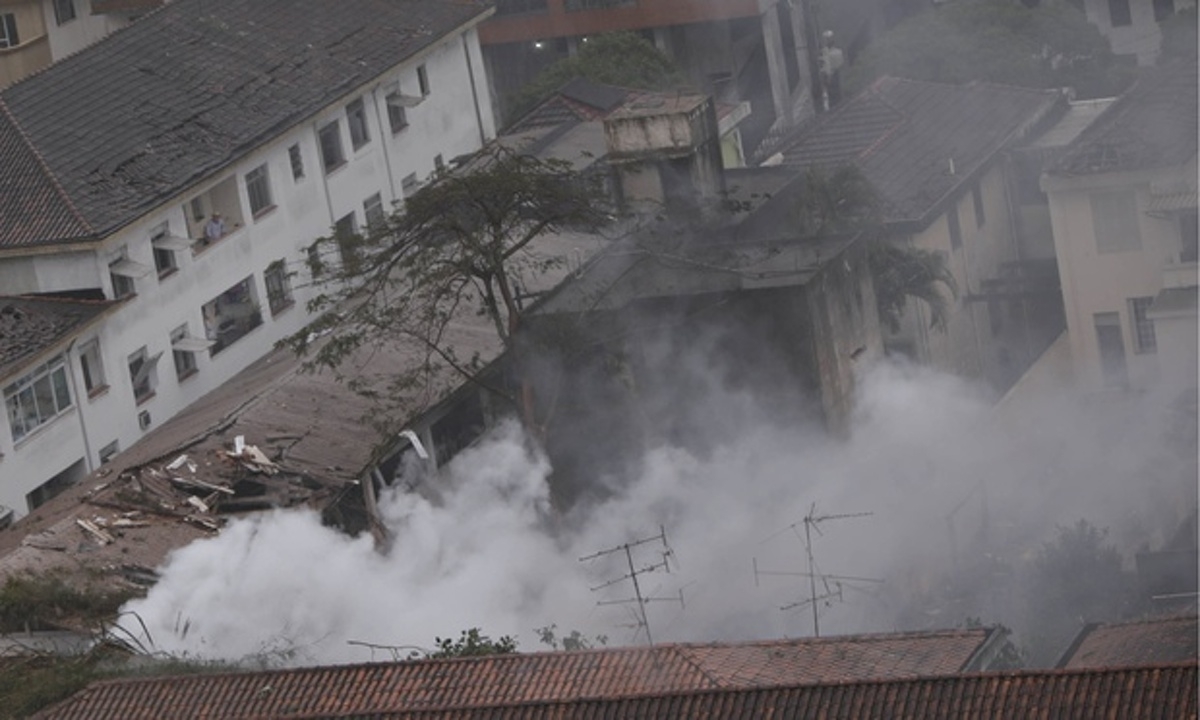
Weather that sharply deteriorated from VFR to IFR conditions surprised a possibly tired crew that lacked specific training for the Citation 560 XLS+, leading to spatial disorientation. That was the conclusion of Brazil's Cenipa in its final report on the Aug. 13, 2014 crash that killed all seven aboard the airplane carrying Eduardo Campos and members of his presidential campaign team. On takeoff from Rio de Janeiro at 8:21 a.m. local time, the crew ofPR-AFA likely had a 7 a.m. report of VFR conditions with five-mile visibility and a 2,200-foot ceiling at the destination. But on arrival at the port of Santos near São Paulo 40 minutes later, conditions were close to IFRminimums, with the ceiling at 800 feet, only 100 feet above minimums, and visibility less than two miles.
The Santos radio operator, new and still lacking a license, informed the crew of IFR conditions but not ceiling and visibility, and the crew didn't ask. The pilots deviated from the prescribed landing approach, which called for crossing the NDB, orbiting and re-crossing. When the runway came into view, the airplane was misaligned, and the pilots decided to go around. But they again failed to follow charted procedures, which referenced a secondNDB that later was found to be turned off.
There was no FDR, the CVR had outdated dialog from 18 months before on it, and ATC radar doesn't cover low altitudes in Santos. Observers saw the aircraft enter clouds, and then cameras caught it plunging well aboveVTO at a 35 degree angle to crash in an urban block at 10:03 a.m.
Cenipa concluded that instrument meteorological conditions removed visual references, and G forces from sharp banking contributed to the pilots' spatial disorientation. Cenipa found no evidence that the crew, who had been hired for the campaign without formal procedures and flown together for only six weeks, had ever performed or trained for a missed approach on a Citation XLS+.
On July 4, Civil Aviation Agency ANAC had issued, but did not yet enforce, new rules requiring training in differences when transitioning to the XLS+ from other aircraft in the CE 560 series. Earlier in the month, the crew had exceeded duty time limits, and analysis of the copilot's voice on ATC recording was consistent with tiredness, although the crew had 30 hours' rest before the fatal flight. The next stop was to be Congonhas, whereLABACE 2014 was under way.


Bristow Group Inc., in partnership with Electra, Avinor and the Norwegian Civil Aviation Authority (CAA Norway), will undertake a series of demonstration flights across five locations in Norway using...
Bombardier marked the 40th anniversary of its industry-leading Smart Services cost-per-flight-hour programs, which today support more than 1,500 enrolled aircraft and account for over 11 mil...
Samson Sky has enlisted renowned Italian automotive designer Luigi Memola to develop the interior design of its Switchblade Flying Car, bringing world-class automotive styling expertise to the roadabl...
Turkish Airlines has taken another major step in its fleet expansion strategy with the signing of a Memorandum of Understanding with CFM International for more than 300 LEAP-1B engines and a long-term...

