



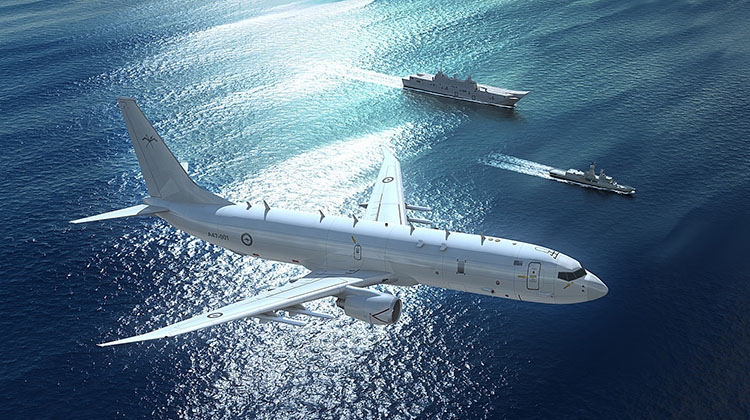
The long-awaited 2016 Defence White Paper has committed the Turnbull federal government to a “fully costed” Integrated Investment Program for Defence that will see $195 billion spent over the next 10 years on defence capabilities including additional P-8 maritime surveillance aircraft and new armed and ship-based unmanned aircraft.
Headlining the capability acquisitions is the government’s reaffirmation of a 12 boat Future Submarine Program via a “rolling acquisition” program, plus a continuous build program for nine Future Frigates and 12 Offshore Patrol Vessels.
Defence capability expenditure through to 2025-26 on “maritime operations and anti-submarine warfare” will also see the acquisition of 15 P-8A Poseidon anti-submarine warfare aircraft (up from eight currently approved) and new ship-based tactical unmanned aircraft.
“Land combat and amphibious warfare” capabilities will see the early replacement of the Tiger Armed Reconnaissance Helicopter in the mid-2020s, new armed unmanned aircraft, and a “fleet of light reconnaissance and attack helicopters” for Special Forces support. Meanwhile the MRH 90 helicopters will gain “role-specific” upgrades for the domestic counter-terrorism role.
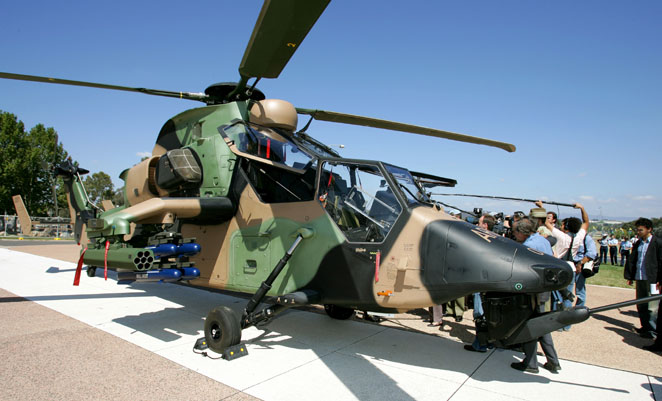
The Tiger will be replaced in the mid-2020s.
Spending on “strike and air combat” capabilities includes the 72 previously-approved F-35A Joint Strike Fighters and 12 EA-18G Growler electronic attack aircraft, plus new air-to-air, air-to-ground, “long-range strike” and anti-ship missiles.
“Air and sea lift” capabilities will see the “longer-term” consideration of another two KC-30A tanker transports (which would take the total fleet to nine) as well as the consideration of “further additional heavy air lift capacity at a later stage”, on top of the eight already acquired C-17A transports.
There is also a focus on ISR, space, EW and cyber capabilities, including seven MQ-4C Triton unmanned surveillance aircraft and a “new long-range electronic warfare support capability” using up to five modified Gulfstream G550 aircraft.
Finally, around 25 per cent of defence capability expenditure will be spent on “key enablers” such as upgrades for infrastructure like bases, weapons and training ranges, IT, simulation, science and technology, and health services.
The 10 year timeframe of the White Paper will see defence spending increase from $32.2 billion in 2016-17 rising to a projected $58.7 billion in 2025-26, on the way passing the government’s two per cent of GDP target in financial year 2020-21.
Daher Aircraft will present its TBM and Kodiak aircraft families at next week’s NBAA Business Aviation Convention & Exhibition (NBAA-BACE), showcasing how their combination of performance, e...
BPE Air, the aviation company founded and wholly owned by entrepreneur Aldrew Crowe, reported approximately US$90 million in revenue in 2025, marking a major milestone in the growth of its integrated...
Turkish Airlines has taken another major step in its fleet expansion strategy with the signing of a Memorandum of Understanding with CFM International for more than 300 LEAP-1B engines and a long-term...
Textron Aviation has marked a key milestone in the development of the Cessna Citation CJ4 Gen3 with the rollout of the program’s first production aircraft. The achievement brings the next-g...

