



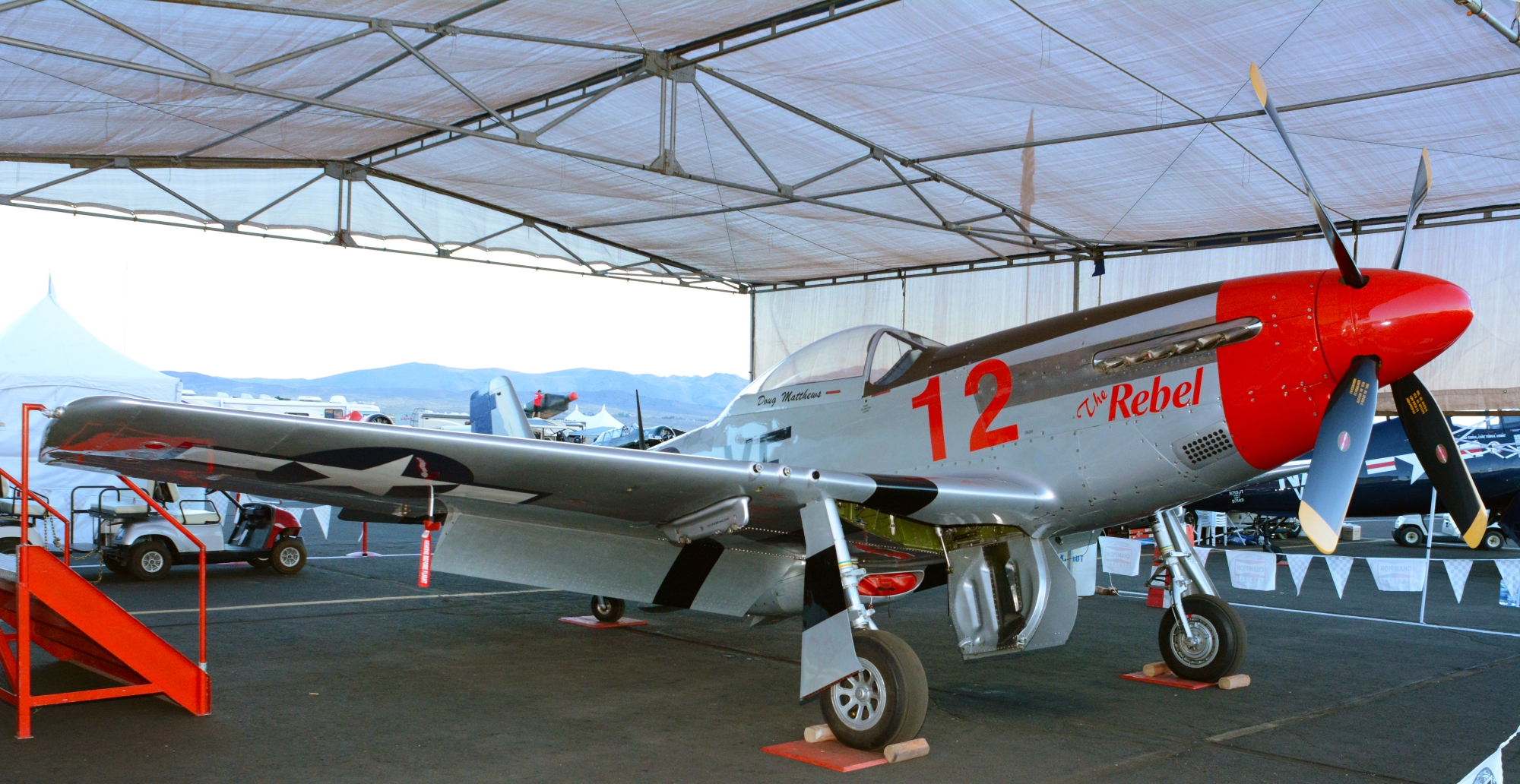
After finally getting a B-17 bomber in its arsenal of attractions, the Museum of Aviation now has the plane that protected it.
The museum staff has reassembled a fully restored P-51 Mustang fighter and rolled it into the Century of Flight Hangar. It will remain there on display for the time being but eventually will be in the Scott World War II Hangar along with the B-17, which is being restored.
The P-51 came to the museum from Chanute Air Museum in Rantoul, Illinois, which is closing after losing some of its financial support. Mike Rowland, curator of the Museum of Aviation, said Chanute spent nine years restoring the P-51, and the plane was its prize possession.
"The P-51 Mustang was perhaps the most important fighter airplane of the war, certainly in Europe," he said.
The P-51 played a crucial role in defeating the Nazis because it had the fuel capacity to go all the way to the target with the bombers and back. The Allies previously thought the armaments on the B-17 and B-24 would allow them to protect themselves from German fighters, but that turned out not to be the case.
The loss rate on missions dropped substantially after P-51s began to be widely used.
"That changed the course of the war," Rowland said.
Crawford Hicks, a former B-17 pilot who lives in Warner Robins, said only on the longest missions did the P-51s have to turn back before reaching the target.
"We had them with us most of the time," he said. "They were truly our friends, and I felt naked when they were not around."
Hicks, who eventually was shot down and taken prisoner, recalled one mission in which a German fighter zoomed up from behind him so close that he said "if the pilot wasn't wearing his mask, I could have recognized him today."
Then he spotted a P-51 right on the German's tail.
"That was the most beautiful P-51 I ever saw," Hicks said.
The museum already has a P-51 replica but this one, a rare H model, is the real thing. It was never in combat but was painted to model an actual P-51 flown by an ace pilot, which is why it has 11 swastikas on the side. The swastikas represent kills of air and ground targets.
Rowland said the plane likely will remain in the Century of Flight Hangar through the winter while museum staff reshuffles planes in the Scott World War II Hangar to make room for it. Because it is in pristine condition, Rowland wanted it to be inside as soon as possible.
Rowland said he isn't sure what will be done with the replica P-51, but one possibility under consideration is to suspend it from the ceiling in the rotunda of the Eagle Building.
Although jets began to replace P-51s starting in the Korean War, the planes remained in use by militaries throughout the world as late as 1980.
Velocity Maintenance Solutions, an FAA-certified provider of maintenance, repair and overhaul services, has announced a significant expansion of its facilities at Wilmington Airport (ILG) in Delaware,...
The U.S. Federal Aviation Administration has certified the Boeing 737-10, the newest and largest member of the 737 MAX family, paving the way for Boeing [NYSE: BA] to begin customer deliveri...
Embraer has delivered the first E175 fitted with next-generation RECARO passenger seats to American Airlines, marking another step in the ongoing modernization of one of the world's most successfu...
AMAC Aerospace Group continues to experience strong business momentum, marked by new certifications, contract wins and rising demand across its maintenance, completion and aircraft modification activi...

