



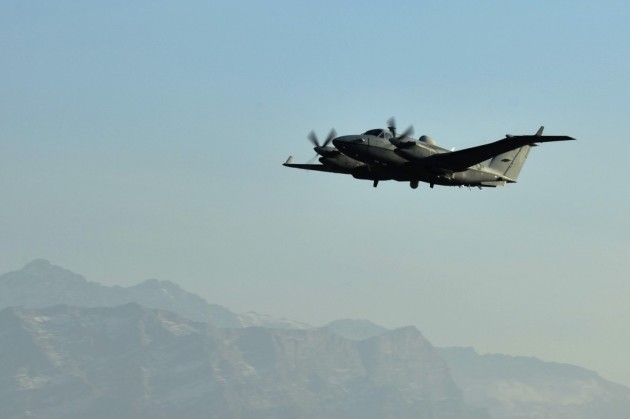
An advanced U.S. Army reconnaissance aircraft crash-landed in a field outside of Irbil in Iraqi Kurdistan on Saturday morning.
A statement from the U.S.-led coalition in Iraq confirmed the crash as an “off-airport emergency landing in a field northwest of Irbil.” None of the four passengers were injured, and the aircraft has been secured by U.S. and Kurdish forces. According to the statement, “the cause of the crash is under investigation but initial reports rule out the prospect of hostile action.”
Footage taken at the scene showed little damage to the twin-engine Beechcraft King Air, as it appears to have slid on its fuselage, warping the propellers and snapping one of the wings. Local reports from the Kurdish news organization Rudaw said the aircraft crashed near the town of Kawrgosk — roughly six miles from Irbil’s international airport. According to Rudaw, the crash site was secured by U.S. military personnel, and the passengers were evacuated by helicopter. Pictures posted to social media show the downed aircraft surrounded by what appears to be well-armed special operations forces.

U.S. Army EMARSS-M prototype during flight test. (U.S. Army Photo)
The same images show that the aircraft has the tail number N6351V. According to an online FAA registry, the number is registered to the U.S. Army. Users on Twitter also traced the tail number to a document posted online showing that the tail number, and subsequently the aircraft, is based out of Hunter Army Airfield in Savannah, Ga., and is outfitted with the Enhanced Medium Altitude Reconnaissance and Surveillance System, or EMARSS.
The Army flies a small fleet of fixed-wing aircraft that is broken down into three categories: Special Electronic Mission Aircraft, or SEMA, transport aircraft and mission support aircraft. EMARSS-equipped aircraft fall under SEMA.
First tested in 2013, the Army began widely outfitting the Beechcraft prop planes–known by their military designation as MC-12s–with the EMARSS in 2015, according to a report from IHS Janes. The four-person crew is comprised of the pilot, mission commander, sensor operator and a systems operator. While there are different variants of the EMARSS, including one specifically designed for countering improvised roadside bombs, the system’s primary role is to rapidly track and identify ground targets regardless of weather condition and time of day. The aircraft can also gather signals intelligence.
From the Janes report:
The EMARSS system consists of a King Air 350ER aircraft equipped with an electro-optic/infra-red (EO/IR) sensor, communications intelligence collection system, an aerial precision geolocation system, line-of-site tactical and beyond line-of-site communications suites, two Distributed Common Ground System-Army (DCGS-A) workstations and a self-protection suite.
It is unclear what the EMARSS-equipped aircraft was doing before the crash. However, northern Iraq is littered with U.S. special operation units, including the Expeditionary Targeting Force, an elite commando unit dispatched to the region to capture and kill Islamic State fighters. While unable to stay in the air as long as drones, manned surveillance aircraft like the MC-12 are integral for missions, such as special operations raids, that require rapid intelligence gathering.
Cirrus Aircraft is celebrating the 10th anniversary of its Collier Trophy-winning Vision Jet at NBAA-BACE 2026, marking a decade of innovation that has continuously advanced the world&r...
Textron Aviation has marked a key milestone in the development of the Cessna Citation CJ4 Gen3 with the rollout of the program’s first production aircraft. The achievement brings the next-g...
Daher Aircraft announced the delivery of a Kodiak 900 to Swiss owners Roland and Claudia Primus, who plan to use the aircraft for adventure flying to remote and short-runway destinations. Their travel...
Viasat has significantly expanded the capacity of its JetXP in-flight connectivity service across the United States, delivering up to five times more bandwidth for business aviation customers equipped...

