



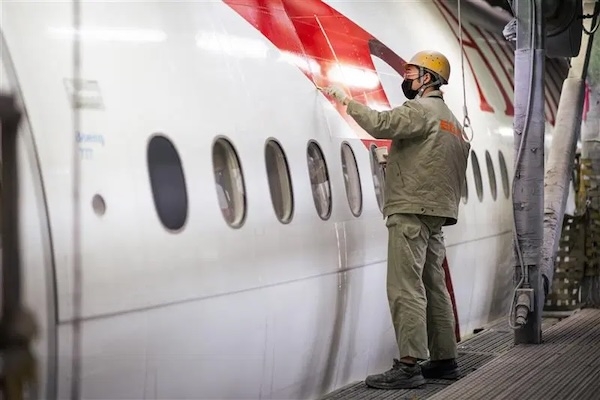
First Austrian Airlines Boeing 777-200ER equipped with the innovative AeroSHARK surface technology has successfully completed its maiden flight. The long-haul aircraft, registered OE-LPC, took off from Bangkok International Airport yesterday night on its inaugural journey to Vienna under flight number OS26. This follows the recent approval by EASA of AeroSHARK for the Boeing 777-200ER, paving the way for the innovation to be used on an additional aircraft type. The modification of four out of six Boeing 777-200ER aircraft operated by Austrian Airlines is expected to be completed in March 2025.
AeroSHARK, a surface film technology jointly developed by Lufthansa Technik and BASF, imitates the microscopic structure of sharkskin to optimize airflow on the aircraft fuselage and engine nacelles. The technology enables fuel savings of approximately one percent, translating into reductions in CO₂ emissions. For Austrian Airlines, this innovation aligns with its commitment to continuously reduce CO₂ emissions in its operations. The modification was carried out during a scheduled maintenance visit, ensuring seamless integration into the aircraft’s operational schedule. Austrian Airlines is the first airline to apply this technology to the Boeing 777-200ER. For this purpose, Lufthansa Technik obtained an extended Supplemental Type Certificate (STC) from EASA for this additional aircraft type.
Harald Gloy, Chief Operating Officer of Lufthansa Technik commented: “With this certification, the fleet-wide implementation of our sharkskin technology on 777-200ER aircraft can begin, supporting airlines worldwide to enhance operational efficiency and achieve their environmental goals.”
Francesco Sciortino, Chief Operating Officer of Austrian Airlines stated: “Reducing our CO₂ emissions in flight operations is at the center of our sustainability efforts. The application of the ‘sharkskin’ developed by Lufthansa Technik and BASF is an important investment that will enable us to fly our long-haul aircraft more efficiently.”

Austrian Airlines estimates that for their four modified Boeing 777-200ERs, the fuel savings enabled by AeroSHARK will result in a reduction of around 2,650 metric tons of kerosene until 2028. This corresponds to approximately 8,300 metric tons of CO₂ emissions, equivalent to about 46 direct flights between Vienna and New York.
This milestone builds on the successful deployment of AeroSHARK across other Lufthansa Group fleets and beyond. The technology has already proven its value in passenger and cargo operations, with currently 22 AeroSHARK-modified Boeing 777 aircraft from six different airlines cruising the skies. Lufthansa Technik and BASF are committed to expanding the application to additional aircraft types and larger surface areas.

Gulfstream Aerospace has enhanced the capabilities of its Customer Support Performance Analytics program, further strengthening its ability to transform aircraft data into actionable insight...
Textron Aviation has marked a key milestone in the development of the Cessna Citation CJ4 Gen3 with the rollout of the program’s first production aircraft. The achievement brings the next-g...
Samson Sky has enlisted renowned Italian automotive designer Luigi Memola to develop the interior design of its Switchblade Flying Car, bringing world-class automotive styling expertise to the roadabl...
Piaggio Aerospace will return to NBAA-BACE this October, bringing its flagship P.180 Avanti EVO to one of the most important gatherings of the global business aviation community while also highlightin...

