




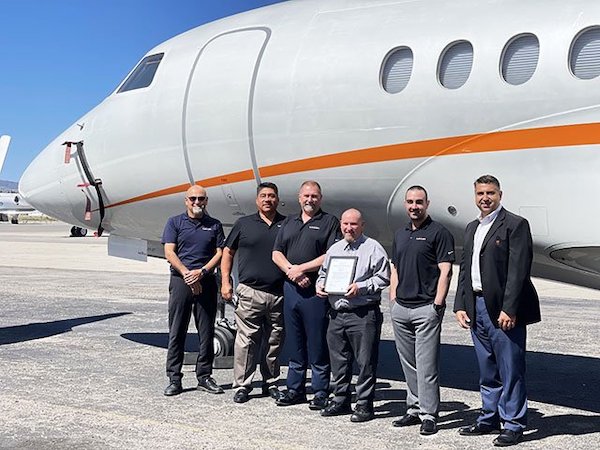
An EASA Part 145 Maintenance Organization certification approval was granted to Clay Lacy Aviation MRO Services by the European Union Aviation Safety Agency. This certification authorizes Clay Lacy to provide maintenance services on business jets that are registered in member countries of the EU. EASA is responsible for civil aviation safety throughout the European Union, and for EU citizens and aircraft traveling abroad.
“We are very proud to add EASA Part 145 to our long list of maintenance certifications and authorizations,” said Ed Mirzakhanian, Clay Lacy’s Senior Vice President of Product Support. “This helps us better serve our European clients, and offers international recognition of our outstanding MRO teams and facilities.”
Expert, Award-Winning Business Jet Maintenance
With more than five decades of experience maintaining every make and model of business jet, Clay Lacy provides complete aircraft maintenance, repair and overhaul services through its FAA repair stations in Connecticut and California. Factory-trained experts perform light line maintenance, heavy airframe inspections, jet engine and APU maintenance, avionics and cabin entertainment upgrades and repairs, and complete interior modification and repair services. Over $3.4 million in parts, warranty administration and AOG mobile response teams further support each client’s flight and maintenance operations.



Air Baltic Corporation AS , Latvia’s national airline and the leading carrier in the Baltic States, announced that airBaltic and its subsidiaries participating in the voluntary Ch...
Archer Aviation all-electric Midnight air taxi successfully completed several days of piloted flights across the San Francisco Bay Area as part of the company’s “No Roads” flight tou...
The U.S. Federal Aviation Administration has certified the Boeing 737-10, the newest and largest member of the 737 MAX family, paving the way for Boeing [NYSE: BA] to begin customer deliveri...
Viasat has significantly expanded the capacity of its JetXP in-flight connectivity service across the United States, delivering up to five times more bandwidth for business aviation customers equipped...

