



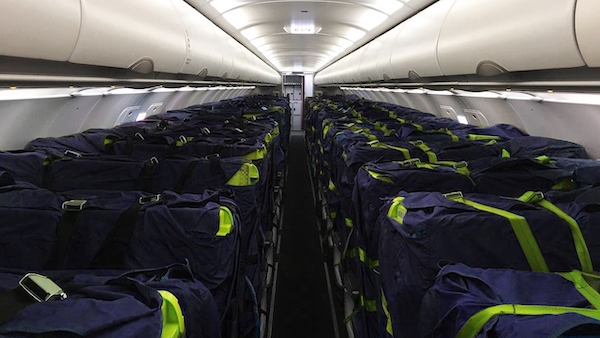
Colibri Aero together with J&C Aero have developed universal Cargo Seat Bags for commercial and humanitarian cargo transportation inside Airbus A319/A320/A321 passenger cabins. The newly developed interior modification kit has already been approved by the European Aviation Safety Agency (EASA) and has received its Supplemental Type Certificate (STC).
The Cargo Seat Bag comes as a spacious 76x76x147 cm (30x30x58 inches) kit for a triple seat, with up to 75 kg (165 lb) of cargo to be stored on the seat and additional 9 kg – under the seat, totaling 252 kg (555 lb) per a triple seat block. The kit can be easily installed within just several minutes and can include a wide range of cargo types: from postal correspondence, household goods, electronics and other commercial cargo to medical equipment and other kinds of humanitarian supplies.
“We started the development of the modification back in 2019, with numerous testing and continuous consultations with both aviation authorities and airlines along the way. In February 2020, amidst the growing concerns over what now is known as the COVID-19 pandemic, we decided to put additional resources to the project in order to have a certified modification as soon as possible. We are thankful to our team and European aviation authorities whose close cooperation will allow us to deliver the modification to the market at a time of need,” shared Laurynas Skukauskas, the Chief Commercial Officer at J&C Aero.
The kits are developed in compliance with Structural Integrity, Fire Protection, and Emergency Evacuation requirements. All aircraft operators will be supplied with a cargo bag special condition compliance justification matrix, a loading manual and additional documentation required by their national aviation authorities (CAA). The MOD kit documentation may also be supplemented with an EASA Form 1.
“We are all in this together and we have to help airlines to adapt during these challenging times. While the passenger traffic has drastically fallen, many airlines keep operating their passenger aircraft for cargo deliveries – both ordinary goods and medical equipment like masks, respirators, and other items. Being able to promptly apply temporary modifications for passenger cabins for cargo purposes may allow aircraft operators to increase cargo capacities thus adapting operations to the growing demand for cargo air deliveries between countries and regions,” said Andrius Norkevičius, the CEO of Colibri Aero.
Textron Aviation has marked a key milestone in the development of the Cessna Citation CJ4 Gen3 with the rollout of the program’s first production aircraft. The achievement brings the next-g...
Cirrus Aircraft is celebrating the 10th anniversary of its Collier Trophy-winning Vision Jet at NBAA-BACE 2026, marking a decade of innovation that has continuously advanced the world&r...
Bombardier marked the 40th anniversary of its industry-leading Smart Services cost-per-flight-hour programs, which today support more than 1,500 enrolled aircraft and account for over 11 mil...
A Discover Airlines Airbus A330 has become the first Airbus aircraft worldwide to enter regular commercial service after undergoing a full-scale AeroSHARK retrofit, marking a signi...

