



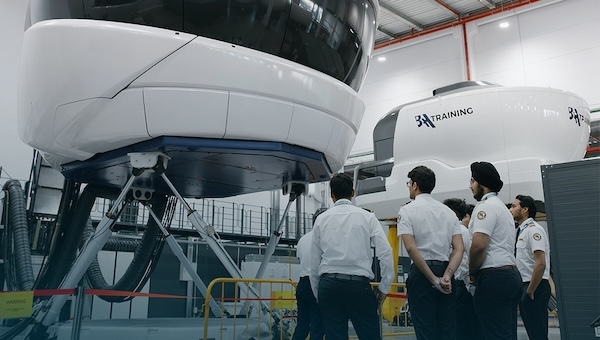
The global flight training market in 2025 was largely defined by contrasts. Initial pilot (ab initio) and MPL (Multi-crew Pilot License) training expanded as airlines invested in future pilot pipelines. Type rating activity, on the other hand, faced headwinds from aircraft delivery delays and market adjustments. For training organizations, 2025 required balancing immediate constraints with long-term positioning. The year showed that airlines were no longer simply reacting to staffing gaps but building structured pathways to meet demand they knew was coming.
Aira Klusaitiene, Chief Sales Officer at BAA Training, commented: "After years of reactive hiring, we're seeing serious investment in ab initio and cadet programs. They know they'll need pilots, and they're acting on it now. Airlines using MPL programs consistently tell us their cadets are better prepared for line operations," Klusaitiene says. "The training is tailored to airline procedures from day one, which makes the transition smoother. We're also seeing airlines value the stability—they know exactly when pilots will be ready and what competencies they'll have. Last year was challenging for type rating," Klusaitiene notes. "Deliveries slowed significantly, and airlines focused on optimization. We saw experienced pilots put back into the market. But even with that, fleet transitions—like airlines switching aircraft families for cost-effectiveness—still created pockets of demand. 2026 looks different regionally. Middle East orders are significant. Qatar Airways alone ordered 160 widebody aircraft. When those deliveries accelerate, training demand will follow. In Vietnam, for example, we're seeing both fleet expansion from established carriers and new airline launches. This creates sustained pilot demand across multiple fronts."
Airlines invested in ab initio and MPL training pipeline
Throughout 2025, ab initio training saw renewed momentum as airlines shifted from short-term solutions to long-term workforce planning. Multi-Crew Pilot License programs moved further into the mainstream. While MPL has existed in Europe for years, 2025 brought notable expansion. For example, the Spanish low-cost airline Volotea launched its partnership with BAA Training in February 2025, offering cadets a job-guaranteed pathway. Qatar Airways and other carriers continued expanding their established cadet initiatives across Europe as well.
For training academies, MPL offered greater stability. Programs backed by airlines reduced reliance on self-funded students and aligned training output directly with airline demand. The model was proving its value not as an alternative to traditional routes, but as a strategic workforce tool.
A constrained year for type rating
Type rating activity in 2025 told a different story. Aircraft delivery delays from Boeing and Airbus created a trickle-down effect across the training market. With manufacturers struggling to meet delivery schedules—and not expecting to fully recover until 2031-2032—airlines worked with the resources they already had.
Fleet growth stalled, and so did the need to train pilots on new aircraft types. Airlines maximized existing capacity rather than expanding, which meant fewer type rating courses than in previous years. The situation was complicated by airline exits from the market late in the year, which returned experienced pilots and aircraft to the available pool.
Narrow-body aircraft, which represents approximately 60% of the commercial aircraft market, remained the focus for future fleet planning. As of mid-2025, narrow-body orders accounted for 88.9% of Airbus's backlog—7,660 aircraft out of 8,617 total. However, delivery delays meant airlines had to defer expansion timelines and optimize existing capacity while waiting for new aircraft.
Looking ahead to 2026
While 2025 presented challenges for type rating, the outlook for 2026 signals a geographic and operational shift in training demand. Asia and the Middle East are positioned to drive the next phase of growth. Middle Eastern carriers placed hefty aircraft orders during 2025. FlyDubai ordered 225 aircraft (150 A320neos and 75 B737 MAXs), while Qatar Airways secured 160 widebody aircraft (130 B787 Dreamliners and 30 B777-9s) in what became Boeing's largest widebody order.
Vietnam exemplifies the regional growth trajectory. Vietjet ordered 20 A330neos in May 2025, doubling its widebody commitment, while Vietnam Airlines planned a tender for 50 narrowbody aircraft. The market also attracted new entrants: Sun PhuQuoc Airways launched in November 2025 with plans to operate 100 aircraft by 2030, targeting 20 million passengers annually.
The concentration of narrow-body orders, particularly A320 and B737 families, means training demand will align closely with delivery schedules. Manufacturers have indicated they expect to address the current backlog by 2031-2032, but as deliveries begin to normalize, training organizations will need to scale type rating capacity accordingly.
Middle East's aviation sector provides context for this growth. In the UAE, aviation contributes 18.2% to national GDP, five times the global average of 3.9%. The region's aviation sector is projected to reach $730 billion in GDP contribution by 2043, more than doubling from current levels.
Airlines continue to face uncertainty around delivery timelines, which affects their ability to plan training intake with precision. However, the underlying demand remains clear: when aircraft arrive, pilots will need to be ready.
How 2025 shaped up to be
Pilot training in 2025 reflected a market in transition. Ab initio and MPL programs expanded as airlines invested in long-term pilot pipelines, while type rating activity contracted under the weight of aircraft delivery delays and market adjustments. It became clear that airlines were planning strategically rather than reacting tactically.
The year reinforced that training demand follows fleet movement. When deliveries stall, type rating slows. When airlines commit to future growth, ab initio investment accelerates. For training organizations, 2025 required balancing immediate capacity constraints with positioning for the demand that manufacturers' backlogs promise will eventually arrive.
Geography also played a defining role. While Europe maintained steady activity, the Middle East and Asia emerged as the centers of future growth, driven by substantial aircraft orders and ambitious aviation expansion plans. Vietnam's launch of Sun PhuQuoc Airways and the Middle East's record-breaking orders signal where the next wave of training demand will concentrate.
As 2026 begins, the training market stands at an inflection point. Aircraft will eventually be delivered. Airlines will need pilots ready to fly them. Training providers that built capacity, maintained partnerships, and aligned with airline planning cycles during the constrained period will be positioned to meet that demand when it materializes.
Daher Aircraft will present its TBM and Kodiak aircraft families at next week’s NBAA Business Aviation Convention & Exhibition (NBAA-BACE), showcasing how their combination of performance, e...
Few infrastructure projects have the potential to reshape an island's future quite like the ongoing transformation of Nevis Airport. To gain deeper insight into this ambitious development and the...
Textron Aviation has marked a key milestone in the development of the Cessna Citation CJ4 Gen3 with the rollout of the program’s first production aircraft. The achievement brings the next-g...
BPE Air, the aviation company founded and wholly owned by entrepreneur Aldrew Crowe, reported approximately US$90 million in revenue in 2025, marking a major milestone in the growth of its integrated...

