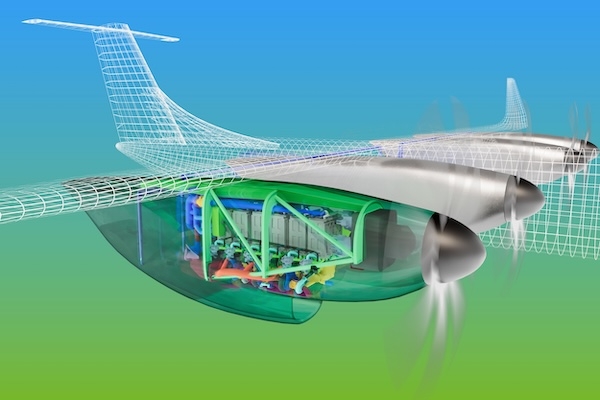
Preliminary design completed: The Clean Aviation technology project HEROPS (Hydrogen-Electric Zero Emission Propulsion System) has reached a significant milestone: “We have successfully concluded the initial design phase for the megawatt-class powertrain,” explains Dr Dominik Wirth, Chief Engineer of HEROPS. “This marks a substantial step towards confirming the fundamental feasibility of scaling up our fuel cell technology,” adds MTU’s fuel cell expert.
Launched in early 2024, the EU technology project HEROPS aims to develop innovative technologies for a climate-neutral, hydrogen-powered electric powertrain based on MTU’s Flying Fuel Cell. This pioneering system is set to power regional aircraft starting in 2035.
What lies ahead? “Having established the essential functional, performance, safety, and interface requirements for the various subsystems, we will now focus on further developing and optimising this megawatt fuel cell engine concept.” The design is expected to be finalised by the end of the year, with next year dedicated to the experimental validation of core technologies. This will include a series of component tests and extensive wind tunnel evaluations of the integrated engine nacelle, propeller, and heat exchanger system. The 1.2-megawatt ground demonstrator is currently under construction at MTU Aero Engines in Munich, where the entire powertrain will undergo rigorous functional and performance testing. HEROPS is anticipated to conclude by the end of next year.
“The HEROPS project exemplifies the type of breakthrough innovation Clean Aviation is proud to support” says Maria Calvo, Head of Project Management Unit at the Clean Aviation Joint Undertaking. “Advancing hydrogen fuel cell propulsion is essential to achieving our climate-neutral goals for aviation, as outlined in the European Green Deal. HEROPS is laying the technological groundwork for the next generation of sustainable regional aircraft.”
The HEROPS consortium comprises industry partners MTU Aero Engines, MT Aerospace, RTX’s Collins Aerospace, Lufthansa Technik, and Eaton, alongside research collaborators the Royal Netherlands Aerospace Centre and the Vienna University of Technology. The project is coordinated by MTU.
The Clean Aviation Joint Undertaking represents the European Union’s foremost research and innovation programme, a successful public-private partnership between the European Commission, under Horizon Europe—the EU’s research and innovation initiative—and the European aviation industry. Its primary objective is to foster sustainable and climate-neutral aviation.
Archived
1 year ago
TARMAC Aerosave has set a new industry benchmark by becoming the first company in the world to secure Aircraft Fleet Recycling Association (AFRA) accreditation across all three scopes of aircraft disa...
Few infrastructure projects have the potential to reshape an island's future quite like the ongoing transformation of Nevis Airport. To gain deeper insight into this ambitious development and the...
Daher Aircraft announced the delivery of a Kodiak 900 to Swiss owners Roland and Claudia Primus, who plan to use the aircraft for adventure flying to remote and short-runway destinations. Their travel...
Bristow Group Inc., in partnership with Electra, Avinor and the Norwegian Civil Aviation Authority (CAA Norway), will undertake a series of demonstration flights across five locations in Norway using...