



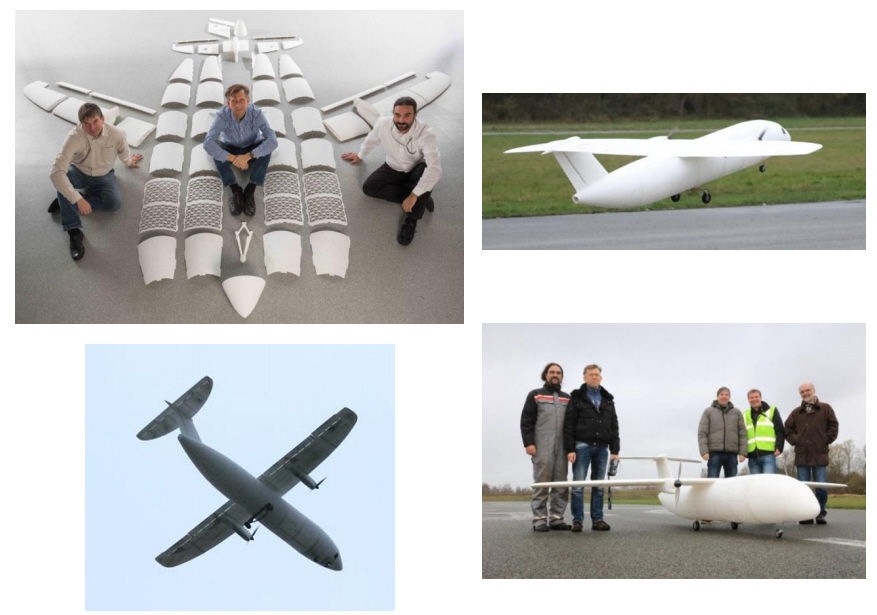
Airbus, the European aerospace giant, has a new drone named Thor. Thor is a clumsy acronym for “Test of High-tech Objectives in Reality,” and what the drone does is nowhere near is important as what it means. The drone, all 13 feet and 55 pounds of it, was 3D printed over the course of about a month.
Unveiled at the 2016 International Aerospace Exhibition and Air Show in Berlin this week, Thor is made of roughly 50 3D printed parts. It is easier to name what in Thor wasn’t printed: some parts of the two engines, and the controls.
Thor had a first successful flight back in November, where it flew for 25 miles. Airbus plans 18 more test missions this year for the aircraft. Should any part break, 3D printing makes replacement easy, and if any part can be improved, it’s easy to print the part to the plane’s design and replace it. It’s the flexibility of 3D printing that Airbus hopes to capitalize on, and regardless of whether or not Thor is useful as an independent product, it’s teaching Airbus engineers what they can do with 3D printed planes. A rough draft of the future, in miniature form.
Daher Aircraft will present its TBM and Kodiak aircraft families at next week’s NBAA Business Aviation Convention & Exhibition (NBAA-BACE), showcasing how their combination of performance, e...
Velocity Maintenance Solutions, an FAA-certified provider of maintenance, repair and overhaul services, has announced a significant expansion of its facilities at Wilmington Airport (ILG) in Delaware,...
Qantas Freight and Australia Post have entered the next chapter of their long-standing partnership with the arrival of the first of three additional Airbus A321 Passenger-to-Freighter (A321P2F) aircra...
Gogo has unveiled its long-term vision for the Galileo connectivity platform at NBAA-BACE 2026, outlining a roadmap designed to enhance and protect customer investments well into the mid-2030s and bey...

