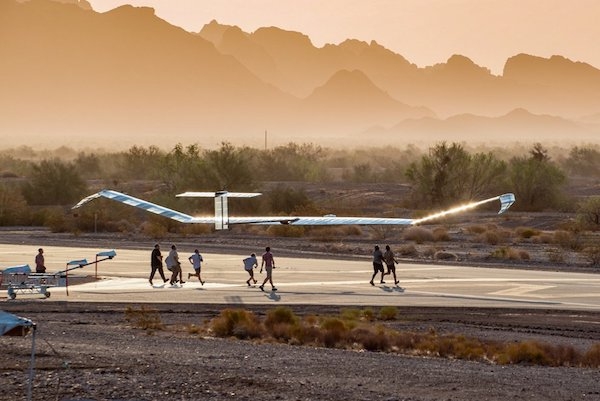
The Airbus Zephyr S completes a successful 2021 test flight campaign in the United States. The final Airbus solar-powered High Altitude Platform System (HAPS) flight touched down on 13th September in Arizona, USA, ending the most ambitious and successful Zephyr flight campaign to date.
The flight campaign had a clear customer focus - to demonstrate how Zephyr could be used for future operations, flying outside of restricted airspace and over airspace shared with commercial air traffic. Carrying an Optical Advanced Earth Observation system for Zephyr (OPAZ) payload, Zephyr proved its operational value to provide instant, persistent, and improved situational awareness.
“Working with Airbus and the Zephyr team during the 2021 flight campaign, significant progress has been made towards demonstrating HAPS as a capability. This summer’s activities represent an important step towards operationalising the stratosphere” said James Gavin, Future Capability Group Head at Defence Equipment & Support, the procurement arm of the UK Ministry of Defence.

“Defence investment in cutting edge technology is key to the development of world-leading military capabilities. Zephyr is an important programme within UK Strategic Command and the recent successful flight has required many innovative technical solutions. This represents a significant milestone for Zephyr which is informing the development of new concepts and ways of enabling military operations, particularly in the context of Multi-Domain Integration.” Said Major General Rob Anderton-Brown, Director Capability and MDI Change Programme at Strategic Command.
The campaign consisted of six flights in total, four low level test flights and two stratospheric flights. The stratospheric flights flew for around 18 days each, totaling more than 36 days of stratospheric flight in the campaign. This adds a further 887 flight hours to the 2,435 stratospheric flight hours for Zephyr to date, marks significant progress for fixed wing HAPS and is a step towards making the stratosphere an operational reality for its customers.
“Credible and proven ultra-persistence, stratospheric agility, and payload interoperability underscore why Zephyr is the leader in its sector. It is a sustainable, solar powered, ISR and network extending solution that can provide vital future connectivity and earth observation to where it is needed.” said Jana Rosenmann, Head of Unmanned Aerial Systems at Airbus.
Such an innovative and potentially game-changing capability is part of Airbus ambition to rapidly move towards operationalizing the stratosphere. “Carbon Neutral”, Zephyr uses sunlight to fly and recharge its batteries, using no fuel and producing no carbon emissions.
With its ability to remain in the stratosphere for months at a time, Zephyr will bring new see, sense and connect capabilities to both commercial and military customers. Zephyr will provide the potential to revolutionise disaster management, including monitoring the spread of wildfires or oil spills. It provides persistent surveillance, tracing the world’s changing environmental landscape and will be able to provide communications to the most unconnected parts of the world.

BPE Air, the aviation company founded and wholly owned by entrepreneur Aldrew Crowe, reported approximately US$90 million in revenue in 2025, marking a major milestone in the growth of its integrated...
Bristow Group Inc., in partnership with Electra, Avinor and the Norwegian Civil Aviation Authority (CAA Norway), will undertake a series of demonstration flights across five locations in Norway using...
Qantas Freight and Australia Post have entered the next chapter of their long-standing partnership with the arrival of the first of three additional Airbus A321 Passenger-to-Freighter (A321P2F) aircra...
Gogo has unveiled its long-term vision for the Galileo connectivity platform at NBAA-BACE 2026, outlining a roadmap designed to enhance and protect customer investments well into the mid-2030s and bey...