



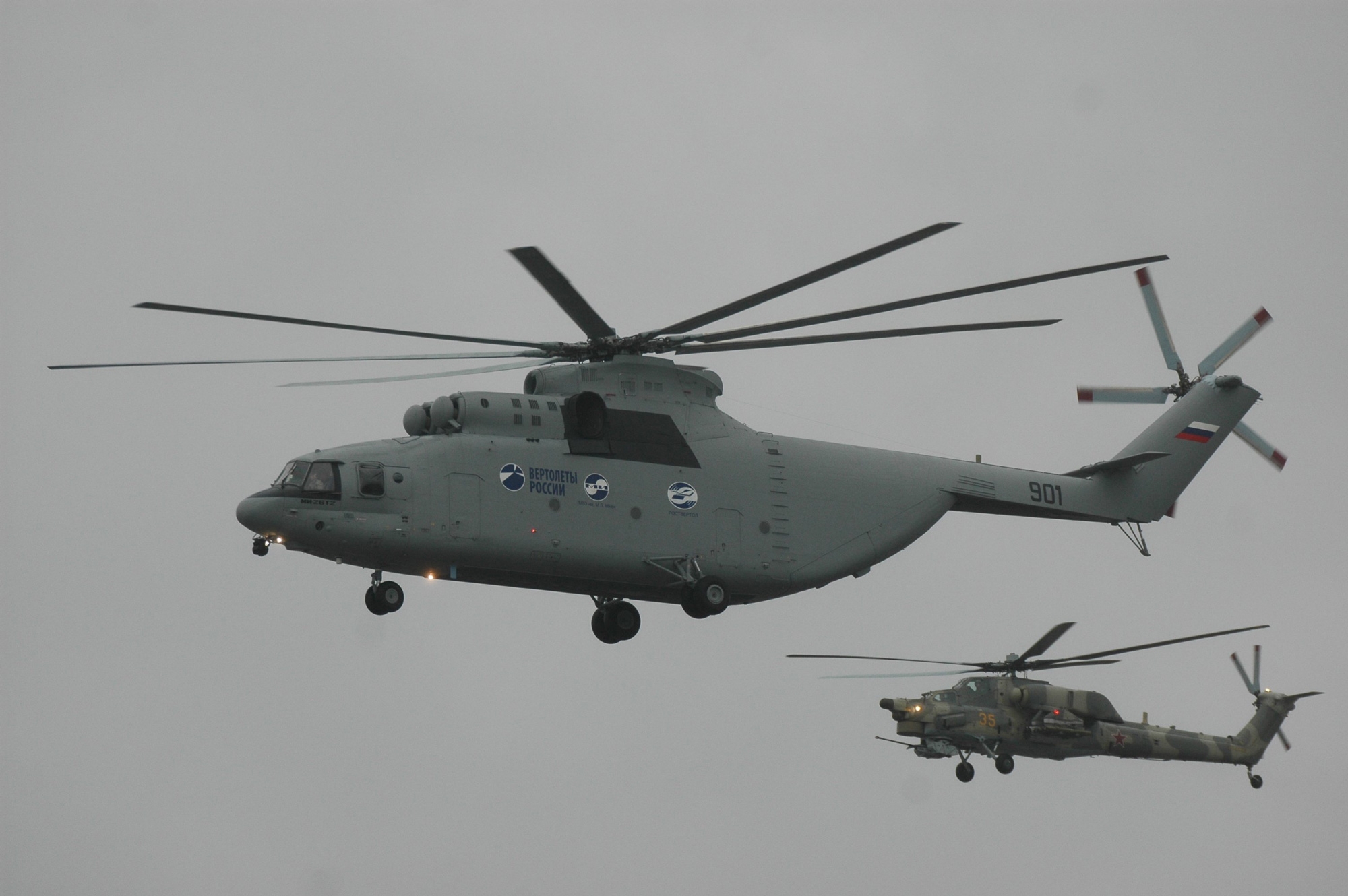
Having taken delivery of six Mil Mi-26T2 helicopters in 2015-16, Algeria has firmed up an option for eight more, for delivery in 2017-18. The North African country was effectively the launch customer for the upgraded version of the heavy-lift machine. Russian arms vendor Rosoboronexport was the intermediary between the customer, the Russian Helicopters holding company, and its subsidiary Rostvertol, which produces the Mi-26. It is the world’s largest rotorcraft in serial production.
As of today, the T2 version is operational only in Algeria. The Russian defense ministry has declared an intent to buy some but has yet to formalize a purchase agreement. China took an additional Mi-26T last year and is considering the T2. The Mi-26T2 is the most recent version of the baseline Mi-26. It has a maximum takeoff weight of 56 metric tons (123,500 pounds) and a maximum payload of 20 tons (44,000 pounds). With a full payload, the helicopter can cover nearly 600 km (320 nm) at a cruise speed of 255 km/h (138 knots). The Mi-26T2 is distinguishable though a state-of-the-art BREO-26 cockpit package from Russian avionics group KRET. It features a glass cockpit of five LCDs, digital data processing, satellite-aided navigation, night flying capability, secure datalink and built-in health-monitoring system. Aircrew is reduced to two to three from five or six for the baseline version.
The Tennessee Valley Authority is demonstrating the real-world value of the Tecnam P2012 Special Mission Platform (SMP), which has become a vital tool for monitoring and maintaining its...
Gulfstream Aerospace has enhanced the capabilities of its Customer Support Performance Analytics program, further strengthening its ability to transform aircraft data into actionable insight...
Private jet catering requires an understanding of the journey as much as the passengers' preferences. SkyDine Jet Catering explores how flight duration, departure schedules, airport location, and...
BPE Air, the aviation company founded and wholly owned by entrepreneur Aldrew Crowe, reported approximately US$90 million in revenue in 2025, marking a major milestone in the growth of its integrated...

