



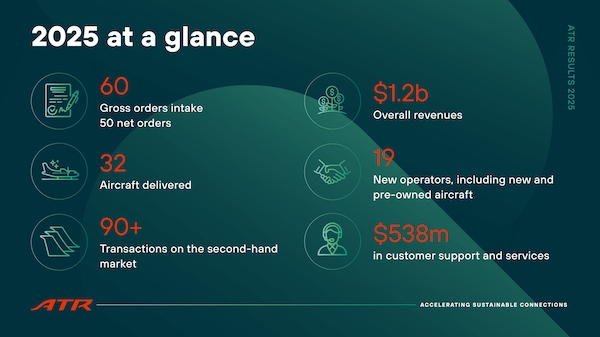
ATR announced its 2025 full-year results, marked by strong commercial performance, stable revenues, and continued investment in its industrial system to support its long-term growth trajectory. ATR reported a gross order intake of 60 aircraft in 2025, from nine customers across nine countries, including double-digit commitments from Air Algérie and UNI Air – 16 and 19 ATR 72-600s respectively. Net orders reached 50 aircraft, bringing the company’s backlog to over 160 units.
ATR broader ecosystem showed strong growth momentum, welcoming 19 new operators across all continents. The year was marked by a dynamic leasing environment, with over 10 brand-new aircraft leased to airlines from lessors’ order books, including a breakthrough within the Ethiopian Airlines Group. The second-hand market was also particularly active throughout the year, with over 90 transactions recorded. Customer support and services achieved revenues of US$538 million. Overall, ATR generated $1.2 billion in revenues in 2025.
The year also saw important fleet developments, including major breakthroughs in North America, with JSX in the United States launching public charter operations with ATR 42-600s, and the certification and delivery of the first ATR -600 in Canada with Rise Air.
Interest in premium regional travel also increased, reflected in further uptake of the ATR HighLine collection, including by Berjaya Air, Air Tahiti and Air Cambodia.
This solid market momentum contrasted with a difficult industrial environment. ATR delivered 32 aircraft in 2025, below its initial target, reflecting another year of supply-chain disruptions impacting key components.
Nathalie Tarnaud Laude, ATR’s Chief Executive Officer commented: “We do not measure the success of a transition year like 2025 on one number. We are determined to raise our delivery rate; and that is why we have worked on concrete steps to address the issues that limited our output. We have strengthened every part of our organisation and laid the groundwork for a safe, sustainable and credible increase in production.”
Marion Smeyers, ATR’s SVP Operations & Procurement stated: “Tangible measures include improvements in Final Assembly Line flow, reopening of stations, a steady decline in part shortages – now down to one-third of early-2025 levels, alongside a close collaboration with our suppliers to get the end-to-end industrial system ready for ramp-up, targeting a 20% increase in deliveries this year compared to 2025”

The manufacturer continued investing throughout the year to stabilise its industrial system and prepare for its ramp-up from 2026 onwards. In 2025, ATR also entered a major new technological cycle driven by the launch of two EU Clean Aviation flagship programmes, HERACLES and DEMETRA. These R&T projects aim to demonstrate a hybrid-electric ATR 72-600 flying testbed by the end of 2029. The plan integrates hybrid propulsion, advanced propeller technology and electrified systems, marking a major step towards next-generation low-emission aircraft.
“Clean Aviation offers us the perfect platform to work hand-in-hand with strategic partners on maturing the technologies that will be essential for our future EVO concept. These projects are already informing the EVO feasibility study, and they play a critical role in ensuring that our next-generation aircraft continues to deliver the right combination of sustainability, economics, and versatility that regional operators expect from ATR,” said Nathalie Tarnaud Laude. “ATR is relevant today, and we will remain relevant tomorrow. No matter how vocal new entrants to the market may be, the only credible regional aircraft combining sustainability, economics and versatility is – and will remain – the ATR. The work we accomplished in 2025 gives us the right foundations to meet the strong demand ahead.”
Alexis Vidal, ATR’s SVP Commercial said: "Demand for our aircraft is strong, regional operators want more capacity. Looking into 2026, regional mobility continues to grow, driven by modal shifts from ground to air in developing economies, a need for greater network connectivity in mature markets, and the development of premium passenger experiences. With a need for affordable air travel, and fuel costs set to increase, turboprops are the only economically viable solution to scale regional connectivity profitably.”
Airbus 2026 Cargo Global Market Forecast, unveiled at the Cargo Facts Symposium, predicts that the global fleet of dedicated freighter aircraft will expand by 46%, rising from 2,360 aircraft in 2026 t...
Turkish Airlines has taken another major step in its fleet expansion strategy with the signing of a Memorandum of Understanding with CFM International for more than 300 LEAP-1B engines and a long-term...
Cirrus Aircraft is celebrating the 10th anniversary of its Collier Trophy-winning Vision Jet at NBAA-BACE 2026, marking a decade of innovation that has continuously advanced the world&r...
Gogo has unveiled its long-term vision for the Galileo connectivity platform at NBAA-BACE 2026, outlining a roadmap designed to enhance and protect customer investments well into the mid-2030s and bey...

