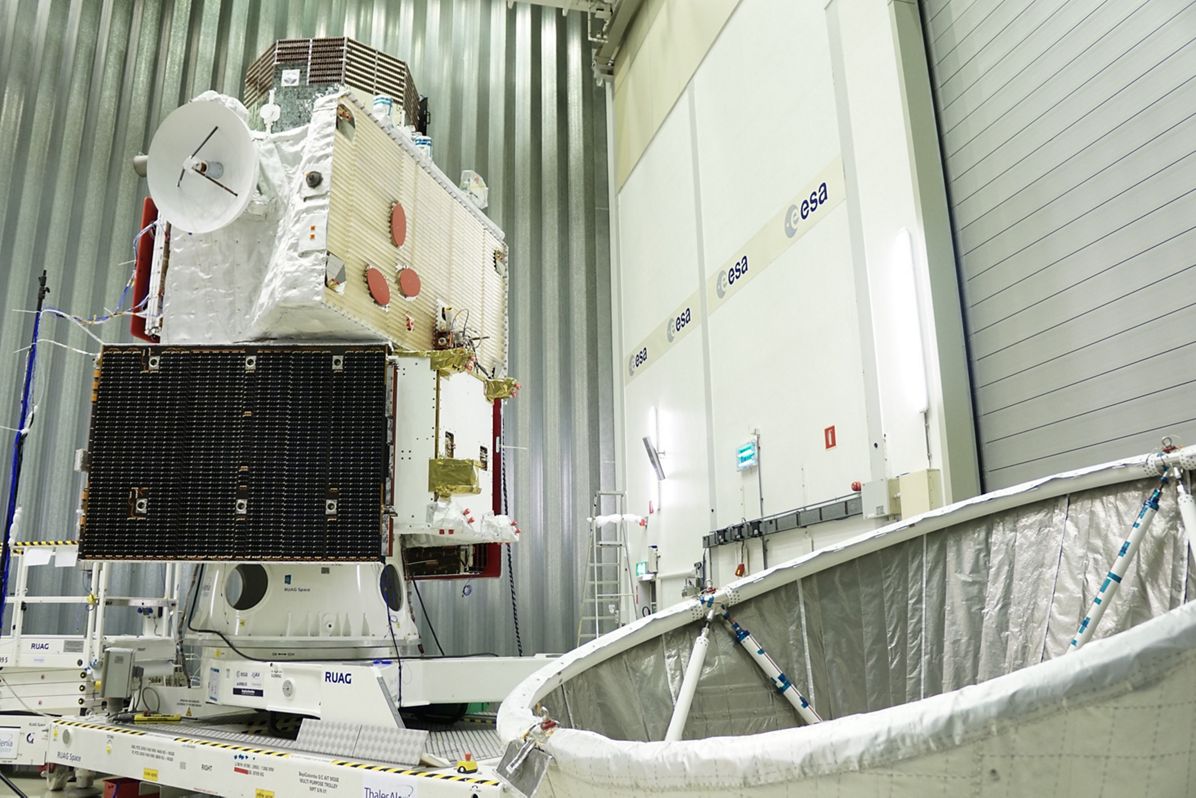
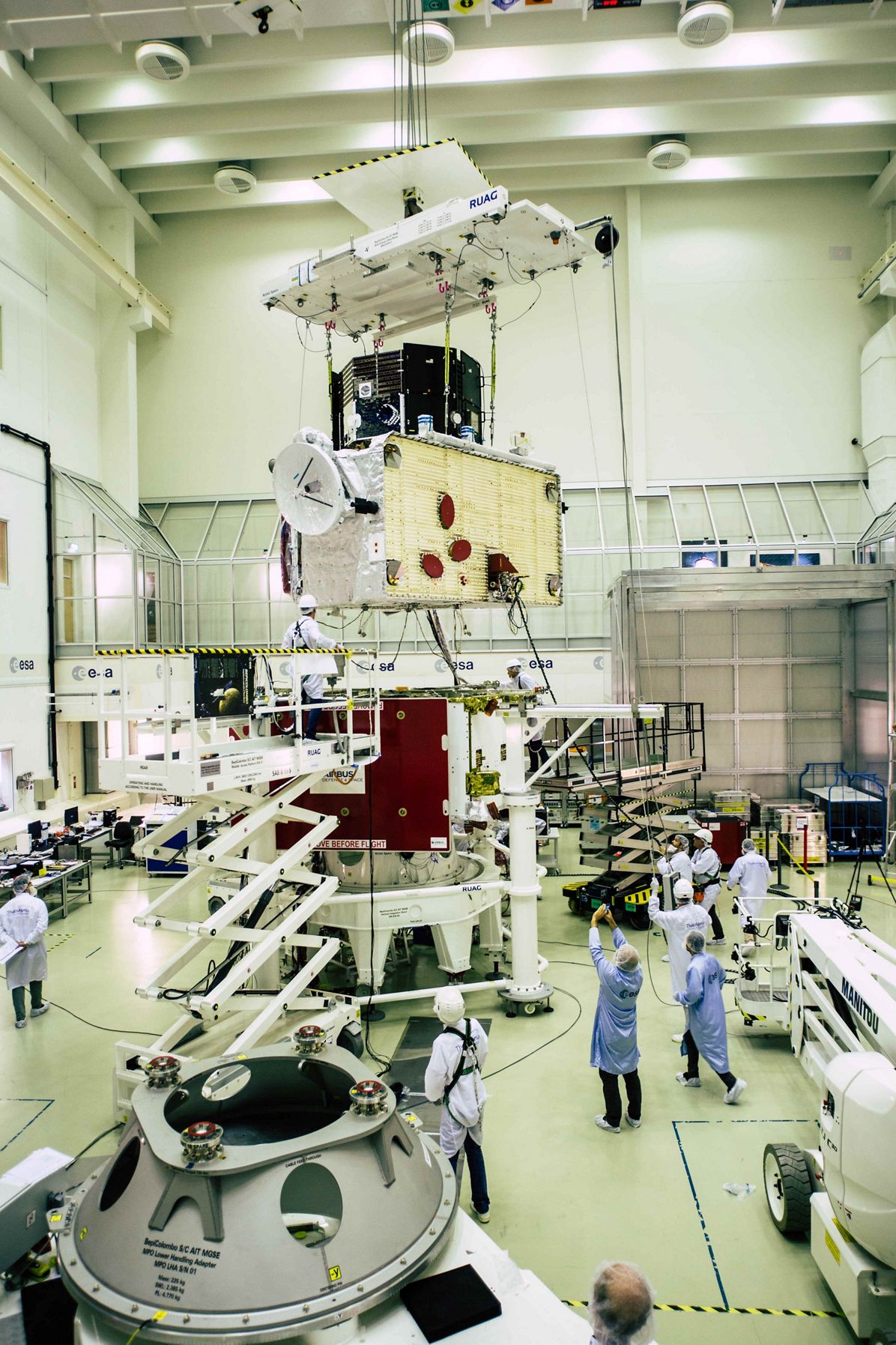
In a 6.4-metre stack, the spacecraft is undergoing final testing in flight configuration
Mercury remains the most mysterious planet of our inner Solar System. BepiColombo, Europe's first mission to Mercury, will set off in October 2018 on a journey to the smallest and least explored rocky planet in our Solar System.
The European Space Agency (ESA), the Japanese Aerospace Exploration Agency (JAXA) and Airbus - the industrial prime contractor leading a consortium of 83 companies from 16 countries - laid out the scientific goals of the mission and presented the impressive four element spacecraft, in a final viewing before its launch next year. Piled up in a 6.4 metre high stack, the 4 tonne BepiColombo spacecraft is close to finishing its test campaign. It will be shipped to Europe´s spaceport Kourou in French Guiana in March 2018.
The Sun’s glare makes it impossible to study Mercury in detail using telescopes and the extreme heat and proximity to the Sun make it hard to reach. So far, only two NASA missions have visited Mercury: Mariner 10 in the 1970’s and Messenger, which orbited the planet from 2011 until it ran out of fuel in April 2015.
ESA and JAXA have teamed up for the mission BepiColombo. Named after the Italian professor Giuseppe ‘Bepi’ Colombo, who was instrumental in making the Mariner 10 mission such a success, the mission is made up of two separate orbiters, the Mercury Planetary Orbiter (MPO supplied by ESA) and the Mercury Magnetospheric Orbiter (MMO supplied by JAXA).
The BepiColombo mission will examine the peculiarities of Mercury´s internal structure and magnetic field generation, and how it interacts with the Sun and solar wind. It will investigate surface features and chemistry, such as the ice in permanently shadowed craters at the poles. The mission's science will significantly improve our understanding of the formation of our Solar System, and the evolution of planets close to their parent stars.
Today is the last time that the complete stack will be on view in Europe. After testing the connection and separation systems with the Launch Vehicle Payload Adaptor System from Arianespace in late July the spacecraft will be disassembled by testing its module separation systems. Additional functional and performance checks will follow the mechanical test programme and then a final thermal test of the Transfer Module will be performed in November. At the end of March 2018, the spacecraft will be shipped to Kourou. Once in French Guiana, the team will reassemble the stack and install it on the Ariane 5 launch vehicle, with launch scheduled for October 2018. After a seven-year cruise, the Transfer Module will be ejected and the remaining modules will reach Mercury in December 2025.
Airbus Involvement
The prime contractor is Airbus in Friedrichshafen, Germany, with responsibility for the system design and realization, functional verification and the overall project management. The Stevenage, UK, team provided the structure and thermal systems for the MPO, and was responsible for the design and build of the MTM. Airbus in Madrid-Barajas, Spain, supplied the MTM structure.
The Electric Propulsion System employs 2 PPUs (Power Processing Units) developed by Airbus in Tres Cantos, Spain. These 48 kg units process 5 kW power each with which to drive the ion engines of the Electric Propulsion System. The PPUs are designed such that the 2 units can operate simultaneously any 2 of the 4 ion thrusters with which the propulsion module is equipped.
The MPO Solar Array, provided by Airbus in Ottobrunn, Germany, is a high temperature design operating at maximum 190°C, with specially developed components designed to be compatible with the thermal conditions. The solar array can deliver 2 kW. The thermal control of the array is achieved by a unique design involving a mix of cells and OSRs (glass mirrors) which occupy 17 percent of the panel area. The solar array is kept in a safe temperature range by controlling the tilt and continuously rotating the array as the spacecraft orbits Mercury.
The MTM Solar Arrays, provided by Airbus in Leiden, The Netherlands, are also of high temperature design operating at maximum 190°C and use the same technologies as the MPO. Whilst approaching the sun the solar array output increases, accompanied by an increase of temperature. Once the array temperature has reached 190°C (at about 0.5 AU) the array must be tilted, thereby reducing its projected area and limiting its output. The two wings total 40 m2 and have a mass of 290 kg.
Few infrastructure projects have the potential to reshape an island's future quite like the ongoing transformation of Nevis Airport. To gain deeper insight into this ambitious development and the...
Samson Sky has enlisted renowned Italian automotive designer Luigi Memola to develop the interior design of its Switchblade Flying Car, bringing world-class automotive styling expertise to the roadabl...
Qantas Freight and Australia Post have entered the next chapter of their long-standing partnership with the arrival of the first of three additional Airbus A321 Passenger-to-Freighter (A321P2F) aircra...
AMAC Aerospace Group continues to experience strong business momentum, marked by new certifications, contract wins and rising demand across its maintenance, completion and aircraft modification activi...