



US Patent and Trademark Office approved an application last June from Boeing’s Robert Budica, James Herzberg, and Frank Chandler for a laser- and nuclear-driven aeroplane engine.
With aeroplane makers constantly on the lookout for new and more efficient ways to power their products, this laser engine is the latest idea cooked up by the engineers at Boeing.
Modern airliners such as the Boeing Dreamliner are powered by multiple turbofan engines. These engines deploy a series of fans and turbines to compress air and ignite fuel to produce thrust.
Boeing’s patented engine provides thrust in a very different and rather novel manner. According to the patent filing, the laser engine may also be used to power rockets, missiles, and even spacecraft.
As of now, the engine lives only in patent documents. The technology is so out-there that it is unclear whether anyone will ever build it.
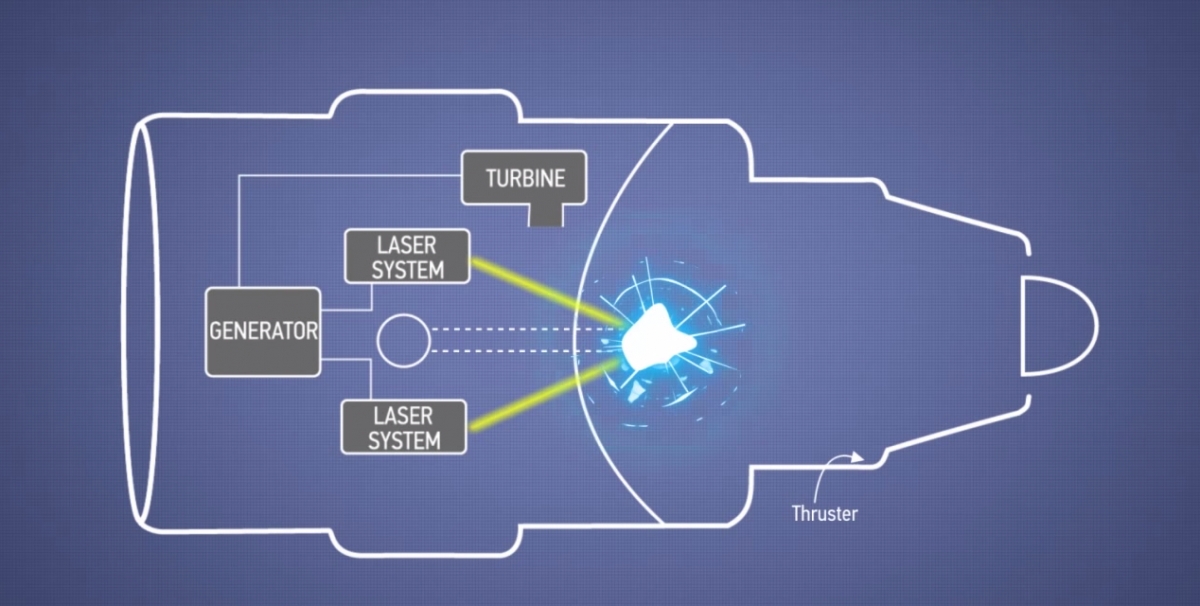
Here’s a look at the inner workings of Boeing’s futuristic engine with the help of some illustrations from PatentYogi.

Boeing's new jet engine works by firing high-power lasers at radioactive material, such as deuterium and tritium.

The lasers vaporise the radioactive material and cause a fusion reaction -- in effect a small thermonuclear explosion.

Hydrogen or helium are the exhaust byproducts, which exit the back of the engine under high pressure. Thrust is produced.

At the same time, the inside wall of the engine's thruster chamber -- coated in uranium 238 -- reacts with the high-energy neutrons produced by the nuclear reaction and generates immense heat.

The engine harnesses the heat by running coolant along the other side of the the uranium-coated combustion chamber.

This heat-energised coolant is sent through a turbine and generator that produces electricity to power the engine's lasers. Yes, lasers!

Other than the radioactive material, the engine requires very little in terms of external energy.

Here's Boeing's patent.
Cirrus Aircraft is celebrating the 10th anniversary of its Collier Trophy-winning Vision Jet at NBAA-BACE 2026, marking a decade of innovation that has continuously advanced the world&r...
Qantas Freight and Australia Post have entered the next chapter of their long-standing partnership with the arrival of the first of three additional Airbus A321 Passenger-to-Freighter (A321P2F) aircra...
The U.S. Federal Aviation Administration has certified the Boeing 737-10, the newest and largest member of the 737 MAX family, paving the way for Boeing [NYSE: BA] to begin customer deliveri...
Few infrastructure projects have the potential to reshape an island's future quite like the ongoing transformation of Nevis Airport. To gain deeper insight into this ambitious development and the...

