



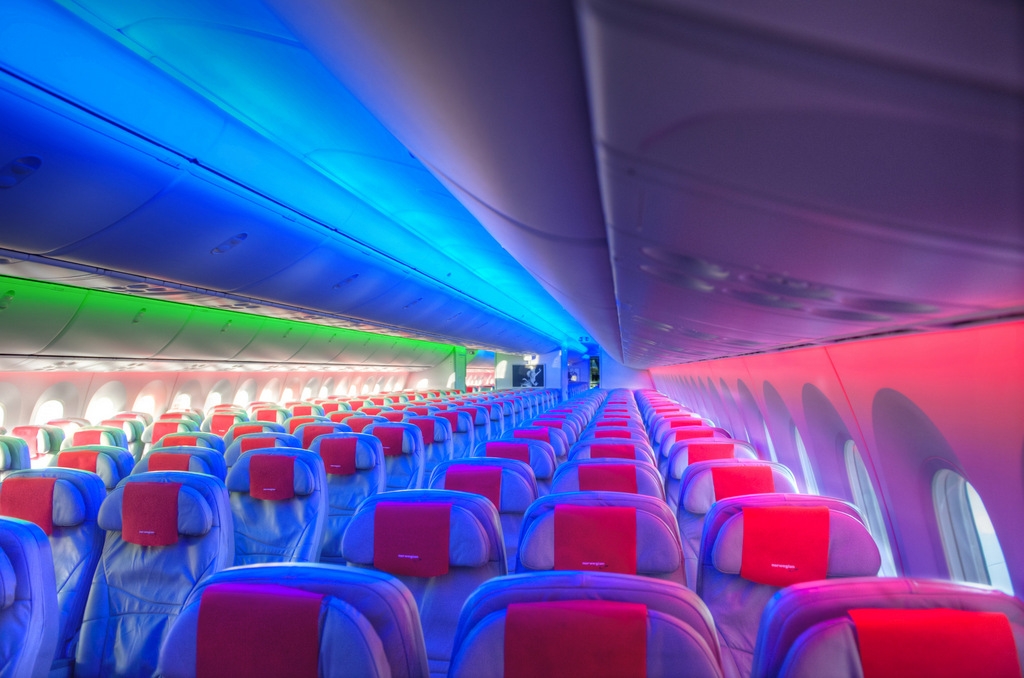
The right cabin design can make passengers feel that they have more room onboard, even when they don’t, and make flying a more pleasant experience.
So said Kent Craver, Director Cabin Experience & Revenue Analysis, Boeing, during the recent APEX Asia Conference in Singapore.
Craver cited research by Boeing’s cabin development group, which found that passenger perception of the onboard experience changes with improvements to core cabin interiors elements.
“We launched a very non-typical research project. We brought psychologist as a director of research who teamed up with cultural anthropologist,” Craver said. “We held focus groups and studies in major cities with cultures all around the world to understand what we, as humans, need.”
Craver said the group found that the tiresome process of air travel sets passengers on edge, long before they reach the aircraft. To adjust for that, Boeing focused on developing a welcoming aircraft design that compensates for the passengers’ potentially negative mindset at the time of boarding.
“What we started to bring with the 787 new interior philosophy was a way of creating even greater psychological space, using architecture and lighting..everything to work together,” Craver said. “This led to the welcoming architecture on the 787, and that information was then applied to other airplanes. We applied it to the 737, the Boeing Sky Interior, and we applied it to the 747 Intercontinental. We approached things..very differently than we had in the past.”
Through changes to cabin lighting and cabin architecture, Boeing found that passengers on otherwise identical aircraft felt better about cabin factors that had not changed, like seat width, legroom, and a general sense of crowding.
These findings were most evident during a comparison study of Norwegian Air Shuttle’s passengers on the 737 NG and 737 Boeing Sky Interior Aircraft.
While Norwegian flew the two types of aircraft in identical markets, and with identical cabin lay-outs (same seats, same pitch), passengers flying on the 737 Boeing Sky Interior reported greater satisfaction overall with their seating than passengers on the traditional 737 NG cabin interior.
Boeing’s study found, for example, that overall passenger satisfaction on the 737 aircraft which had Boeing’s Sky Interior was not affected by load factor (the overall number of passengers onboard). “It stayed pretty constant and that was a big surprise to us,” Craver said.
Additionally, passenger sense of pitch (the space between seats, or legroom) was better in the 737 Boeing Sky Interior aircraft, though the type of seats and the cabin lay-out in both aircraft types was identical.
“Norwegian Airlines is a 30-inch pitch airline. Like other airlines, some seats have a little more pitch and some a little less—some are 29-inch pitch, some 31-inch pitch. But we knew where people surveyed were seated, so we had a chance to look at it,” Craver explained. “As you would expect, the 29-inch pitch rated a little less than 30-inch, which was less than the 31″ on the original 737 interior. We expected that the Sky Interior would [perform a little better]. What we didn’t expect was that the 29-inch pitch passengers on the Boeing Sky interior actually gave higher ratings than those at 31-inch pitch on the 737 NG. This was completely unexpected.”
Additionally, when asked how eager they were to fly the aircraft again, 13.7% of respondents said they were very eager to fly on the 737 NG aircraft, and nearly double that number (25.6%) said they were eager to fly on the 737 Boeing Sky Interior aircraft.
Craver said these results led Boeing to conclude, “There is no one single element that drives passenger satisfaction. Everything involved contributes to that experience.”
This same interiors philosophy, and the work of this cabin studies group, continues to influence new Boeing aircraft designs, including the 777X aircraft which is still in development.
While saying that Boeing’s research has found “there is no difference in overall preference in Economy class between 9-abreast and 10-abreast” on the 777, as an example of the influence of holistic design, Craver granted that this halo effect has its limits.
“I think there are limits, absolutely,” he said. “You can be too narrow.”
However, Craver also pointed out that while passengers always want more, they are not always willing to pay more for it.
“That’s always the trade-off for everybody. It’s balancing all of those things and, from our perspective, we’d like to just provide as much flexibility as possible, and let the airline decide what’s best for their business.”
Few infrastructure projects have the potential to reshape an island's future quite like the ongoing transformation of Nevis Airport. To gain deeper insight into this ambitious development and the...
Viasat has significantly expanded the capacity of its JetXP in-flight connectivity service across the United States, delivering up to five times more bandwidth for business aviation customers equipped...
Cirrus Aircraft is celebrating the 10th anniversary of its Collier Trophy-winning Vision Jet at NBAA-BACE 2026, marking a decade of innovation that has continuously advanced the world&r...
Bombardier marked the 40th anniversary of its industry-leading Smart Services cost-per-flight-hour programs, which today support more than 1,500 enrolled aircraft and account for over 11 mil...

