

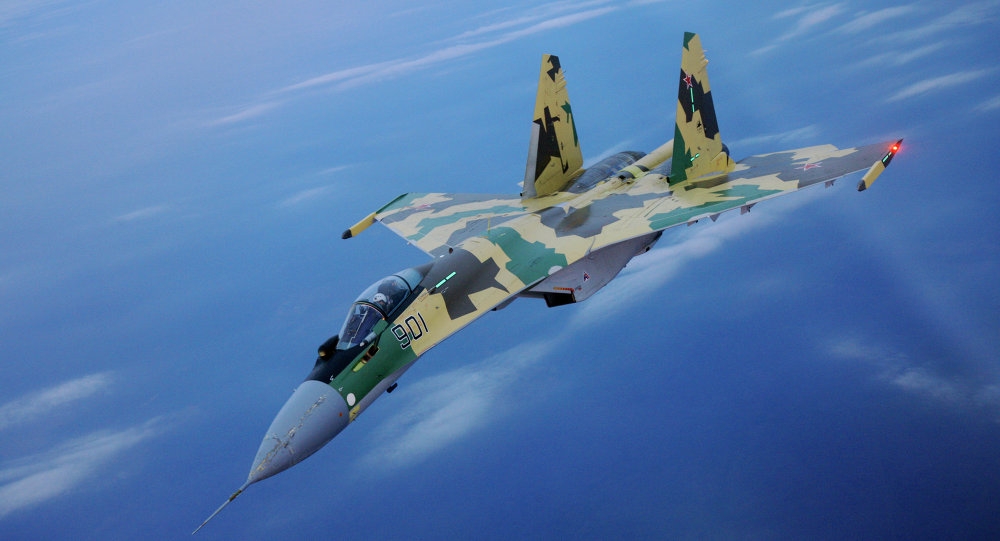
The first four Su-35 fighter jets from a 24 aircraft arms deal between the two allies are to be delivered before the end of the year according to a statement by the Komsomolsk-on-Amur aviation plant.
This week the governor of Khabarovsk Krai, a federal area located in the Russian Far East, said in a statement during the opening of a new aircraft production plant that China will receive the first four Russian-made Sukhoi Su-35 multirole fighter jets in consideration of a 24 aircraft deal between Moscow and Beijing signed in November of 2015.
From 2016 to 2018, the Komsomolsk-on-Amur Aircraft Production plant will build and deliver a total of 24 Su-35 combat jets to China, the governor said according to RIA news agency as part of the agreement first forged between the parties in late 2015.
The Diplomat explains that the "the Su-35 is a Fourth++ generation, twin-engine, highly maneuverable multirole fighter jet powered by two AL-117S turbofan engines. The Russian aircraft’s powerful turbofan engine is also the most likely reason why China is interested in acquiring Su-35 fighters."
The fighter jet has a maximum speed of 1,553 MPH (2500kmh) with advanced dry thrust and afterburner capabilities that enhance the aircraft’s dogfight maneuverability and semi-stealth design that makes it possibly the most lethal fighter jet in the sky. The Su-35 is Russia’s top air-superiority fighter, until the fifth-generation PAK-FA stealth fighter comes into production, with a clear maneuverability edge over existing fighter jets and a limited radar cross section after adjustments were made to the engine inlets and canopy as well as a series of modifications including the use of “radar-absorbent material” that gives the flanker a stealth-like profile.
The fighter jet comes armed with K-77M radar-guided missiles with a range of over 120 miles (193km) providing pilots with standoff capabilities ensuring pilot protection, an R-74 infrared-guided missiles that allow for targeting by a pilot using a helmet-mounted optical sight, and a thirty-millimeter cannon with 150 rounds for dogfight battles.
The acquisition of the Su-35 by the Chinese is a major boon for the country’s defense as well as its avionics industry. China has worked to produce its own turbofan akin to the Su-35’s, known as the WS-10 turbofan, but it continues to underperform the Russian-made AL-117S. If China is able to reverse engineer the technology they may be able to rapidly overcome their avionics gap with the West.

Qantas Freight and Australia Post have entered the next chapter of their long-standing partnership with the arrival of the first of three additional Airbus A321 Passenger-to-Freighter (A321P2F) aircra...
Gulfstream Aerospace has enhanced the capabilities of its Customer Support Performance Analytics program, further strengthening its ability to transform aircraft data into actionable insight...
Aviation Capital Group, the Newport Beach, California-based global aircraft asset manager, has signed a firm order for 75 additional Airbus A320neo Family aircraft, bringing its cumulative orders for...
Textron Aviation has marked a key milestone in the development of the Cessna Citation CJ4 Gen3 with the rollout of the program’s first production aircraft. The achievement brings the next-g...