



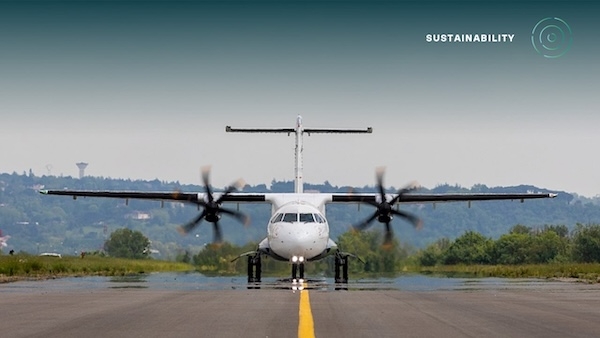
ATR was selection by the European Union’s Clean Aviation Joint Undertaking (Clean Aviation) to lead two groundbreaking initiatives set to redefine the future of low-emission regional aviation. As part of Clean Aviation’s Ultra-Efficient Regional Aircraft (UERA) thrust, ATR will spearhead two ambitious development projects aimed at demonstrating the integration of hybrid-electric propulsion, advanced propeller systems and electrified aircraft systems on a regional aircraft.
By 2030, ATR will achieve a world first: flying a hybrid-electric regional aircraft using an ATR 72-600 test bed. This breakthrough will be made possible through several projects, two of which will be led by ATR, with the support of the European Union, and in collaboration with international industry and research organisations, including Safran and RTX businesses Collins Aerospace and Pratt & Whitney Canada.

ATR’s flagship project, HERACLES, (Hybrid-Electric Regional Aircraft Concept for Low EmissionS), will define an ultra-efficient regional aircraft concept integrating hybrid-electric propulsion, high-performance batteries, and a thermal engine compatible with 100% Sustainable Aviation Fuel. These technologies will be flight-tested through DEMETRA (Demonstrator of an Electrified Modern Efficient Transport Regional Aircraft), using an ATR 72-600 flying test bed.
Nathalie Tarnaud Laude, Chief Executive Officer at ATR commented: “We are honoured to lead this transformative effort with the support of Clean Aviation. This is more than a technological demonstration, it’s a bold commitment to the future of regional aviation. By flying the world’s first hybrid-electric regional aircraft by 2030, we aim to further demonstrate that sustainability and connectivity can go hand in hand. These projects build on our unmatched legacy of fuel efficiency and position ATR at the forefront of the next generation of aviation.”
These initiatives support Clean Aviation’s strategic goal of achieving up to 30% improved fuel efficiency and significantly reduced carbon emissions for next-generation regional aircraft, targeting an entry into service by 2035. They align with the European Union’s climate ambitions, including the Fit for 55 package and the European Green Deal, and support the decarbonisation ambitions of the aviation industry.

Samson Sky has enlisted renowned Italian automotive designer Luigi Memola to develop the interior design of its Switchblade Flying Car, bringing world-class automotive styling expertise to the roadabl...
Qantas Freight and Australia Post have entered the next chapter of their long-standing partnership with the arrival of the first of three additional Airbus A321 Passenger-to-Freighter (A321P2F) aircra...
Gogo has unveiled its long-term vision for the Galileo connectivity platform at NBAA-BACE 2026, outlining a roadmap designed to enhance and protect customer investments well into the mid-2030s and bey...
Velocity Maintenance Solutions, an FAA-certified provider of maintenance, repair and overhaul services, has announced a significant expansion of its facilities at Wilmington Airport (ILG) in Delaware,...

