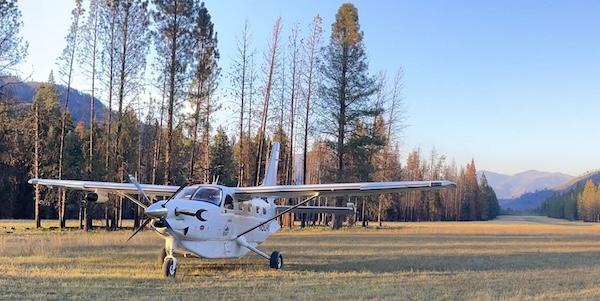
Daher Aircraft has flown its “go anywhere” Kodiak multi-role airplane into some of the most remote and challenging backcountry airstrips across the Pacific Northwest while delivering critical support for the U.S. Forest Service as part of a collaborative effort with the Recreational Aviation Foundation. The airlift utilized a Daher Aircraft-owned Kodiak 100 to transport equipment along with two U.S. Forest Service (USFS) contractor engineers and three Recreational Aviation Foundation volunteers during flights to a total of seven locations across Idaho.
Staged out of the historic Moose Creek Ranger Station airstrip (1U1), these missions involved 14 landings at backcountry locations that serve as critical access points for the USFS in firefighting, forest health monitoring, search & rescue, and recreational oversight.
Daher CEO Nicolas Chabbert commented: “Our Kodiak aircraft family is uniquely designed to meet the rigorous demands of such deployments, bringing short takeoff and landing performance, robust cargo capacity and excellent low-speed handling qualities together with rugged reliability.”
This latest collaboration with the Recreational Aviation Foundation is the eighth such joint effort during the past four years, underscoring Daher Aircraft’s dedication to supporting backcountry aviation in the United States.
The Kodiak’s large and easily reconfigurable cabin played an important role in the mission’s success, with its passenger seats removed and reinstalled as necessary when carrying the USFS contract engineers and RAF volunteers, along with a total of 12 firepits sourced by the Forest Service – each weighing approximately 80 pounds.
The four-day deployment involved airstrip surveys, surface condition assessments and deliveries of the fire pits with flights performed from the Moose Creek field base to Cayuse Creek (C64), Dixie (A05), Fish Lake (S92), Magee (S77), Orogrande (75C) and Wilson Bar (C48).
Paul Carelli, Daher Aircraft’s Senior Director of Multi-Mission Aircraft and Business Development for the Americas said: “We flew to extremely remote locations where high elevations, short field lengths and blind approaches require an airplane that guarantees both performance and flexibility. The Kodiak’s short takeoff and landing capabilities, slow approach speeds, and the designed-in resistance to stalls and spins make it ideal for these missions.These 10-seat turboprop-powered airplanes are in the 7,000-8,000-lb. maximum takeoff weight categories, and they handle such 1,500-foot airstrips as Wilson Bar with no problem. The Kodiak 100 and Kodiak 900 carry much higher payloads into the backcountry than smaller aircraft, and there are no others in their category that can match them.”
Carelli added that the Kodiak 100 – along with Daher’s larger, faster Kodiak 900 – are perfectly suited for such challenging airfields (several of which are labeled on the navigation charts as “hazardous”), even when the aircraft are fully loaded with personnel and equipment.
In citing an example of the challenging operating conditions faced during the recent deployment, Carelli said the Fish Lake airstrip has a posted sign warning that five aircraft have crashed into the lake in past takeoff accidents.
Archived
1 year ago


The U.S. Federal Aviation Administration has certified the Boeing 737-10, the newest and largest member of the 737 MAX family, paving the way for Boeing [NYSE: BA] to begin customer deliveri...
Daher Aircraft announced the delivery of a Kodiak 900 to Swiss owners Roland and Claudia Primus, who plan to use the aircraft for adventure flying to remote and short-runway destinations. Their travel...
Textron Aviation has marked a key milestone in the development of the Cessna Citation CJ4 Gen3 with the rollout of the program’s first production aircraft. The achievement brings the next-g...
AMAC Aerospace Group continues to experience strong business momentum, marked by new certifications, contract wins and rising demand across its maintenance, completion and aircraft modification activi...