



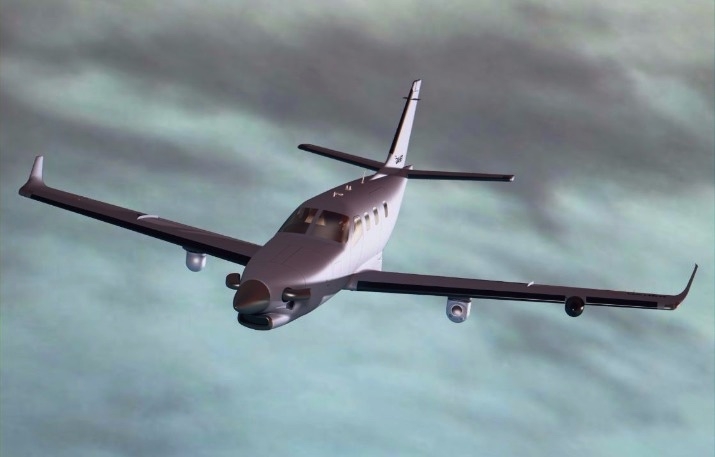
Daher today announced a new configuration of its TBM 910 and TBM 930 high-speed single-turboprop aircraft as efficient and capable platforms for intelligence, surveillance and reconnaissance (ISR) missions.
The enhanced ISR capability for Daher’s in-production TBM family aircraft was announced at Eurosatory 2018, the international defense and security show being held June 11-15 at the Paris Nord Villepinte exhibition center (Daher booth is K99 in the hall 6).
This new TBM configuration is characterized by underwing hardpoints with electrical connections that enable the aircraft to be equipped with various sensors and large-format cameras. A Daher flight test campaign, followed by the use of a 110-lb. (50 kg.) ultra-high definition camera for photo-taking trials, validated that the TBM retains its handling qualities and flight envelope performance in the ISR configuration.
In addition to photographic duties, the TBM 910/TBM 930 ISR version can perform surveillance missions with a multi-sensor optronic retractable turret, as well as Synthetic Aperture Radar/Ground Moving Target Indicator radar (SAR/GMTI), a communication interception system, and secure transmission means. In the cabin, a quick-change console can be mounted behind the pilot for an operator in charge of the various systems and tactical situation monitoring.
"The new TBM ISR version brings a fast, all-weather airborne platform to the market for surveillance operations and aerial photography, with a very competitive cost-performance ratio compared to existing solutions,” commented Nicolas Chabbert, director of the Daher Airplane Business Unit. “As a result, we are now offering the TBM ISR as an alternative – or complement – to medium-altitude, long-endurance (MALE) unmanned aerial vehicles and to heavier aircraft in a platform that is rapid and efficient to deploy, with limited logistics requirements.”
In the ISR configuration, the TBM 910 and TBM 930 can fulfill a wide range of defense, security, medical evacuation and transport missions, benefitting from the autonomy of more than six hours on a surveillance mission, and the ability to be reconfigured rapidly for its various duties.
Advantages of the TBM 910 and TBM 930 ISR include:
- Higher speed range for sensitive missions and rapid travel time to the mission zone,
- Reduced external noise for discretion,
- Reduced takeoff and landing distances, enabling operations from 2,455-ft. (750- meter) runways,
- Sufficient power generation allowing a full range of mission equipment to be integrated,
- A modern human-machine interface (main functions available on control yoke, single power lever), allowing the crew to fly comfortably during long-duration missions.

Samson Sky has enlisted renowned Italian automotive designer Luigi Memola to develop the interior design of its Switchblade Flying Car, bringing world-class automotive styling expertise to the roadabl...
Qantas Freight and Australia Post have entered the next chapter of their long-standing partnership with the arrival of the first of three additional Airbus A321 Passenger-to-Freighter (A321P2F) aircra...
The Tennessee Valley Authority is demonstrating the real-world value of the Tecnam P2012 Special Mission Platform (SMP), which has become a vital tool for monitoring and maintaining its...
Viasat has significantly expanded the capacity of its JetXP in-flight connectivity service across the United States, delivering up to five times more bandwidth for business aviation customers equipped...

