



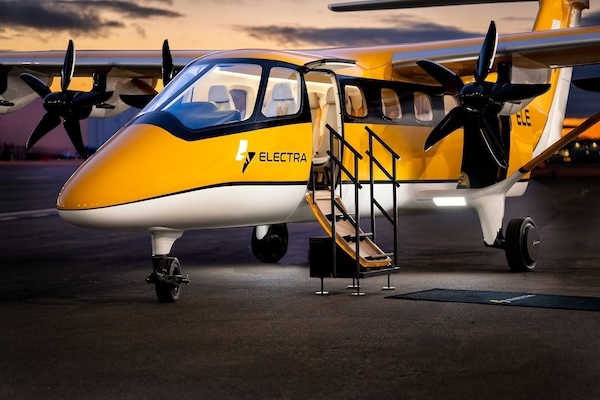
Electra and The Atlas Group today announced a landmark airframe agreement for the EL9 Ultra‑Short aircraft, uniting Electra’s next‑generation design with Atlas’s established aerospace manufacturing capabilities as the program progresses through flight testing, certification, and preparation for scaled commercial production.
Electra is developing the EL9 Ultra‑Short to unlock Direct Aviation — a new model of regional mobility that brings air service closer to where people live, work, and play. Designed to carry nine passengers and meaningful payload while taking off and landing in as little as 150 feet, the EL9 can operate from dramatically smaller sites, enabling shorter, more direct connections between communities instead of forcing travelers into long drives or distant, congested airports.
Under the agreement, Atlas will manufacture and assemble EL9 airframes to support Electra’s flight‑test and certification campaign. Production activities begin this month at Atlas’s facilities, with initial deliveries planned for 2027. The partnership represents a major milestone in Electra’s progress toward certification and commercial entry into service, leveraging Atlas’s extensive expertise in aerospace manufacturing, complex aerostructures, production‑system development, and advanced automated fabrication. The two teams will work closely to mature the EL9 production architecture, reduce manufacturing risk, and build the industrial foundation needed to scale output after certification.
Marc Allen, CEO of Electra commented: "Today's agreement with The Atlas Group is another great milestone in Electra's journey to open a new era of aviation. The EL9 is designed to transform how people travel and where aviation serves us all. Realizing this vision requires more than a breakthrough aircraft; it requires the ability to build and deliver it with the consistency and scale of an advanced production system. Atlas, with its manufacturing expertise and aerospace discipline, now joins us in turning the EL9 from a new kind of airplane into a new way of connecting communities."
Greg Harwell, CEO of The Atlas Group stated: "We are excited to be a part of the Electra team as we engage in transforming a groundbreaking hybrid-electric aircraft concept into a producible, scalable platform. Atlas brings decades of expertise in aerospace manufacturing, industrialization, and supply chain execution to help bridge the gap between innovation and production, ensuring the EL9 is positioned for successful growth and long-term market adoption."
The EL9 is a nine‑passenger hybrid‑electric aircraft engineered for takeoff and landing in as little as 150 feet, enabling operations from compact sites located much closer to where people live, work, and travel than traditional airports. Its blown‑lift aerodynamics and distributed electric propulsion deliver the lift required for Ultra‑Short operations, while an efficient turbogenerator provides the electrical power needed to support practical regional range and payload.
By combining the proximity and accessibility of helicopter operations with the speed, comfort, and flexibility of a fixed‑wing aircraft, the EL9 is designed to make direct regional air travel both feasible and scalable. It is intended to offer quiet, safe, and cost‑effective service with meaningful payload and practical range from far more locations than conventional aircraft can serve today.
Electra’s agreement with Atlas comes as the company accelerates its progression from successful Ultra‑Short technology demonstrations toward full certification, production, and commercial launch of the EL9.
In July, the FAA formally established the EL9's certification basis, defining the framework for several industry firsts including distributed hybrid-electric propulsion, blown lift for ultra-short takeoff and landing, and advanced fly-by-wire flight controls. Electra has also entered a life-of-program development and production agreement with Safran for the TG600 turbogenerator that will power the EL9.
Electra has selected Springfield, Ohio, as the home of its first EL9 production facility. The planned $850 million investment will create nearly 2,000 jobs and is designed to ultimately support production of up to 800 aircraft annually. Together, Electra's production campus and a growing network of experienced aerospace partners are creating the industrial base needed to move the EL9 from certification into high-rate commercial production.
Those investments are being driven by a regional mobility market that already exists at significant scale. Electra's Direct Aviation Market Outlook identifies approximately 35 million passenger trips each day across U.S. regional routes between 50 and 500 miles. In the heart of the market, trips between roughly 50 and 250 miles are too long to drive and too short to fly, leaving most travelers with few practical alternatives.
Electra estimates that serving the modeled Direct Aviation market between 2030 and 2040 will require 12,000 to 16,000 EL9 aircraft. The company has secured more than 2,200 provisional aircraft orders from more than 60 operators worldwide, and earlier this year Bristow Group entered into a pre-delivery payment agreement securing the first EL9 delivery slot for five aircraft, with options for an additional 45, subject to certification.
The EL9 is targeting entry into commercial service in 2030.
Archer Aviation has unveiled plans to develop three air taxi networks across Austin, Dallas-Fort Worth and Houston, aiming to improve connectivity between major airports, business centers and key regi...
PAL-V has appointed Nobleo Manufacturing as its strategic industrialisation partner for the world’s first FlyDrive production facility. Following the achievement of both automotive and aviation...
MTU Maintenance and Garuda Indonesia have entered into a three-year agreement for the maintenance, repair and overhaul of the airline’s GE90-115B engines, which power its fleet of eight Boeing 7...
Private jet catering requires an understanding of the journey as much as the passengers' preferences. SkyDine Jet Catering explores how flight duration, departure schedules, airport location, and...

