



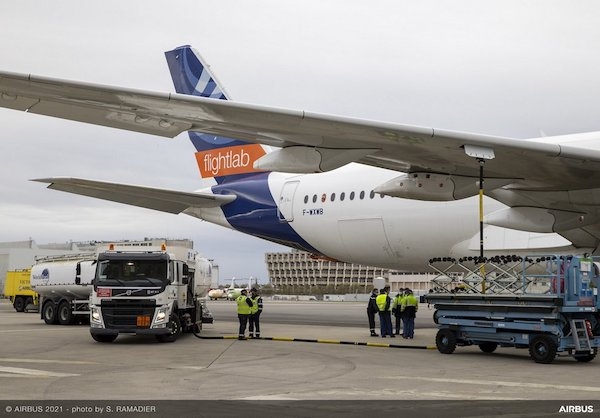
A team of aerospace specialists has launched the world’s first in-flight emissions study using 100% sustainable aviation fuel (SAF) on a wide-body commercial passenger aircraft. Airbus, German research centre DLR, Rolls-Royce and SAF producer Neste have teamed up to start the pioneering ‘Emission and Climate Impact of Alternative Fuels’ (ECLIF3) project looking into the effects of 100% SAF on aircraft emissions and performance.
Findings from the study - to be carried out on the ground and in the air using an Airbus A350-900 aircraft powered by Rolls-Royce Trent XWB engines - will support efforts currently underway at Airbus and Rolls-Royce to ensure the aviation sector is ready for the large-scale use of SAF as part of the wider initiative to decarbonise the industry.
Fuel-clearance engine tests, including a first flight to check operational compatibility of using 100% SAF with the aircraft’s systems, started at Airbus’ facilities in Toulouse, France, this week. These will be followed by the ground-breaking flight-emissions tests due to start in April and resuming in the Autumn, using DLR’s Falcon 20-E ‘chase plane’ to carry out measurements to investigate the emissions impact of using SAF. Meanwhile, further ground tests measuring particulate-matter emissions are set to indicate the environmental impact of SAF-use on airport operations.
Both the flight and the ground tests will compare emissions from the use of 100% SAF produced with HEFA (hydroprocessed esters and fatty acids) technology against those from fossil kerosene and low-sulphur fossil kerosene.
The SAF will be provided by Neste, a leading worldwide supplier of sustainable aviation fuel. Additional measurement and analysis for the characterisation of the particulate-matter emissions during the ground testing will be delivered by the UK’s University of Manchester and the National Research Council of Canada.
“SAF is a vital part of Airbus' ambition to decarbonise the aviation industry and we are working closely with a number of partners to ensure a sustainable future for air travel,” said Steven Le Moing, New Energy Programme Manager, Airbus. “Aircraft can currently only operate using a maximum 50% blend of SAF and fossil kerosene; this exciting collaboration will not only provide insight into how gas-turbine engines function using 100% SAF with a view to certification, but identify the potential emissions reductions and environmental benefits of using such fuels in flight on a commercial aircraft too."
Dr Patrick Le Clercq, ECLIF Project Manager at DLR, said: “By investigating 100% SAF, we are taking our research on fuel design and aviation climate impact to a new level. In previous research campaigns, we were already able to demonstrate the soot-reduction potential of between 30 and 50% blends of alternative fuels, and we hope this new campaign will show that this potential is now even greater.
“DLR has already conducted extensive research on analytics and modelling as well as performing ground and flight tests using alternative fuels with the Airbus A320 ATRA research aircraft in 2015 and in 2018 together with NASA.”
Simon Burr, Director Product Development and Technology, Rolls-Royce Civil Aerospace, added: “In our post-COVID-19 world, people will want to connect again but do so sustainably. For long-distance travel, we know this will involve the use of gas turbines for decades to come. SAF is essential to the decarbonisation of that travel and we actively support the ramp-up of its availability to the aviation industry. This research is essential to support our commitment to understanding and enabling the use of 100% SAF as a low-emissions solution.”
Jonathan Wood, Neste’s Vice President Europe, Renewable Aviation, added: “We’re delighted to contribute to this project to measure the extensive benefits of SAF compared with fossil jet fuel and provide the data to support the use of SAF at higher concentrations than 50%. Independently verified analysis has shown 100% Neste MY Sustainable Aviation Fuel delivering up to 80% reduction in greenhouse gas emissions compared to fossil jet fuel use when all life-cycle emissions are taken into account; this study will clarify the additional benefits from the use of SAF."

Viasat has significantly expanded the capacity of its JetXP in-flight connectivity service across the United States, delivering up to five times more bandwidth for business aviation customers equipped...
Piaggio Aerospace will return to NBAA-BACE this October, bringing its flagship P.180 Avanti EVO to one of the most important gatherings of the global business aviation community while also highlightin...
TARMAC Aerosave has set a new industry benchmark by becoming the first company in the world to secure Aircraft Fleet Recycling Association (AFRA) accreditation across all three scopes of aircraft disa...
Textron Aviation has marked a key milestone in the development of the Cessna Citation CJ4 Gen3 with the rollout of the program’s first production aircraft. The achievement brings the next-g...

