



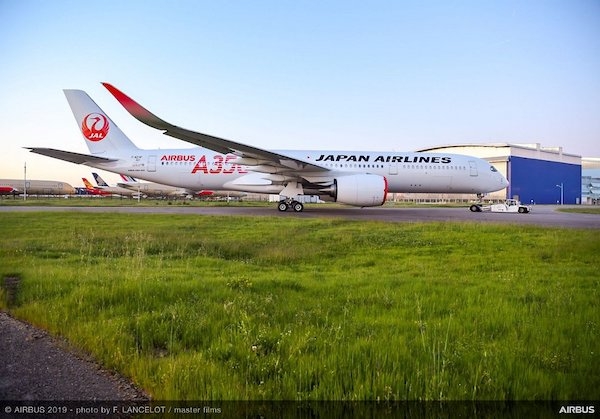
The first A350 XWB for Japan Airlines (JAL) has rolled out of the Airbus paint shop in Toulouse, France. The A350-900 is the first ever Airbus aircraft to be produced directly for JAL and features a special A350 red logo on the fuselage.
The aircraft will now proceed to ground and flight tests, before delivery to JAL in early summer.
In total JAL has ordered 31 A350 XWB aircraft, comprising 18 A350-900s and 13 A350-1000s. The A350-900 will initially be operated on major domestic routes, with a three class configuration seating 369 passengers.
The A350 XWB is the world’s most modern and eco-efficient aircraft family shaping the future of air travel. It is the long-range leader in the large wide-body market (300 to 400+ seats). The A350 XWB offers by design unrivalled operational flexibility and efficiency for all market segments up to ultra-long haul (15,000km).
The A350 XWB features the latest aerodynamic design, carbon fibre fuselage and wings, plus new fuel-efficient Rolls-Royce engines. Together, these latest technologies translate into unrivalled levels of operational efficiency, with a 25 per cent reduction in fuel burn and emissions. The A350 XWB’s Airspace by Airbus cabin is the quietest of any twin-aisle and offers passengers and crews the most modern in-flight products for the most comfortable flying experience.
At the end of March 2019, the A350 XWB Family had received 890 firm orders from 50 customers worldwide, making it one of the most successful wide-body aircraft ever.

BPE Air, the aviation company founded and wholly owned by entrepreneur Aldrew Crowe, reported approximately US$90 million in revenue in 2025, marking a major milestone in the growth of its integrated...
Bristow Group Inc., in partnership with Electra, Avinor and the Norwegian Civil Aviation Authority (CAA Norway), will undertake a series of demonstration flights across five locations in Norway using...
Gulfstream Aerospace has enhanced the capabilities of its Customer Support Performance Analytics program, further strengthening its ability to transform aircraft data into actionable insight...
TARMAC Aerosave has set a new industry benchmark by becoming the first company in the world to secure Aircraft Fleet Recycling Association (AFRA) accreditation across all three scopes of aircraft disa...

