



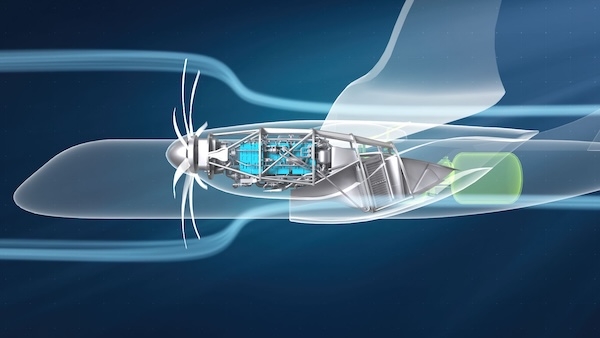
MTU Aero Engines has made significant progress in developing its Flying Fuel Cell and remains on track: after successful testing of the central hydrogen and air supply systems, the first integrated demonstrators are now entering the next phase. At the same time, MTU and Airbus are industrializing the revolutionary engine technology. MTU is also working with EASA to create the conditions for its approval. In the process, MTU’s hydrogen-fuel cell propulsion system is gaining maturity.
Supply systems validated
The successful tests of the energy and supply systems mark an important developmental step for the FFC. After the liquid Hydrogen Fuel System was validated, testing of the Fuel Cell Hydrogen System was also successfully completed. This system, which supplies gaseous hydrogen to the fuel cell, held up under rigorous operating conditions. The air supply tests also went well - central performance and regulation models were validated at the MTU site in Munich, and were qualified for the next development steps. The two supply systems form the basis for the upcoming integration and demonstration programs.
Building the demonstrators
Following the supply system tests, the focus will now shift to integrated testing of the FFC. The first close-to-production 350 kW fuel cell stack is now being built at MTU in Munich. At the same time, a full-system demonstrator is also being built here, where the interactions between all of the components, subsystems, and regulation functions can be tested. The goal is to demonstrate the overall system’s performance under flight conditions, and to gain more information for developing a later aircraft propulsion system. Both test campaigns will start this year in Munich. They will lay the groundwork for the next phase of technology validation and scaling. The test runs will take place in the two fuel-cell test cells, which are currently being put into operation.
HEROPS design finalized
The European clean aviation research project HEROPS (Hydrogen-Electric Zero Emission Propulsion System) is making a significant contribution to help realize the FFC. Together with partners, MTU is developing technologies for a hydrogen-driven powertrain that could power regional airplanes starting in 2035. Now that the design phase is complete, the focus will be on validating the key technologies. The centerpiece is a system scaled for 1.8 megawatts, which is being developed and simulated at MTU in Munich. It will prove the feasibility of the groundbreaking new technologies and demonstrate that they can be scaled to outputs between two and four megawatts, based on a modular engine architecture.
MTU and Airbus MTU plan joint venture for fuel cell propulsion systems
In addition to the technological advances, industrial implementation is gaining momentum. In early July, MTU and Airbus announced they would be deepening their collaboration in the area of hydrogen-based fuel-cell propulsion systems. “Our ambitious goal is to pave the way for a newly developed, safe, reliable and economical propulsion system that will contribute to climate-neutral aviation,” explained Dr. Stefan Weber. MTU's SVP Engineering and Technology described the project as a “crucial milestone” on the path to the first hydrogen-powered propulsion system, and as “true European technology leadership”. The project will establish an enterprise that covers the entire life cycle – technology, development and testing, production and certification, market launch and customer support. The partners started collaborating last year.
Certification partnership with EASA
MTU has been working with EASA for five years now, developing the groundwork for certifying flying fuel cells. The partnership makes it possible to include regulatory requirements in the development early on, paving the way for later type certification. Since the technology and the corresponding certification standards are new territory for both partners, the collaboration is especially important. By renewing the innovation partnership, MTU and EASA are continuing their collaboration on a reliable regulatory framework for the next generation of zero-emission aviation propulsion systems.
Avolon, one of the world’s leading aviation finance companies, has reinforced its long-term growth strategy with a firm order for 110 Airbus aircraft, including 35 A330-900 widebodies and 75 A32...
Airbus Helicopters Canada has partnered with the Saskatchewan Indian Institute of Technologies (SIIT) to strengthen Indigenous participation in the aerospace sector through enhanced training and workf...
Bombardier has expanded its customer support capabilities in the Asia-Pacific region with the launch of a new Line Maintenance Station in Sydney, Australia. The facility enhances operational convenien...
Skandia’s King Air 200/300 soundproofing kit has received final approval from Brazil’s ANAC, opening the door for wider adoption among operators across the country. The certifica...

