




While a helicopter serves many purposes, one of the most common is aerial surveillance and/or video and photography. How many times have you turned on your local news and watched a slow pan across rush hour traffic, or looked on in horror as the national news presents you with a birds-eye view of the latest natural or man-made disaster? Of course, now there are drones moving in to the aerial photography space, but helicopters are still widely used for the purpose, and it’s one of those technologies that most of us tend not to think about too closely, in terms of the mechanics behind it.
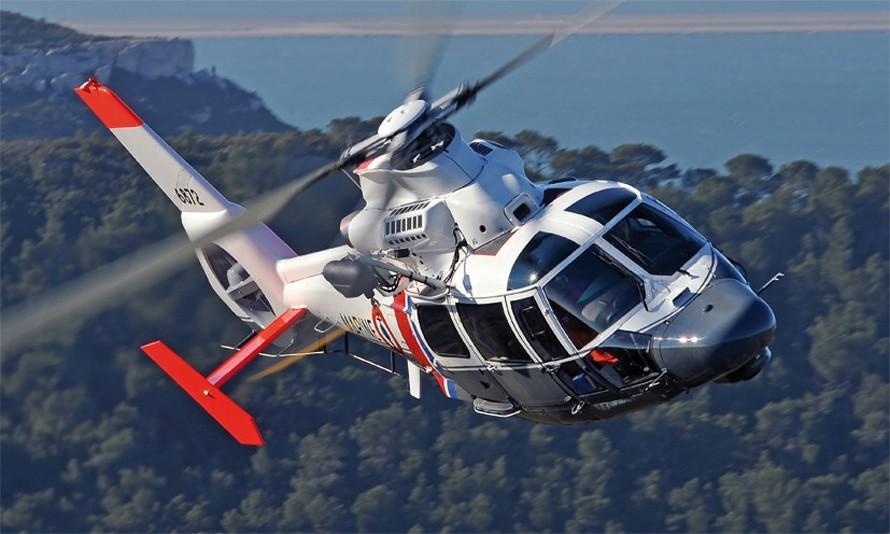
Like just about everything, though, a tremendous amount of thought and work goes into mounting a camera on a helicopter, and Airbus Helicopters is currently working to optimize their design by creating a camera mount extension to help police or military forces more effectively follow movement on the ground. It’s not a simple process, but – surprise! – the company has found that 3D printing is making things a lot faster, easier and less expensive.
Airbus Helicopters is a big fan of German RepRap, as evidenced recently when they used the company’s X400 industrial 3D printer to develop and prototype more effective windshield wipers for their helicopters. Now Airbus is turning to the X400 again to prototype their new camera mount extensions.
Extra support elements are required on the helicopter’s cockpit frame in order to mount a camera on the front. It may sound simple to design a camera frame in CAD, but there’s a lot more work that goes to into it to get the right fit. First, the frame is designed according to the measurements of the helicopter and mounting space available, and it doesn’t take long to 3D print a functional prototype, which can then be tested to see how it interacts with the helicopter’s other components. That’s just the first step, though.
“Different tests are required in order to examine functionality and maintainability,” said Frank Singer, manager of Vehicle System Installation Germany at Airbus Helicopters Deutschland GmbH. “The later suitability of the installation and the manufacturing process also have to be examined.”
The first fit check allows the designers to assess the part’s suitability, which can’t full be done in CAD. However, any adjustments that need to be made to the part’s shape and fit can be done in the CAD program onsite, at which point a new prototype can be quickly printed and tested, and additional adjustments made until the perfect fit is finally obtained. Thanks to 3D printing, it’s a pretty quick and easy process, but that wouldn’t be the case with other manufacturing methods.
“Using a conventional process would require cutting,” Singer continued. “For example, a part would be cut from aluminum – a far less attractive process in terms of the cost and time required.”
To give you a concrete idea of the difference between additive and traditional manufacturing, German RepRap has assessed that while 3D printing the needed part takes about six hours, cutting that same part from aluminum would require two to three days, factoring in external production and delivery time. Meanwhile, 3D printing the part costs about €50, as opposed to €120 for external machining.
“The application at Airbus Helicopters Deutschland GmbH very clearly shows the benefits of manufacturing prototypes with our German RepRap 3D printer,” said Florian Bautz, CEO of German RepRap. “Besides the obligatory time and cost savings, the internal prototype manufacturing using the FDM procedure also offers greater freedom in the design process.”
So there you have it. It should come as no surprise to anyone even remotely interested in 3D printing that the technology delivers such huge cost and time savings – we hear it over and over again, after all. But it’s always nice to see real-world examples.
Viasat has significantly expanded the capacity of its JetXP in-flight connectivity service across the United States, delivering up to five times more bandwidth for business aviation customers equipped...
Qantas Freight and Australia Post have entered the next chapter of their long-standing partnership with the arrival of the first of three additional Airbus A321 Passenger-to-Freighter (A321P2F) aircra...
The Tennessee Valley Authority is demonstrating the real-world value of the Tecnam P2012 Special Mission Platform (SMP), which has become a vital tool for monitoring and maintaining its...
Daher Aircraft will present its TBM and Kodiak aircraft families at next week’s NBAA Business Aviation Convention & Exhibition (NBAA-BACE), showcasing how their combination of performance, e...

