



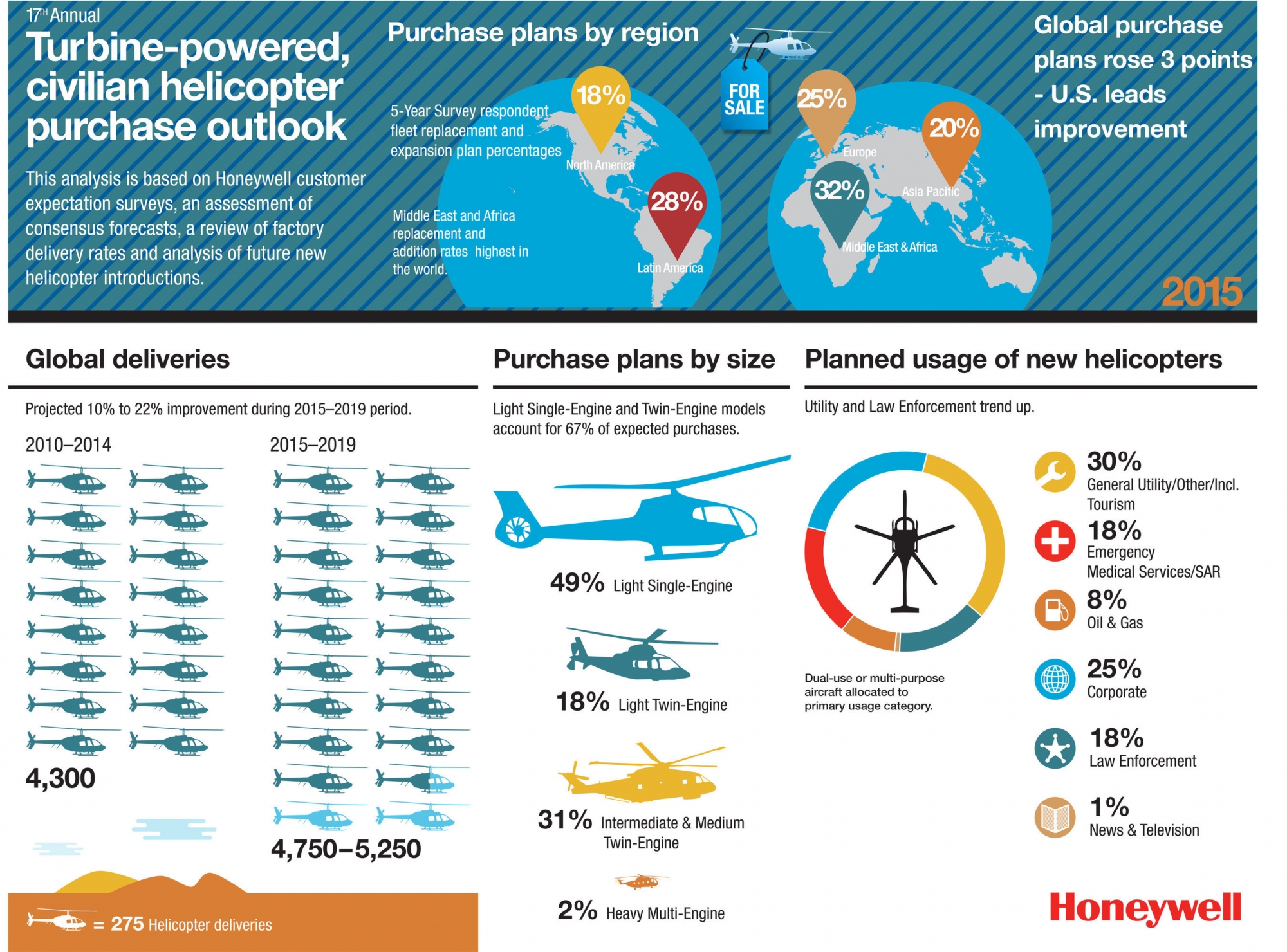
In the face of a slower global economic growth environment and increased volatility in oil and gas-related markets, the helicopter industry is reacting with a cautious outlook for near-term new purchases. In its 18th annual Turbine-Powered Civil Helicopter Purchase Outlook, Honeywell forecasts 4,300 to 4,800 civilian-use helicopters will be delivered from 2016 to 2020, roughly 400 helicopters lower than the 2015 five-year forecast.
"The current global economic situation is causing fleet managers to evaluate new helicopter purchases closely, and that's why we're seeing a more cautious five-year demand projection compared with previous years," said Carey Smith, president, Defense and Space at Honeywell Aerospace. "Even in a slower growth environment, Honeywell is well-positioned to help operators keep current fleets lasting longer with aftermarket upgrades and repairs."
Key global findings in the outlook include:
Helicopter Use Expected to Increase
Regional Overview
Latin America The 2016 results show strong fleet replacement and growth expectations, well above the world average, rising 8 percentage points over the prior year.
Middle East and Africa This region has the second-highest new purchase rate among the regions, with up to 30 percent of respondent fleets slated for turnover with a new helicopter replacement or addition.
North America Purchase expectations fell 2 percentage points in this year's survey but still provide a strong base of demand for light single-engine and intermediate or medium twin-engine platforms.
Europe Purchase plans decreased slightly with continued weakness in reported Russian buying plans.
BRIC countries (Brazil, Russia, India and China) Demand continues to ebb and flow with stronger results recorded for India andBrazil in the 2016 survey.
Methodology
The 2016 outlook presents a snapshot of the helicopter business at a point in time and reflects the current business and political environment. This year's survey queried more than 1,000 chief pilots and flight department managers of companies operating 3,070 turbine and 360 piston helicopters worldwide. The survey excluded large fleet or "mega" operators, which were addressed separately. Input received from large oil and gas support and emergency medical service fleet operators is factored into the overall outlook in addition to the individual flight department responses. The survey detailed the types of aircraft operated and assessed specific plans to replace or add to the fleet with new aircraft.


Velocity Maintenance Solutions, an FAA-certified provider of maintenance, repair and overhaul services, has announced a significant expansion of its facilities at Wilmington Airport (ILG) in Delaware,...
Bristow Group Inc., in partnership with Electra, Avinor and the Norwegian Civil Aviation Authority (CAA Norway), will undertake a series of demonstration flights across five locations in Norway using...
Cirrus Aircraft is celebrating the 10th anniversary of its Collier Trophy-winning Vision Jet at NBAA-BACE 2026, marking a decade of innovation that has continuously advanced the world&r...
Few infrastructure projects have the potential to reshape an island's future quite like the ongoing transformation of Nevis Airport. To gain deeper insight into this ambitious development and the...

