



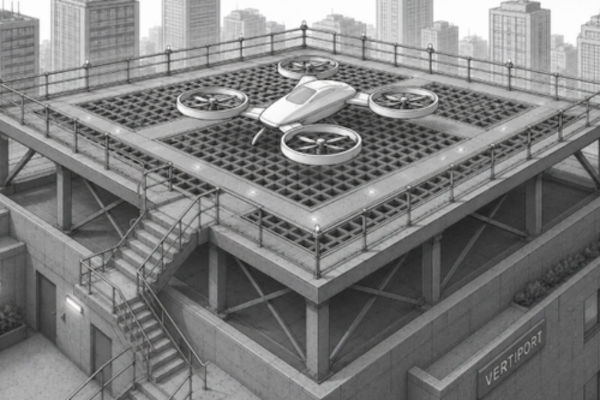
Perforated landing pads could significantly reduce the noise of delivery drones and electric aircraft during take-off and landing, new research by the University of Bristol has found. As electric air taxis move from the realm of science fiction to reality, the study, published in Applied Acoustics this week, could influence the design of landing pads to help these futuristic vertical aircraft limit noise, addressing one of the biggest challenges facing the future of Urban Air Mobility.
The research team suggest that vertiports – like helipads but for eVTOL vehicles - could be designed to incorporate a perforated landing surface such as an elevated grid structure. This would provide a practical solution for reducing urban aircraft noise in cities. The study demonstrates, for the first time, how perforated surfaces can reduce the loud noise caused by ‘ground effect’, a phenomenon that happens when aircrafts that can take-off and land vertically operate close to the ground.
Unlike solid surfaces, perforated sheets allow portions of the airflow to pass through the openings, reducing the formation of high-pressure areas beneath the aircraft. At the same time, the perforations reduce acoustic reflections from the ground surface, which reduced the noise created.
The findings have shown that replacing solid landing surfaces with perforated sheets can reduce the noise caused by blades as much as 15 decibels and lower overall sound pressure levels by up to 7 decibels.
Lead author Dr Esmaeel Masoudi, Lecturer in Aeroacoustics in the School of Civil, Aerospace and Design Engineering, commented: “The perforated surfaces effectively disrupt the mechanisms responsible for ground-effect noise amplification. Instead of the airflow strongly impinging on a solid surface, part of the flow is passed and dissipated within the perforations. Reducing noise is essential if drones and air taxis are to become a practical part of future urban transportation systems. This work demonstrates that perforated landing surfaces have the potential to significantly reduce and, in some cases, nearly eliminate the noise penalties associated with ground effect, helping pave the way for quieter and more sustainable urban skies.”
The study highlights the importance of considering both aircraft design and infrastructure development together when addressing urban noise challenges. The researchers believe the findings could contribute to the design of next generation vertiports, rooftop landing pads, and drone delivery hubs in densely populated areas.
The study was led by Dr Esmaeel Masoudi from the University of Bristol’s aeroacoustics research group under the leadership of Professor Mahdi Azarpeyvand. The research team also included senior researchers Dr Sung Tyaek Go and Dr Abhishek Gautam.
Caption: An AI-created image showing how a perforated landing pad could look (not to scale, for illustrative purposes only)
Credit: Esmaeel Masoudi/University of Bristol
Gulfstream Aerospace has enhanced the capabilities of its Customer Support Performance Analytics program, further strengthening its ability to transform aircraft data into actionable insight...
Velocity Maintenance Solutions, an FAA-certified provider of maintenance, repair and overhaul services, has announced a significant expansion of its facilities at Wilmington Airport (ILG) in Delaware,...
Daher Aircraft will present its TBM and Kodiak aircraft families at next week’s NBAA Business Aviation Convention & Exhibition (NBAA-BACE), showcasing how their combination of performance, e...
A Discover Airlines Airbus A330 has become the first Airbus aircraft worldwide to enter regular commercial service after undergoing a full-scale AeroSHARK retrofit, marking a signi...

