




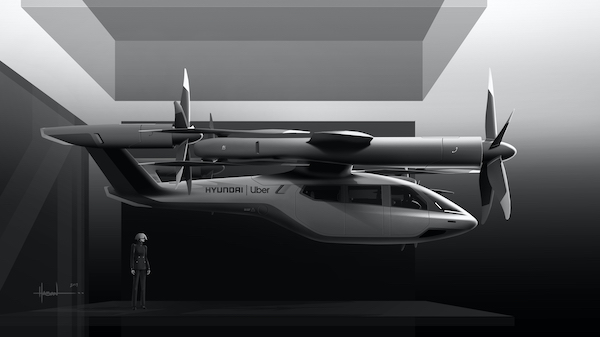
Hyundai Motor Company and Uber announced a new partnership to develop Uber Air Taxis for a future aerial ride share network and unveiled a new full-scale aircraft concept. Hyundai is the first automotive company to join the Uber Elevate initiative, bringing automotive-scale manufacturing capability and a track record of mass-producing electric vehicles. The air vehicle concept Hyundai released today was created in part through Uber's open design process, a NASA-inspired approach that jump-starts innovation by publicly releasing vehicle design concepts so any company can use them to innovate their air taxi models and engineering technologies.
In this partnership, Hyundai will produce and deploy the air vehicles, and Uber will provide airspace support services, connections to ground transportation, and customer interfaces through an aerial ride share network. Both parties are collaborating on infrastructure concepts to support take-off and landing for this new class of vehicles.
"Our vision of Urban Air Mobility will transform the concept of urban transportation," said Jaiwon Shin, Executive Vice President and Head of Hyundai's Urban Air Mobility (UAM) Division. "We expect UAM to vitalize urban communities and provide more quality time to people. We are confident that Uber Elevate is the right partner to make this innovative product readily available to as many customers as possible."
"Hyundai is our first vehicle partner with experience of manufacturing passenger cars on a global scale. We believe Hyundai has the potential to build Uber Air vehicles at rates unseen in the current aerospace industry, producing high quality, reliable aircraft at high volumes to drive down passenger costs per trip. Combining Hyundai's manufacturing muscle with Uber's technology platform represents a giant leap forward for launching a vibrant air taxi network in the coming years," said Eric Allison, head of Uber Elevate.
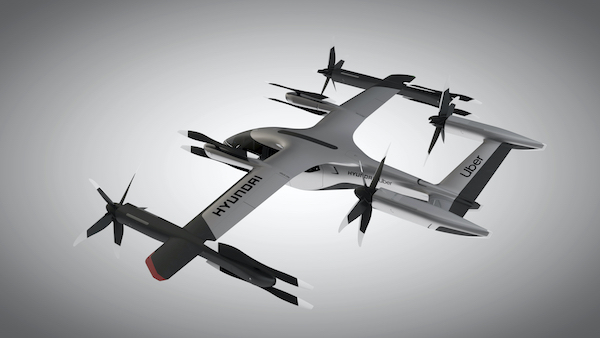
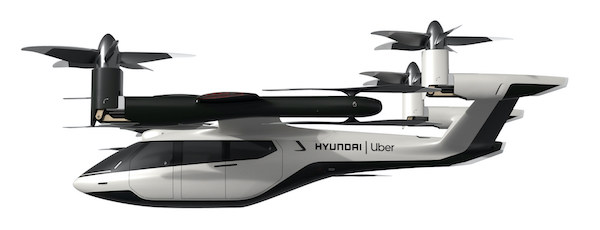
In preparation for this announcement, Hyundai has worked with Uber Elevate to develop a PAV (Personal Air Vehicle) model, S-A1 that utilizes innovative design processes to optimize electric vertical take-off and landing (eVTOL) aircraft for aerial ridesharing purposes. The Elevate initiative based this process on NASA's historical approach of putting design concepts out publicly to inspire innovation amongst multiple companies, spurring the development of common research models to investigate novel aerodynamic concepts and catalyzing industry progress in wing design, noise, aerodynamics, and simulation verification.
As a result, Hyundai's S-A1 model unveiled at CES reflects previous eVTOL designs Uber Elevate has released in the following ways:
Ushering in the era of seamless mobility, Hyundai's exploration of future urban transportation incorporates the electric PAV concept with a new ground transportation, the Purpose Built Vehicle (PBV) concept. Hyundai's vision for creating communities from future transit systems comes into focus with yet another new infrastructure concept, called the Hub. When many PBVs and PAVs are docked and connected to a Hub, they make a new public space where diverse groups of people can come together.

Aviation Capital Group, the Newport Beach, California-based global aircraft asset manager, has signed a firm order for 75 additional Airbus A320neo Family aircraft, bringing its cumulative orders for...
Qantas Freight and Australia Post have entered the next chapter of their long-standing partnership with the arrival of the first of three additional Airbus A321 Passenger-to-Freighter (A321P2F) aircra...
A Discover Airlines Airbus A330 has become the first Airbus aircraft worldwide to enter regular commercial service after undergoing a full-scale AeroSHARK retrofit, marking a signi...
Samson Sky has enlisted renowned Italian automotive designer Luigi Memola to develop the interior design of its Switchblade Flying Car, bringing world-class automotive styling expertise to the roadabl...

